
Events & Personalities
Towering award
The Bomonjee Hormarjee Wadia Clock Tower and Fountain built in 1882 on Perin Nariman Street finds an honorable mention in the United Nations Educational, Scientific and Cultural Organization’s (UNESCO) list of Asia-Pacific Awards for Cultural Heritage Conservation for 2017, announced the agency’s website on November 1, 2017. Constructed in commemoration of a merchant prince and sheriff of the city, the Clock Tower that houses a fountain had long quenched the thirst of both humans and animals, but had fallen into disrepair. The structure was restored by the Kala Ghoda Association (KGA) and unveiled to the public in January this year (see "Three treasures restored,” Parsiana, January 21, 2017). The jury’s citation on the UNESCO website states that the restoration "demonstrates the success of a pioneering public private partnership to valorise (give) public amenities” in Bombay. It adds: "associated with the local Zoroastrian community, this unique architectural landmark... (used) a non-invasive approach (for conservation)... The project undertook structural strengthening, repair of decorative features and returned the vandalized clock to working order.”
KGA chairman Maneck Davar informed Parsiana on November 21 that the Association will continue to maintain the Clock Tower for the next five years. He let on that the restoration of the Kothari Pyau (Fountain) on Mahatma Gandhi Road is KGA’s next project and that the Mulji Jetha Fountain at Ballard Estate, recently restored by them, would be an entry for the 2018 UNESCO awards. Also on the cards is restoration of the 147-year-old David Sassoon Library and the Magen David Synagogue in downtown Bombay.
KGA chairman Maneck Davar informed Parsiana on November 21 that the Association will continue to maintain the Clock Tower for the next five years. He let on that the restoration of the Kothari Pyau (Fountain) on Mahatma Gandhi Road is KGA’s next project and that the Mulji Jetha Fountain at Ballard Estate, recently restored by them, would be an entry for the 2018 UNESCO awards. Also on the cards is restoration of the 147-year-old David Sassoon Library and the Magen David Synagogue in downtown Bombay.
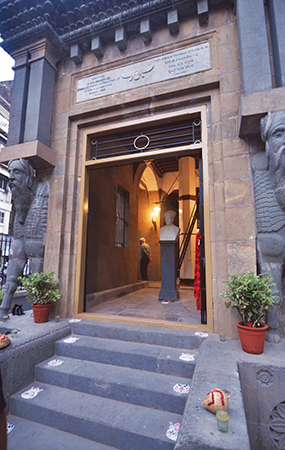
The Bomonjee Hormarjee Wadia Clock Tower and
Fountain: UNESCO recognition
Architect Vikas Dilawari, who was responsible for the conservation of the Tower told The Indian Express of November 11 that "we reused all the old wooden beams which could be salvaged and restored... We only had to replace the earlier stone slab and cast a new concrete slab.”
Another Bombay structure, the Wellington Fountain near Regal Cinema also found a place in the list of honorable mentions in the awards list. The Royal Opera House (ROH) and the Christ Church in Byculla received Awards of Merit. The design for ROH was conceived in 1908 by Jehangir Framji Karaka, head of a firm of coal brokers, and Maurice Bandmann, an American entertainer. The refurbished iconic theater was opened to the public late last year (see "A royal return,” Parsiana, November 21, 2016).
Of the four Bombay structures, three have been restored by Dilawari, with the ROH having been restored by conservation architect Abha Narain Lambah. Of the 15 Asia Pacific-wide awardees for 2017, seven are from India, the other national awardees being Sri Ranganathaswamy Temple, Tamil Nadu, the gateways of Gohad Fort, Madhya Pradesh and Haveli Dharampura in Delhi. Countries represented on the awards list include China, Singapore, New Zealand, Iran and Australia.
The jury selected projects from 43 submissions, including 31 in the conservation category and 12 for new design. The awards recognize the efforts of private individuals and organizations that have successfully restored and conserved structures in the last 10 years. Starting this year, "the eligibility criteria for minimum age of heritage properties have been eliminated to reflect growing... importance of recognizing contemporary cultural heritage,” states the UNESCO website.
◆ ◆ ◆
From the archive