
Books
Getting away with murder
In Hot Blood. The Nanavati Case That Shook India by Bachi Karkaria. Published in 2017 by Juggernaut Books, KS House, 118 Shahpur Jat, New Delhi 110049. Pp: 302. Price: Rs 699.
Society often suspends its moral compass when an assailant is either handsome or avenging dishonor to his family or from the armed forces or charismatic. Commander Kawas Nanavati was all of these, and a Parsi, in "an era which was less questioning of entitlement,” as Bachi Karkaria so pithily puts it in her book, In Hot Blood. Throw in a pretty English wife, political connections at the highest level, a Sindhi playboy as the villainous victim and it is God himself providing a script for a film and a book. How the establishment exploited popular will to let off Nanavati (who shot dead his wife’s lover, Prem Ahuja) in a shockingly brazen manner, is narrated by Karkaria in this real life thriller.
Painstakingly well researched, interspersed with nuggets of a swinging sixties Bombay, Karkaria has unravelled many hitherto unknown facets of this crime passionnel, like Ahuja’s skull being passed from juror to juror; Jawaharlal Nehru admitting at a press conference that the Naval chief had indeed approached him to intervene after the accused had been meted a life term and indeed the government had intervened; Ahuja had a loyal Parsi secretary, Sheroo Wadia, who blamed the straying wife for seducing her boss; and that the Hollywood star, Vivien Leigh, visited the celebrity prisoner during his extended parole, which was at a spacious Lonavla bungalow!
Painstakingly well researched, interspersed with nuggets of a swinging sixties Bombay, Karkaria has unravelled many hitherto unknown facets of this crime passionnel, like Ahuja’s skull being passed from juror to juror; Jawaharlal Nehru admitting at a press conference that the Naval chief had indeed approached him to intervene after the accused had been meted a life term and indeed the government had intervened; Ahuja had a loyal Parsi secretary, Sheroo Wadia, who blamed the straying wife for seducing her boss; and that the Hollywood star, Vivien Leigh, visited the celebrity prisoner during his extended parole, which was at a spacious Lonavla bungalow!
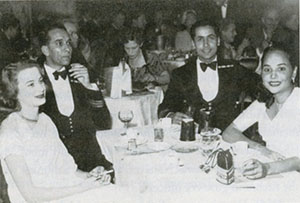
From left: Sylvia Nanavati, Lt Cdr John Pereira,
Lt Cdr Kawas Nanavati, Joyce Pereira (1952)
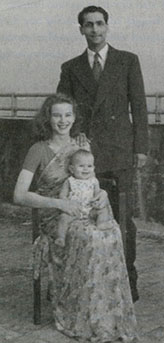
Kawas, Sylvia and daughter Tannaz (c. 1955)
The challenge before the author was how to grip the reader’s attention about something which happened 58 years ago, and when the facts are so widely known and much discussed in the media after the recently released Bollywood film, Rustom, about this episode. Karkaria has met this challenge admirably. This reviewer, despite being a lawyer, discovered new facts and aspects in virtually every page of the book.
Karkaria, a non-lawyer, has managed to present the legal battle in the Sessions, High and the Supreme Courts, with such erudition and lucidity, that it is almost unbelievable. She must be having some legal genes in her DNA. How the overtly theatrical Karl Khandalavala (Nanavati’s defence counsel in the trial court, who was subsequently fired) managed to greatly irritate the Sessions Judge, who may not have otherwise referred the matter to the High Court, which convicted Nanavati and sentenced him to life imprisonment. It has always been a part of legal folklore that the Nanavati case was botched up by his defence team by overpitching, though Karkaria does not directly allude to this.
The murder pitted the Parsi and Sindhi communities against each other. Ironically, as Karkaria graphically describes, Nanavati’s astonishingly early pardon from jail (after a little over two years) became possible, only due to a Sindhi prisoner being simultaneously pardoned to allay the Sindhi community. Although a Parsi, Karkaria displays not the slightest bias. On the contrary, she reiterates, time and again, that being a Parsi, in the early ’60s, immensely helped Nanavati’s cause. It certainly did. However, it is difficult to believe that all these incredible and unprecedented events which transpired to free him in just over two years were due to his being a Parsi. Nanavati’s family was essentially upper middle class, with no serious money or political connections. Yet upright politicians like Nehru and Krishna Menon personally intervened; an extraordinary order suspending Nanavati’s life sentence was passed by the Maharashtra Governor; the Government steadfastly refused to tell even the Bombay High Court the reason why such an order was passed; the top brass of the Indian Navy did everything under the sun to save him; Nanavati’s entire family was relocated in Canada after his release — all this indicates that possibly adultery was only a façade to silence an inconvenient Ahuja, who perhaps was a fixer and go-getter in the armed forces. Tongues have always wagged that there was something more than what met the eye. Was Ahuja about to spill the beans about some powerful people including Nanavati? How did the Nanavatis enjoy such domestic bliss in Canada and why did Nanavati’s family stand like a rock behind his self-confessed wife. Karkaria’s book does not dabble in any conspiracy theory but provides such succinct details which makes the reader wonder about these issues.
Tracing the psychological impact of the trial on Nanavati’s children; discovering the ‘very nice man’ that otherwise Ahuja was; interviews with Ram Jethmalani and few other surviving players in the episode; the life of the Nanavatis in Canada, the book does a splendid job in transporting us to an earlier era.
This tome may not have literary pretensions and is written in a staccato speedy style by the veteran journalist that Karkaria is. The reader has to tell himself again and again that what he is reading is not fiction. Easy to read and peppered with digs at the characters involved, Karkaria’s Parsi sense of humor is evident throughout. It is helpful that she has eschewed her propensity to pun excessively.
While Karkaria’s racy narrative, upto the pardon, is taut and tight, a couple of the subsequent chapters on Bombay in the ’60s, the then Parsis, Nanavati’s naval career, do appear to drag a bit. Nevertheless, the author demonstrates her mastery over this genre of books. She may well consider writing another on the psychopath, Firoze Daruwalla’s multiple murders case, which shook Bombay. In stark contrast to the phenomenally blessed Nanavati, Daruwalla was unceremoniously hanged, as his elitist community squeamishly slunk away to look elsewhere.
All said and done, a delightful read which well could have been titled, "In Cold Blood.”
◆ ◆ ◆
From the archive