
Books
Villain or victim?
"Mamie Ahuja was the real heroine” in the Commander Kawas Nanavati saga, said nonagenarian lawyer Ram Jethmalani at a panel discussion with In hot blood author Bachi Karkaria and journalist and writer Naresh Fernandes on May 21, 2017 at the landmark Royal Opera House. "Bachi has been unfair to her,” and the book contained "a tirade against the Sindhi community,” alleged Jethmalani. In 1959 Nanavati had shot Mamie’s brother Prem as he was having an affair with his English wife, Sylvia. Citing his evidence, the noted criminal lawyer quoted the page number which notes the Ahujas belong to the "moneylenders Shikapuris” community, and adds "for many decades, almost every estate agent in Bombay was a Sindhi.” Licensees in flats "lived in terror of a Sindhi landlady, tough as nails beneath her dyed hair, white organdy sari, diamond ear studs and satsangs.” While the Parsis "stormed the barricades, the Sindhis were less visible and certainly less vocal...the well-off were too busy with their businesses and addictive bridge, rummy and mahjong at the CCI (Cricket Club of India) or Radio Club…
"If the chief ‘villain’ of the Nanavati case was a Sindhi, so was the lawyer Ram Jethmalani hired by Mamie.” How did he become a villain? Jethmalani inquired.
"If the chief ‘villain’ of the Nanavati case was a Sindhi, so was the lawyer Ram Jethmalani hired by Mamie.” How did he become a villain? Jethmalani inquired.
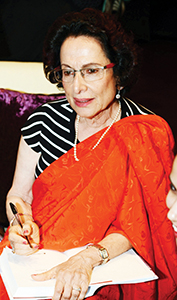
Bachi Karkaria
Karkaria emphatically denied the accusations, believing the passage cited by Jethmalani had been wrongly interpreted by him. "I’ve antagonized the Parsi community and now it’s the Sindhis,” she moaned. "I thought I had redeemed the Sindhis.”
Jethmalani termed the crime "an open and shut case...an unprovoked murder” and dismissed as fabrication the allegation by Nanavati’s lawyers during the sensational trial that when the naval officer asked Prem whether he had any intention of marrying Sylvie, Prem replied, "Do I have to marry every woman I sleep with?” Jethmalani alleged there was no conversation, only the firing of three bullets. He said Prem was a handsome man and women pursued him.
Jethmalani pointed out that almost none of the lawyers or judges involved in the case from the Sessions Court to the Supreme Court were Sindhis. In the Sessions Court, a divided jury of eight to one favoring Nanavati permitted the judge to set aside the verdict and refer the matter to the High Court. After being convicted and sentenced to prison, Nanavati was pardoned by the governor of Maharashtra (who was not a Sindhi, noted Jethmalani) and four years later migrated to Canada.
Even the two state secretaries involved with the pardon, Burjor Paymaster and Bobby Dalal were Parsis. The secretaries fretted over the repercussions from the Sindhi community but due to Mamie forgiving Nanavati and another Sindhi businessman and philanthropist, Bhai Pratap, being pardoned at the same time, "there was not one outcry from the Sindhi community,” Jethmalani noted. They were all "so gracious....Mamie deserves praise from the Parsi community,” he emphasized. Though he was not directly involved in the case, he held a watching brief for the victim’s sister and was pivotal in reconciling the parties. As Nanavati and Sylvia had made up, Prem was a playboy and all said and done, "Nanavati was Nanavati.” The Sindhis forgave the Commander, he commented.
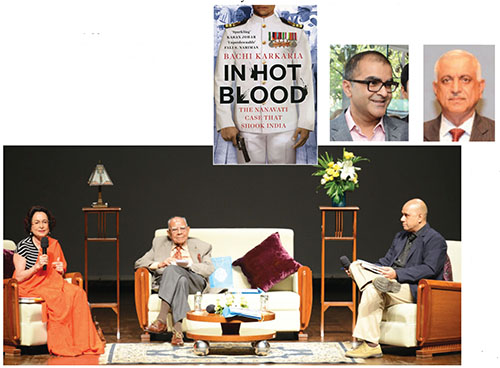
Bachi Karkaria (left) with Ram Jethmalani and Naresh Fernandes.
Top (from left): book cover; Asad Lalljee, curator, Royal Opera House
and Vice Admiral Girish Luthra
Fernandes who moderated the panel mentioned that several of the people he knew in his Bandra neighborhood were connected with the case. Lt Cdr Dennis Cooper in charge of the gunnery department of INS Mysore who issued the .38 Smith and Wesson revolver to Nanavati told Fernandes that Nanavati was worried about his "personal safety on a road trip he was going to take.” Cooper remembered Sylvia "as a warm person.”
Fernandes also observed that during that time all the articles on the murder prefixed the word "dashing” before Nanavati and "playboy” before Prem. He then threw the discussion open to the audience, inquiring tongue-in-cheek, "Let’s see who else we can p___ off now?”
Karkaria noted the idea for the look originated from the publishers, Juggernaut, who commissioned her to write a short book on the subject, "a quickie,” as she termed it. But on the advice of others and after delving into the material, Karkaria felt there were several issues to contend with. It was the "first upper class crime of passion,” involving, in the eyes of the public, "an upright Parsi and an unscrupulous Sindhi.” The sensational case involved constitutional issues and resulted in the jury system in India being abolished (except for the Parsi Matrimonial Court — editors).
Nanavati had "a sense of self entitlement,” said the author, being both a Parsi and part of the naval establishment, rubbing shoulders with the likes of Lord Mountbatten, defence minister V. K. Krishna Menon and others. "He felt he could do no wrong.” Her attempts to contact Sylvia or the other family members met with no luck. "Canada was a closed book,” she lamented.
Someone asked if there were any humorous instances in the trial that Jethmalani could narrate. "Karl Khandalavala was a very serious person,” he replied. Khandalavala defended Nanavati as did solicitor Shiavax Vakil of Mulla and Mulla, both outstanding lawyers. Vakil subsequently became legal advisor to the House of Tatas and was a trustee of the Bombay Parsi Punchayet for a short stint when his disclosures on the state of the Bombay dakhmas raised the hackles of the traditionalists led by B. K. Boman Behram.
The case divided the bar, Karkaria noted. "The jury system in the UK failed to take root here,” she remarked. When asked by a member of the audience (comprising many Parsis) why the jury system persists in the USA, Jethmalani replied, "America has more faith in their people than we do.”
◆ ◆ ◆
From the archive