
Books
“Always been a foreigner”
Novelist, playwright and poet, Laila Wadia has lived in Italy for 30 years and writes in Italian
Readers are so involved with contemporary Parsi writers who write in English that they sometimes overlook members of the community who have achieved fame and recognition in countries other than India, Canada, USA and the UK.
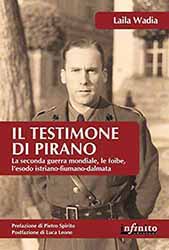
Laila Wadia, 50, a novelist, playwright and poet, who has lived in Italy for the last 30 years, was recently in Bombay for a presentation of her latest book Il Testimone di Pirano: La seconda guerra mondiale, le foibe, l’esodo istriano-fiumano-dalmata (The Witness from Pirano: the Second World War, the ‘foibes’, the Istrian-Fiuman-Dalmatian Exodus) at an event organized by the Italian Consulate and the Italian Women’s Caffé on September 26, 2016. She has published several novels and books: Il Burattinaio e Altre Storie Extra Italiane (The Puppeteer and Other Extra-Italian Stories ["this is a pun on words in Italian because foreigners are referred to as extra-communitari”]), Pecore Nere (Black Sheep), Amiche per la Pelle ("My English translation for this was very unfaithful. I called it Italian Lessons;” the film, Babylon Sisters based on the novel, is to be released in October 2016), Come Diventare Italiani in 24 ore (How to become Italian in 24 hours), Kitchensutra (a collection of poems in English and Italian), Se Tutte Le Donne (If Only All Women), and Mondo Pentola (World Pot).
Laila Wadia, 50, a novelist, playwright and poet, who has lived in Italy for the last 30 years, was recently in Bombay for a presentation of her latest book Il Testimone di Pirano: La seconda guerra mondiale, le foibe, l’esodo istriano-fiumano-dalmata (The Witness from Pirano: the Second World War, the ‘foibes’, the Istrian-Fiuman-Dalmatian Exodus) at an event organized by the Italian Consulate and the Italian Women’s Caffé on September 26, 2016. She has published several novels and books: Il Burattinaio e Altre Storie Extra Italiane (The Puppeteer and Other Extra-Italian Stories ["this is a pun on words in Italian because foreigners are referred to as extra-communitari”]), Pecore Nere (Black Sheep), Amiche per la Pelle ("My English translation for this was very unfaithful. I called it Italian Lessons;” the film, Babylon Sisters based on the novel, is to be released in October 2016), Come Diventare Italiani in 24 ore (How to become Italian in 24 hours), Kitchensutra (a collection of poems in English and Italian), Se Tutte Le Donne (If Only All Women), and Mondo Pentola (World Pot).
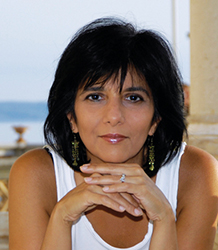
Laila Wadia: struck a chord Photos: Tullio Valente
The evening began with a presentation by Amedeo Lovisoni, business analyst at "Relations at Work,” on the beautiful landscape of Trieste, a port in northeast Italy. After a brief introduction by Anna Senese, founder, Italian Women’s Caffé, Bombay, and a welcome by Ugo Ciarlatani, the Italian Consul General, Luca Bernadini, historian, Italian studies, made a lucid presentation and placed Wadia’s novel in a historical context. Wadia spoke warmly and affectionately about her father-in-law, Mario Valente and illustrated her talk with authentic and charming family photographs. Cristiana Peruzzo, corporate social responsibility director, Innovaid Advisory Services, gave an effective and moving personal reflection on the novel. During the war, one of her uncles was captured in Libya and was a prisoner of war in Australia. His girlfriend waited for him throughout the war with no communication, neither a single letter nor a telephone call, and finally married him in 1949 when the war ended. Dramatic and sensitive readings from the novel by Lovisoni followed with a brief question answer session.
 Wadia, the daughter of Pesi Wadia and Arnaz Karanjia, studied at Cathedral and John Connon School and completed her HSC from Sophia College before she won a scholarship from the Italian Embassy to study in Italy. She has been there ever since. "When you leave your country,” she says, "you find there is something missing within you. I’ve always been a foreigner wherever I have gone. Even if you are living in India, you may be 100% Indian but still be considered more of a Parsi than an Indian: you belong, and still don’t belong. There is the longing for another place inside you. For me, I could trace this back to Persia. In one of my stories, I say that I think my heart is a garden of Persian roses, a place I belong to and to which I can never go back.”
 Hence, it is no wonder that one of the main themes in her work is displacement, migration and a search for identity. Wadia is allergic to the word "identity” if the word is used in its limited sense and is reduced to mere nationalism. She agrees with American poet and writer Walt Whitman when he said, "I contain multitudes.” It is possible this mingling of cultures came to her early in life; her step-father was an Italian prisoner of war by virtue of his being born in a British prison camp in Dehradun during the Second World War. His family decided to stay back in India.
In 2004, encouraged by her husband Tullio Valente, an astronomer and travel photographer, Wadia sent her story "Curry di Pollo” for a competition for foreigners writing in Italian. The story, which won the award, centers around an Indian girl growing up in Milan who lives in two worlds: the domestic Indian one, with old fashioned parents who drink masala tea, eat vegetables drowned in oil and mustard seeds wrapped in chapattis and who insist she should oil her hair; and the external Italian world, with boyfriends, highlights and mini-skirts. "It struck a chord with all second generation kids who needed to be represented.” It was a runaway success; but more importantly Wadia realized that this theme of migration was close to her heart and this gave her a focus for her future novels. "The masters have said it all, whether it is Shakespeare or Dante, and the only thing I could do was to give my work a contemporary twist. I wanted to talk about and to represent what is really going on in Italian society and what people are unaware of as the media is skewed and only wants to represent stereotypes.”
The present novel, Il Testimone di Pirano, is the story of Mario, who narrated it over long Sunday lunches and was recorded by her over a period of six months. She was 20 when her father-in-law was 86; however, a common thread bound them: a love for food (he had undergone starvation during the War), a hatred of former British Prime Minister Sir Winston Churchill and, especially, a longing for a place that no longer exists except in the memory.
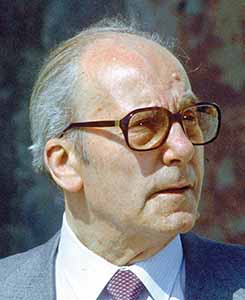
Mario Valente: broke the silence
Mario was a simple and impoverished man, a war orphan who lived in a beautiful town with Venetian houses. "Although poor, he could put out a fishing line and catch fish whenever he wanted. If you are happy, you don’t bother about being poor.” He joined the army and was part of the fire brigade when the war broke out. Istria, annexed to Italy as a result of the First World War, was ethnically mixed with a population which comprised Italians, Croatians and Slovenians. At the end of the Second World War, Istria, with the exception of the province of Trieste, became a part of Yugoslavia. In 1943, came the exodus when large numbers of ethnic Italians left the Yugoslavian territory of Istria. These were terrible times and atrocities were committed by both the Italians as well as the Yugoslavians. Mario faced the tragedy of the ethnic cleansing in 1943. As a result of the ferocious secret service OZNA, Italians started disappearing, especially clerics. "His brother-in-law who was a priest disappeared.” Finally, when Mussolini abdicated, hundreds of corpses from both the sides were found in the ‘foibes,’ a natural feature of the landscape of the region, resembling a well or a mine shaft. Being a fireman, he had to recover bodies from the ‘foibes’ using gas masks.
Wadia deals with a page in Italian history which has been forgotten. Italy itself is ashamed of this and has conveniently swept it under the carpet. It was only in 2010, over 60 years after the end of the Second World War that the president apologized to the people who had suffered displacement and injustice during the ethnic cleansing and the Istrian exodus.
What struck a chord in Wadia was the parallel between the exodus of the Istrian people and the flight of the Zoroastrians leaving Persia, both more or less an imposition, not as a result of free will. (Zoroastrians probably came to India for trade as well as freedom of worship — editors)
"I wanted to write this book because we can’t give back to someone who has died or suffered loss but we can break the silence and give back some respect. It is only by talking about the past and coming to peace with it, that one can look to the future.”
Though she is bi-lingual, she has not really translated her own work. In Kitchensutra, she has written poems both in English which have been "translated” into Italian and vice versa. "Poetry can’t be translated: you lose the essence of something. It is a rewriting, especially because it is about food and spirituality which translate differently into different cultures. For example, how does one convey the essence of dhansak or pav bhaji in Italian?” Several of her Italian friends have asked her to publish these recipes but she believes that recipes cannot convey the emotion and the nostalgia associated with the dish.
Wadia’s family ties remain in Bombay and she tries to visit at least twice a year. It is amazing to realize how "Indian” and "Parsi” she is in spite of spending more than two-thirds of her life in Italy. "I love the essence of the religion. Perhaps not the paraphernalia. It is the most beautiful, simple, pure philosophy that you can get, a distillation of the spirit, it resonates within me.”
◆ ◆ ◆
From the archive