
In Memoriam
“Timekeeper of the nation”
Hundreds of employees of Titan Company walked for over an hour alongside the flower bedecked truck that carried the mortal remains of Xerxes Sapur Desai as the cortège wound its way to the crematorium in Hosur (near Bangalore) on June 30, 2016. For the staff members of Titan, 79-year-old Desai was not only the venerated founder of their organization but one who was fondly addressed as "father.” Banners and posters along the route testified their admiration for the man who whilst building the company had also contributed to their individual growth.
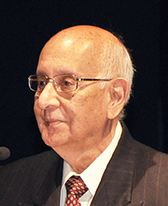 "He was a titan amongst titans,” summed up the chairman of Tata Sons Limited Cyrus Mistry, adding, "He was a true visionary and in Titan he has created and established one of the finest and most successful companies of our age… He was an extraordinary leader with the capacity to inspire people to deliver well beyond their reach. We greatly respect Xerxes’ life-long commitment to the Tata Group. He served our Group tirelessly for over five long decades in many capacities and roles.”
When Desai joined the Tatas, he was posted in Jamshedpur. He then had a longer innings with Tata Chemicals in Mithapur after which he worked for a while with Tata director and J. R. D. Tata’s brother-in-law Col Leslie Sawhney. For the Taj Group of Hotels Desai planned the extension to the Taj Palace Hotel, the Taj Inter-Continental in Bombay, the Mansingh Road Taj Mahal Hotel in Delhi and the Fort Aguada Hotel in Goa and oversaw the Indian Hotels’ public issue and listing on the stock exchange. He then had a stint as managing director of Tata Press where he was not only able to turn around the loss making venture but also build a second unit of the press at New Bombay. His most enduring contribution though was to Titan, a wrist watch making company he conceived and nurtured as its first managing director from the time the factory was developed on an arid piece of land in Hosur in Tamil Nadu in 1986.
"He was not only our founder, but also our greatest advocate. Over the years, his guidance and dogged pursuit of perfection helped make Titan a household name and a market leader,” noted a press release from Titan. "He was big thinking, iconoclastic, meticulous, insightful, humanitarian with an enhanced sense of style and taste; articulate and quality conscious,” the current managing director of Titan Bhaskar Bhat was quoted in Mint, June 28.
As Desai had earlier conveyed in an interview with tata.com, Titan’s success can be attributed to "a bit of everything that went into making it such a powerful brand — the choice of technology, focus on styling, and the good fortune to be able to put together good marketing and manufacturing teams. We were also fortunate to begin life in a sheltered environment where there was little or no competition within India… An essential prerequisite to make a brand global is a combination of guts, vision and belief in oneself. I think it also takes a certain amount of vanity to venture forth in the manner in which we did.”
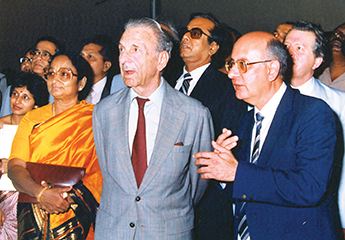
Xerxes Desai with J. R. D. Tata
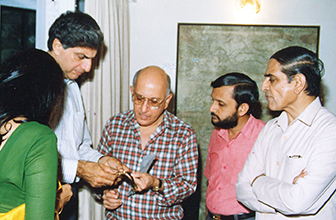
Xerxes Desai with Ratan Tata
Those who were on his team remembered well the frustrations and bureaucracy he encountered in the days of license raj when he had to endure major resistance from government officials who would not give approvals and faced a dearth of collaborators. The only Indian watches then available were from state owned HMT.
"He was in fact a pathsetter for this industry in India and led it to earn a place of pride,” noted a condolence letter from Mihir and Hemal Kharod on behalf of Tradepost, the international watch and clock magazine.
Regarded as a mentor par excellence, he inspired tremendous loyalty among his employees some of whom were even motivated to compose lyrics for "father Desai.” As seen from the scores of condolence tributes, Desai has been given credit for espousing "an organizational culture that was friendly, frank, open and non-hierarchical.” He often brought his two dachshunds, Max and Minus to work. A passionate rationalist he believed that "Yesterday’s truths are today’s heresies.”
The founder of Titan who was a management council member of the National Centre for the Performing Arts and loved western classical and jazz music "will always be synonymous with the signature (Mozart) tune in all Titan TV advertisements…and the turquoise blue ink which he used to write his comments/remarks. He has left an indelible impression on all of us,” wrote one of his juniors R. Sunder. On behalf of Ogilvy and Mather, the advertising agency that handled the Titan account, Piyush Pandey commented that Desai was "a living example of dignity, precision and honesty. We all learnt a lot from him right through our careers.” "In Greek mythology, Xerxes means hero which he was for all,” commented another Titan employee.
"He was a perfectionist, a disciplined man and always on time,” admired N. R. Narayana Murthy, recalling the time when his company Infosys distributed custom-designed watches to 25,000 employees in celebration of its Billion Dollar Day.
Once Titan expanded to start its Tanishq jewelry branch Desai "meticulously focused on the minutest details...His contribution towards setting high quality standards in design is matchless… His lessons will go a long way towards making a design-enabled India,” wrote Pradyumna Vyas, director, National Institute of Design.
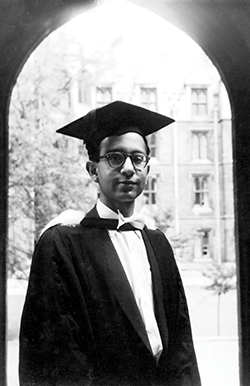
Desai on his graduation
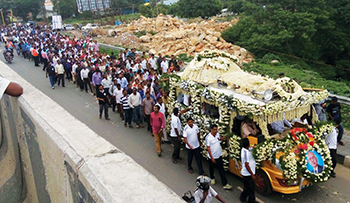
Cortège in Hosur
Desai earned his BA in history from Bombay’s Elphinstone College and subsequently studied philosophy, politics and economics at the Oxford University from where he earned his MA degree. "I joined the Tata Group more by accident than design, as a sabbatical from the academic career which was my first preference, yielding to pressures placed on me by well-intentioned family friends in Bombay House while I was still at Oxford on a J. N. Tata scholarship,” Desai was quoted by tata.com. The fact that he continued with Tatas, he noted, "is entirely attributable to the values that we have long cherished in this extraordinary entity we call the Tata Group and the bonds created.”
Senior to Desai by a year at Tata Administrative Service, Nawshir Khurody declared, "He understood ‘brand’ and gave life to this now much abused word. We both got reputations for speaking our minds at ‘high level’ meetings!... For me he was the timekeeper of the nation.”
He was specially deputed by the Tata Group to be part of the New Bombay Project in the early 1970s and had also served on the National Commission on Urbanization constituted by then Prime Minister Rajiv Gandhi in the early 1980s. As he had earlier commented, "I find that our cities are in the hands of a bunch of people characterized by a lethal combination of three things: corruption, incompetence and wrong values… What set New Bombay apart was the fact that the government had set up a special government owned company to undertake the development of New Bombay. We were doing the concept thinking, planning the design, construction, managing the kind of nodes we had set up…”
Desai regretted that Bangalore which was supposed to be a pensioner’s paradise had become a pensioner’s nightmare and the garden city had turned into a garbage city.
The visionary had bought land, not too far from the Titan factory, "and developed it so that his employees, young as they were, would start investing money in buying plots and building their own houses… Later they asked for a school so he started the school on behalf of the company and remained its chairman till he passed away,” revealed his sister Armaity Desai, former chairperson of the University Grants Commission and erstwhile director of the Tata Institute of Social Sciences where Xerxes too had served as board member. Among the other academic institutions where Xerxes had contributed as board member were the Indian Institute of Science and the National Institute of Advanced Studies in Bangalore. He also took a keen interest in the efforts of the Indian Institute for Human Settlements to establish a university to train graduates in urban planning and design.
In 2007 he had received the lifetime achievement award from the National Institute of Design and Business World. A decade prior in a survey conducted by Business World he had been rated as India’s fifth best CEO and was privileged to be inducted into the A&M Hall of Fame.
After his retirement he endowed the Titan School Library in the names of his parents Tehmina and Sapur. The family also endowed a scholarship in their name in the Bombay Parsi Punchayet where his father, being a long-serving secretary, had authored several publications including History of the Bombay Parsi Punchayet: 1860-1960, and mother set up a daycare center, the Fort Nursery and Infant School for poor Parsi children in the neighborhood, which ran for 40 years. Married to Rajani Pandit, his contemporary at Oxford, the couple’s son Shyarsh is based in New York and daughter Anahita Sander Meulmeester resides in Amsterdam. Since both the children wanted to pay their last respects after his passing away on June 27, his body was kept in a morgue for three days before it was brought to his residence and later taken to the Titan factory.
"While he was not a practicing Zoroastrian in a ritualistic sense, he had imbibed the values and practiced them in his life,” stated Armaity. "He believed the Zoroastrian religion should have pervaded the world as it was a very peaceful religion. He was a calm person, gentle, but could act tough when needed.”
◆ ◆ ◆
From the archive