
Essays from the archives
Maps for a Mortal Moon: Essays and Entertainments. Selected prose by Adil Jussawalla edited by Jerry Pinto. Published in 2014 by Aleph Book Company, 7/16, Ansari Road, Daryaganj, New Delhi 110002. Pp: 340. Price: Rs 495.
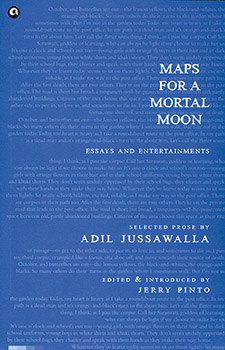 One has always associated the name of Adil Jussawalla with poetry. Not many are aware of his immense contribution to prose. We do not realise that in addition to his being a poet, he was the editor of magazines like Debonair, For You and copy editor at Science Age, the Book Review Editor for the Sunday edition of the Indian Express as well as The Times of India and contributed a fortnightly syndicated column for Yogi Aggarwal’s Associated News Features from 1991 to 2002. Several of his prose works have now been complied and edited by Jerry Pinto in a collection entitled Maps for a Mortal Moon. The subtitle to this collection is "Essays and Entertainments” which calls to mind English writer and playwright Graham Greene’s classification of his fiction into "novels and entertainments.” With Jussawalla, as with Greene, the "entertainments” often have very serious concerns albeit treated in a slightly lighthearted manner; however, both the essays as well as the entertainments are imbued with a keen and perceptive vision, a sense of humor, and a perfectly balanced and colorful prose style which is limpid, clear and concise.
Just as many of us are unaware of Jussawalla’s prose writings, we are also not aware of the great effort he made to set up Clearing House, a poets’ cooperative along with Gieve Patel, Arvind Krishna Mehrotra and Arun Kolatkar. As Pinto mentions in his introduction, "The publishing house was meant to act as a clearing house for the many manuscripts that were lying around unpublished.” It is this concern for the difficulty in publishing poetry which is repeated in several of the essays. If he discovered in the late 1960s how much writers had "to depend on themselves and on one another to get their work published,” the scene today is much worse as no publisher has surfaced to keep pace with either the new poets who have recently emerged or with those of the earlier generation who have continued to write. In "Six Authors in Search of a Reader,” he expresses his discontent with publishers who take the easy way out and prefer to "drug the reader with whatever he’s got used to.” The same concern is expressed in his "Preface to 3 Poets” (poetry does not sell) as well as "Small Beginnings” in which he narrates the efforts of Clearing House as well as P. Lal’s Writers Workshop to publish poetry and plays.
There are several personal essays: very moving tributes to his mother, Mehera Jussawalla and his father, Dr Jehangir Jussawalla. In "The Joy of Sensuous Writing,” Jussawalla writes evocatively about writing with a pencil. He brings back memories of when we were children and used "hard leads which almost incised the paper you wrote on, the softer leads which caressed it.” One remembers with great nostalgia the erasers one used and the pencils one sharpened. He recalls writing with a fountain pen and describes the distress one felt when a pen was lost or stolen or when it "nose-dived” off the edge of the school desk and the "smooth platypus beaks” transformed into those of vultures.
In "What’s this? A New Two-nation Theory?” he takes Bill Buford, American author and journalist, to task when, on the occasion of 50 years of Indian Independence in 1997, Buford suggests that the best Indian writing was from outside the sub-continent. As the year 1998 would be Sri Lanka’s turn to celebrate the same landmark Jussawalla suggests that this event be commemorated with an anthology of writing from South Asia comprising solely of work produced from within these countries whether in English or written in the mother tongue and translated into English.
One of the most moving essays is the description of a visit made by him, Raj Rao and Cyrus Mistry to Nissim Ezikiel, towards the end of his life when he was in a home for the aged. The poignancy and the pathos of this great poet reduced to making trite comments on account of his dementia, is interspersed with lines from his poetry. It is apparent that Ezikiel still believes he is in his PEN office at the Theosophy Hall as he makes frequent references to the Alliance Francaise and the programs they often hold. Jussawalla effectively prevents this essay from becoming melodramatic by describing minor humorous occurrences: while scratching the itch in his foot, Jussawalla’s elbow jogs Cyrus’ side and Cyrus’ left knee suddenly jumps up and narrowly misses the face of Raj Rao who has, at that moment, bent to tie his shoelaces.
It is not surprising that Pinto had great difficulty in choosing from the immense wealth of information available in Jussawalla’s archives. His initial selection was 300,000 words which he reduced with great difficulty to 280,000 and finally had to take Jussawalla’s help to bring it to its present size. While every credit should be given to Jussawalla for this feast he has offered us, one cannot underestimate the skill and the careful selection made by Pinto. Reading these essays one realises that poets can also be magnificent prose writers; I wonder if the reverse would hold true.