
Fascinating fantasy
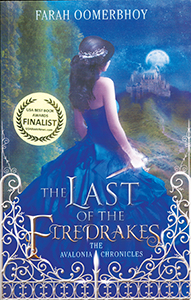
The Last of the Firedrakes: The Avalonia Chronicles by Farah Oomerbhoy. Published in 2015 by Wise Ink Creative Publishing, 837 Glenwood Avenue, Minneapolis, Minnesota 55405. Pp: 403. Price: Rs 349.
 It is evident from her debut novel The Last of the Firedrakes: The Avalonia Chronicles that Farah Oomerbhoy (pictured) is "a firm believer in the fantastic and magical and often dreams of living in Narnia, Neverland, or the Enchanted Forest.” Written for the young adult reader, the fantasy transports both the young and the mature, into an enchanting universe — a dangerous one filled with good and evil characters. This novel was a finalist at the USA Best Book Awards 2015.
To capture the attention of the young reader, Oomerbhoy (née Lawyer) with a master’s degree in English literature does not waste time. Sixteen-year-old Aurora is plagued by one recurring dream of an evil woman, Morgana, armed with a curved dagger rushing towards her mother who is carrying her in her arms. The dream always ends abruptly with a flash of lightning and Aurora screaming.
It later transpires that this is not just an imaginary dream; it is a sub-conscious recollection of an event which really took place in the past and which continues to haunt Aurora. Her father Azaren, who was the benevolent and kindly King of Illiador had a cruel step-sister, Morgana, who craved for the throne. To achieve this end, she killed Aurora’s parents and is now seeking to kill Aurora, so destroying the last of the bloodline and, thus, achieving her complete right to the throne of Illiador. She sends her messenger, Oblek, to abduct Aurora and, passing through a tapestry, he takes her from the real world into the fantasy world of Avalonia. Aurora escapes from the clutches of Oblek with the help of the kindly Kalen, the cynical and treacherous Finn, and the suave and handsome Rafe, the Black Wolf, with whom Aurora instantly falls in love.
 Here she creates a world of fantasy with great care and perseverance. There is a map on the first page showing the different kingdoms and the various important places where significant events take place. She creates a whole spectrum of magical creatures. Sinister looking witches, fearful shadow warriors, and, on the other hand, Pegasus, who carries Aurora to safety and the ferocious Manticore, with "fangs dripping with blood” but with kind eyes "full of anguish” who comes out of hiding to help her.
Since the kingdom of Avalonia is an imaginary one, Oomerbhoy has had to create a landscape against which the action takes place. She has the ability to create locales both luscious — with verdant pastures, rolling hills, flower filled meadows with sprays of "pinks, purples, yellows and reds” — and "shadowy alleyways, dark streets,” the unbearable odor of garbage, loud and boisterous inns with the stench of alcohol and unwashed bodies.
However, not all is fun and games. Oomerbhoy slips in gentle instruction for the reader in a very unobtrusive manner. Through various episodes in the novel, she seems to project that everything is "part of a divine plan” and difficulties should be seen as a means of discovering and building one’s potential. She also presents the idea that there are several differing perspectives of history, the need for discipline, and the powers of concentration, the ill-effects of anger and tells her young readers that a wise queen is both "just and humble.”
Aurora has a penchant for getting into trouble. This quality follows her from the real world into Avalonia and her relative naivety and foolhardy behavior do not help her in the least. Though she goes to school at Evolon, the best school for learning subjects like healing, warrior skills, illusions and history (from a teacher who has lived for 300 years and been a witness to all the major historical events) she has several lessons to learn. She does not realize that every action has a consequence; she is unable to control her own ego or her impulsiveness. At the end of the novel, she disregards the counsel of all around her and sets off on what we feel is prima facie an ill-considered and hasty decision. However, Oomerbhoy ends the novel on a cliff hanger: refusing to listen to the voice of reason, she has unwittingly let loose the forces of evil consequences of Aurora’s actions which will probably be revealed in a sequel.
As is the case with this genre, all the characters in the novel are either black or white. It would be a good lesson for young readers to realize that such clear cut choices in life are not possible and most often selections have to be made between shades of grey. The novel is well-written, is a fascinating page turner, and one waits to hear about Aurora’s further adventures. FIRDAUS GANDAVIA