
Events & Personalities
“Scary figures”
According to estimates the Parsi population of India is around 60,000 and the projected figures for the following decades show an alarming decline with only 34,000 Parsis by 2051 unless immediate remedial steps are taken to arrest this. "These are scary figures and action must be taken right now,” stressed Pearl Mistry of the Jiyo Parsi program while addressing community members in the twin cities of Secunderabad and Hyderabad at the Parsi Dharamshala in Secunderabad on December 5, 2015. The meeting was organized by the Parsi Zoroastrian Anjuman of Secunderabad and Hyderabad (PZASH) whose president Gulbanoo Chenoy made the introductory remarks.
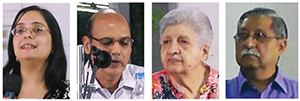
From left: Pearl Mistry, Jehangir Bisney, Gulbanoo Chenoy and Aspi Debara
Jehangir Bisney, PZASH trustee, who sent a write-up on the event to Parsiana, introduced Mistry as a mother of three young children aged 15, 10 and five who, armed with degrees in psychology and sociology has counseled over 70 couples receiving fertility treatment and has conducted workshops across the country on good parenting and family life in modern times. He spoke briefly about the Jiyo Parsi program which was started by the Ministry of Minority Affairs of the Government of India (GOI) to facilitate a change in attitudes about marriage and family size, as well as to financially support couples going in for assisted reproductive technologies. Partners in the scheme are Parzor Foundation in Delhi, the Bombay Parsi Punchayet and the Tata Institute of Social Sciences in Bombay. Sam Balsara’s Madison World created an advertisement campaign to boost the program.
"It’s not that Parsis cannot have children. Some people were offended when our ads came up saying that ‘our manhood is being questioned!’” Mistry told the gathering. "It’s not fertility but the mindset not to have more children which is the root cause,” she explained. Also, the ratio of deaths to births is alarming, with 800 deaths against 200 births. With 30% of the population not marrying, others marrying outside the community, the high rate of divorce and emigration, the situation has worsened. Mistry explained that the Jiyo Parsi program aims to first stabilize the population and then increase it. About 150-200 couples would be assisted to overcome fertility issues using the latest medical advances along with advocacy and counseling. Jiyo Parsi would foot the bill up to Rs 5,00,000 per couple irrespective of whether the treatment culminated in pregnancy or not, the write-up notes.
When asked whether the program had been successful, Mistry responded, "Yes, of course!” So far 35 babies have been born and many more couples are soon to be parents. More than a dozen couples are under treatment. Confidentiality is always maintained and there has been positive feedback from the community, Mistry revealed. With a strong and dedicated team led by Dr Shernaz Cama of Parzor, Dr Katy Gandevia, Dr Anahita Pandole, Shashikant Sakat, Binaifer Sahukar, Dr Niloufer Shroff and Mistry herself, the program is making progress. Mistry told the gathering, "Each one of you needs to become a Jiyo Parsi ambassador!” Similar consciousness raising meetings have already been held in Bombay, Delhi, Surat and Navsari, she mentioned.
While proposing a vote of thanks Kerfegar Antia, managing committee member of PZASH noted that this was a wake-up call for the community. It was sad that it required the GOI to arrest the decline while community members are busy with material and gastronomical delights, the write-up concludes.
◆ ◆ ◆
From the archive