
Events & Personalities
Poets’ dissent
Poet and author Keki Daruwalla is among the three dozen awardees who have returned their prestigious Sahitya Akademi awards in protest against the killings of anti-superstition crusader Narendra Dhabolkar, progressive thinker Prof M. M. Kalburgi and Dadri resident Mohammed Akhlaq who was lynched by fanatics on suspicion of consuming beef. The Sunday Express (TSE) on October 25, 2015, profiled 33 of the laureates who have repudiated their awards because the Akademi has not spoken out against increasing intolerance and atrocities. Poet Adil Jussawalla has also voiced his protest in a letter written to the president of the Akademi, Dr Viswanath Prasad Tiwari.
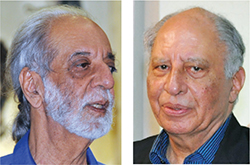
Poets Adil Jussawalla (left) and Keki Daruwalla
Daruwalla told TSE: "I admit this award I got is prestigious and I must have gained in reputation from it. But there are times when one must stand up to be counted. The rising tide of intolerance being what it is, I am constrained to return the award.” A recipient of the Padmi Shri in 2014, Daruwalla won the Sahitya Akademi award much earlier, in 1984, for his collection of poems, The Keeper of the Dead. The writer has to his credit 10 volumes of poetry, five of short stories and a full length novel titled For Pepper and Christ. An official of the Indian Police Service (IPS), Daruwalla began his literary journey as a poet in 1970 with his collection Under Orion in which he drew on his experiences as an IPS official serving in strife torn regions. Now retired, he has been a member of the National Commission for Minorities and also served as special assistant to the prime minister in the previous government.
Jussawalla, in his letter to the Akademi’s president mentioned that he was "honored” to receive the award for 2014, but the murder of writers and "unacceptable censoring of many other writers by violently intolerant groups must be condemned… Perhaps a resolution could be reached at the meeting of the executive committee in December. Better still, couldn’t an emergency meeting be called to pass such a resolution earlier? ...This is the time to boldly state that (the Akademi) unequivocally supports the rights of the nation’s writers and condemns the violence used to suppress or destroy those rights.”
Internationally acclaimed poet and novelist Vikram Seth, who was interviewed by TSE of the same date, commented "I am very shocked by their silence and inaction on this matter. Keki Daruwalla has said that when he wrote to somebody at the institution, they didn’t write back to him but they called him and said, ‘Saab, bahut pressure hai yahan par (Sir, there is tremendous pressure here).’ Frankly, I haven’t felt the pressure. It’s an individual decision… let’s hope something robust comes out of the Sahitya Akademi.”

Irked by the spate of protests about the Akademi’s "silence,” president Tiwari issued a statement saying: "We wish to emphasize that the Akademi stands for freedom of expression of all writers, irrespective of caste, color, creed or nationality. Sahitya Akademi condemns the attack on and murder of any writer or artist anywhere. (It) is committed to the core secular values enshrined in the Constitution of India… I as president can express my official views on any matter only after placing (it) before and getting the requisite approval from the executive board…at the next meeting.”
A resolution belatedly passed by the Akademi of October 24, 2015 has "fulfilled the demands of protesting writers,” wrote Daruwalla in an article in The Indian Express on October 28, though "it took them two desultory months to come to the table.” Daruwalla described the agitation as "not manufactured. Nemesis, the goddess charged with checking presumption, strode in even as the culture minister dismissed Akhlaq’s mob-murder as an ‘accident.’”
Film makers and historians have begun to return their awards. Finance minister Arun Jaitley termed the protestors "rabid anti-BJP elements” and described their action as a "manufactured rebellion.”
◆ ◆ ◆
From the archive