
Zoroastrians Abroad
Space stimulation
"I love to make people go ‘wow.’ I can do that simply by showing a beautiful photo, but it is more fun to go deeper and really amaze people with scientific interpretation of these photos. Just how big is Saturn? How ancient is Mars’ surface? How far away is Pluto?” explains Emily Lakdawalla who has been writing and editing The Planetary Society (TPS) Blog for the last 10 years, reporting on space news, explaining planetary science and sharing beautiful space photos. Founded 35 years ago in the US as a non-profit organization, TPS, according to its website, is "the largest and most influential public space organization group on Earth… to inspire and involve the world’s public in space exploration.” The Los Angeles resident clarified in her email responses to Parsiana, "These ‘wow’ moments can briefly transport people from their mundane cares to an appreciation of how vast and old the universe is. It can make you feel small but it can also give you a sense of wonder, of gratitude at being a creature that is mentally capable of appreciating the grandeur of space.”
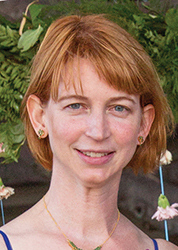
Emily Lakdawalla
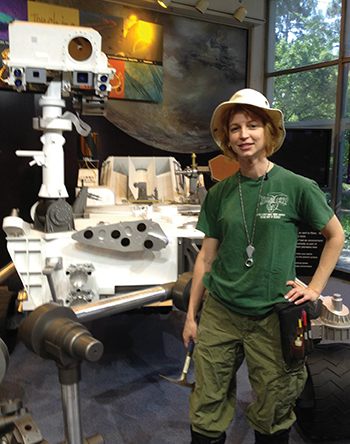
Emily Lakdawalla dressed as a geologist with a model of the Curiosity rover
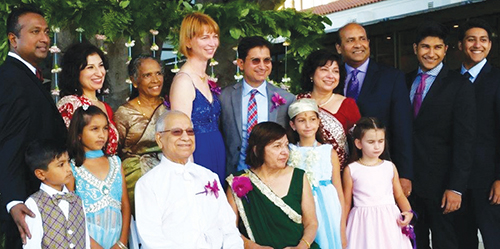
Lakdawalla family at Anahita’s navjote (Photo: Adi Billimoria)
Among the growing league of viewers and listeners she has impressed was Parsiana subscriber Cyrus Guzder who first brought Lakdawalla’s contributions to our attention having heard her "wonderful exposition” on the program "On Point” aired by National Public Radio, "an independent broadcasting station in the US.”
A postgraduate in planetary geology from Brown University, Lakdawalla joined TPS in 2001 to oversee a portion of their Red Rover Goes to Mars project, an education and public outreach program on the Mars Exploration Rover mission funded by LEGO. She appears weekly on the Society’s Planetary Radio podcast, responding to listener queries or summarizing the latest space news from the TPS Blog. As a popular science communicator, she has appeared on television, in webcasts, on Google+ Hangouts, and on Snapshots from Space, viewable from TPS’s YouTube channel. She has also served as administrator of the forum UnmannedSpaceflight.com since 2005, supporting a worldwide community of amateur space image processors and is contributing editor to Sky & Telescope magazine. In 2011 she was awarded the Jonathan Eberhart Planetary Sciences Journalism Award from Division for Planetary Sciences of the American Astronomical Society for her blog entry about the Phoebe ring of Saturn.
As a graduate student who specialized in geology from Amherst College she learnt how spacecraft capture and return data from space. She soon became knowledgeable on how to interpret that data – in the form of pictures, topography or chemical compositions – and figure out what it had to reveal about world history. "I use exactly the same skills now as a blogger, checking out the latest pictures from space or academic articles written by scientists and I translate those things for a more general audience, helping people learn about the new worlds that deep-space robots are exploring. It’s a very exciting time in solar system research; there are dozens of missions out there, and increasing interest from Asia with China and India both recently beginning planetary exploration. As a space blogger, I can write about every planet and every mission, and help both the public and the space community stay on top of all that is happening,” she explains in her work profile.
She is currently working on her first book to be published by Springer-Praxis which she hopes to finish writing next year. This book will be enjoyed by professionals as well as members of the public: "people who are interested in space exploration, who want more and deeper information than you can get in the mainstream media; the sort of people who would subscribe to science or astronomy magazines. But you won’t need any prior knowledge to enjoy my book,” she is emphatic. As the space blogger reminds us, "The Curiosity mission (Curiosity is a car-sized robotic rover exploring Gale Crater on Mars as part of NASA’s Mars Science Laboratory mission to gauge whether Mars could have supported life, to determine the role of water, and to study the climate and geology of Mars) is so incredibly complicated that there isn’t any one person who understands the whole thing. Many of the engineers don’t understand the mission’s science, and the scientists certainly don’t appreciate the complexities of how the spacecraft works. I hope that my book will be a useful reference for anyone who wants to understand more about it.”
Lakdawalla is happy she enjoys a "very flexible working arrangement in which I can work full-time mostly from home… on my own schedule so that I can be present when my children need me.” Emily and her husband Dr Darius Lakdawalla, a professor of economics at the University of Southern California and founder partner of Precision Health Economics, have two daughters, nine-year-old Anahita who was navjoted last month and six-year-old Sanaya who both attend monthly Sunday School at the Zoroastrian Center. The mother takes pride in reporting that Anahita plays the violin and Sanaya, the piano, and both learn Bharat Natyam dancing.
Whilst they have not been directly associated with the Southern California Zoroastrian Association, Emily appreciates that Darius’ parents Noshir and Rhoda are "highly active in it and keep us connected with the community. Dad served as treasurer of the association for a number of years and played an instrumental role in fundraising for the association’s new Zoroastrian Center in Orange, California. Mom served as secretary of the Association for a number of years… I look forward to Parsi community events that my mother-in-law graciously hosts at her house, and I even cook dhansak at home, though it’s not as good as hers.”
When asked to share her views on the Parsi community and the Zoroastrian religion, Emily replied that although she has witnessed and participated in religious events at her inlaws’ place, "I think it would be presumptuous of me to express any views on someone else’s religion! Darius explained some of the tenets and philosophy of the religion to me before we were married and we had a Zoroastrian wedding ceremony. Before agreeing to officiate at our wedding, the priests asked us whether we intended to raise our children in the faith, and we agreed. I do my best to help my daughters act in the world with good thoughts, good words and good deeds. As for the community, I have found it to be very open and welcoming to me.”
◆ ◆ ◆
From the archive