
Hail the Hall
Zoroastrians choosing alternative modes of disposal for the dead will be able to avail of the new Prayer Hall at Worli
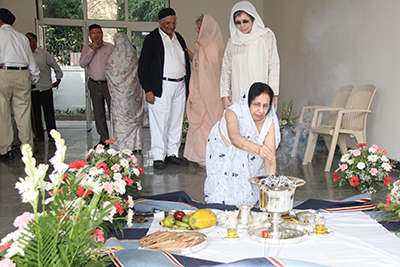
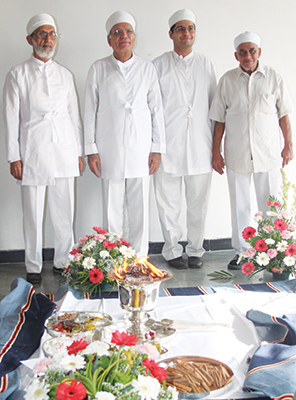
Barring half a dozen ladies who were dressed in saris and one gentleman in a dagli, the others had come in their workday attire since they were uncertain whether the jashan should be viewed as a solemn or joyous event. Three individuals were seen praying from the Khordeh Avesta whilst the jashan was in progress. For the nearly 60 other attendees, sitting with their heads dutifully covered, the event accorded an opportunity to familiarize themselves with the layout of Vaikunth Dham (eternal abode) where the Worli crematorium is located and the facilities that would be available to Parsis.
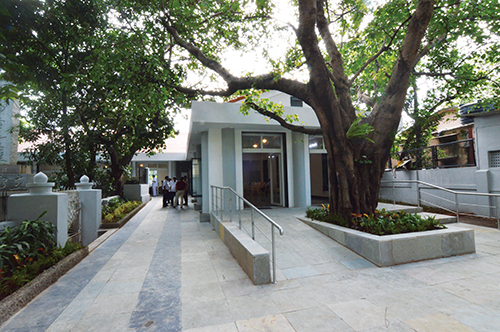
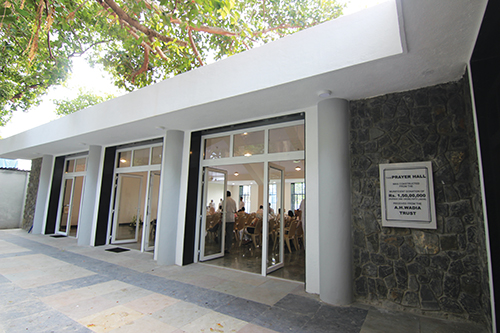
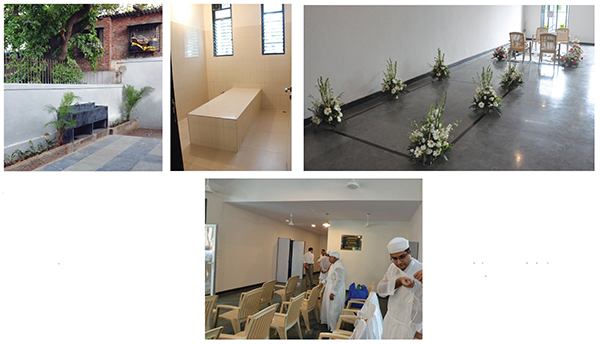
The L-shaped Prayer Hall constitutes two well ventilated and illuminated rooms, the larger one can seat around 125 people comfortably, and the smaller one around 80. In addition to an anteroom where the deceased could be given the final sachkar bath are the toilets for ladies and gents on the premises. The adjoining neglected structure which currently houses the electric crematorium with two furnaces will shortly be rebuilt by the Bombay Municipal Corporation which has sanctioned Rs 40 lakhs for this purpose.
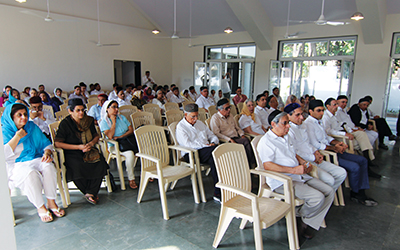
Devotees at the jashan
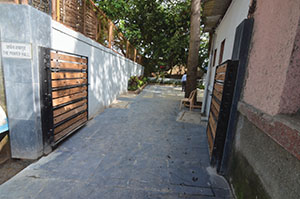
Entrance
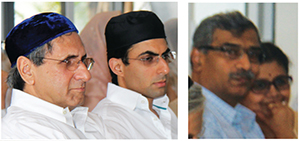
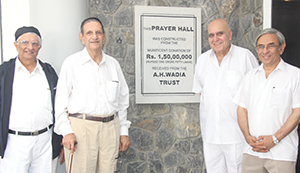
(From l): Ervads Framroze Mirza, Khushroo and Fali Madon, Jal Balsara
As explained by one of the staff members on the premises, the two furnaces at Worli are used alternately for around 60 corpses each month. One of them is always kept burning at 600°C. Once a body is placed inside a chamber, the temperature is raised to 800-900°C and it turns to ashes within one-and-a-half hours. In case of urgency, the ashes are specially cooled with water but under regular circumstances family members are requested to collect them the next day. For Hindus and other communities who opt for wood pyre cremation, there are two sheds nearly half a kilometer away from the Prayer Hall with the infrastructure to burn seven corpses. Yet another structure a little beyond is the Snan Grah with facilities for bathing.
Two days prior to the jashan, the body of 68-year-old Roomy Russy Shroff was cremated at Worli but the Prayer Hall was not used as the Memorandum of Understanding between the Municipality and The Prayer Hall Services and Maintenance Trust (TPHSMT) had yet to be signed. The trustees were hopeful that the formalities would be completed by end August this year.
"Very much impressed by the new Prayer Hall,” Khushroo Madon felt the community "should be grateful” for this facility. Whilst appreciating the philanthropy of the A. H. Wadia Trust, he believed due credit should also be given to Kanga, Khusrokhan and Tamboly whose persistence had made the Hall possible. Madon hoped it would make a major difference to those who want to choose the cremation mode of disposal. Due to shortage of space at their own homes Madon would earlier undertake some prayers like uthamna from his own residence at Godrej Baug until he was compelled to stop by the trustees of the Bombay Parsi Punchayet. Considering that Parsis will get priority during the main time slots (7-9 a.m., 3-8 p.m., 4-6 a.m.) at the Prayer Hall, "that is enough,” he opined, sanguine that "more and more members of the community will opt for cremation and perform prayers at Worli.” For the four-day prayers at the Worli Prayer Hall, the priests have agreed to charge a consolidated sum of Rs 22,000, to maintain parity with the rates at Doongerwadi, he informs.
Whilst geh sarna prayers would always be permitted at crematoria, there were invariably constraints of space for the uthamna and other prayers, mentioned Mirza who views the new Prayer Hall as "a very good boon.” For want of space families would occasionally forego prayers, observed Mirza who expects that "without hesitation people will now come forward for cremation.” Not only those opting for cremation, but even those choosing burial or donation of body can use the Prayer Hall, he stated. Whilst very few opt for burial or donation of body in Bombay, he specified, "My intention is to pray for the deceased. I’m not bothered with the method of disposal.” As he further pointed out, "Now each and everyone can participate in these prayers.” Hitherto even non-Parsi family members and close friends would not be permitted to attend the geh sarna and other prayers at Doongerwadi, being compelled to sit in a separate pavilion.
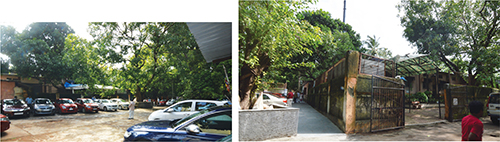
Car park and entrance to electric crematorium
Tamboly’s invitation to "attend the jashan and participate in what will be the commencement of a historic movement for Parsi Irani Zoroastrians opting for alternate methods of disposal and being assured of having the four-day obsequies performed,” received flak from orthodox community activists. Members of Traditional Mazdayasni Parsi/Irani Zarathustis (TMYZ), Traditional Zarathushtris Mailing List (TZML), Traditional Parsees, and Ilm-e-Khshnoom started circulating emails citing different reasons to dissuade those contemplating cremation and use of the Worli Prayer Hall.
According to Jimmy Tavadia, "Chinvat is the home of the dead of the Mazdayasnans. When anyone other than a Mazdayasnan dies a special spirit affiliated to his form of worship comes forthwith and takes the possession of the soul of the dead and takes him to the house of his dead ancestors situated in the city of the special Dakhue-continent (abode of the dead) of his jiram (class). Thus cremation or burial is quite suitable for their journey after death.
"Quite different is the case of a Mazdayasnan Zoroastrian. His home of Chinvat is situated in what may be called eternity i.e. intensely far off having no connection with this living world. The Zoroastrian ruvan has himself to go to Chinvat without the help of any angel” but with favorable circumstances in the form of "parallel rays of the sun… devoured by vultures and other birds and animals of prey… Zoroastrian ceremonies… The condition of a Zoroastrian ruvan who is cremated or buried is like a man separated from his country and relations without money, relation, friend or acquaintance roaming about in a foreign land, hungry and thirsty, suspected as a thief or spy by the police of the place and consequently harassed.”
Hoping to detract cremation supporters, he started and concluded his email with a quote by Dr Framroze Chiniwala, "Those who are not treated after death according to the Zoroastrian ways of disposal retain their invisible form as in life which has no will or option or end or aim worse than an animal life like a man in a deep swoon full of distress and anxieties. He is neither in this world nor in the other. No description can be given of his miserable state.”
Remarked Ketayun Bamji, "It is sad that our age old tradition of dakhmenashini is being dealt such a big blow by people from within the community itself. People who basically are quite ignorant of the reasons we do what we do. The dakhmas are not just places where you place a body. They are power boosters and energy generators… Each to his own but this is a sad day for our community, not a ‘big step’ as mentioned…”
The longest email though was from Pervin Mistry whom Tamboly described as "the high priestess of traditionalists.” She wrote on behalf of the TMYZ: "It is sad that some Parsis who consider themselves above the spiritual wisdom of our Paigambar Saheb disobey the injunctions given in the Pak Avesta and destroy our religion from within by attacking the fundamental, revealed, time-tested and long-standing tenets and rituals which withstood the destruction of Alexander and the Arabs, only to be discarded now by these misled Zarathushtis!” Attacking Tamboly for his association with the World Zoroastrian Organisation — UK and his involvement with the Foundation for Development of Udvada, she alleged, "Tamboly is encouraging those who wish to get buried or cremated… Constantly Tamboly only promotes the agitators of religious ‘reforms.’ These are not really reforms in the true sense of the word but only deviations from the revealed, mandated rules…”
These lengthy emails received a curt response from Khusrokhan who commented, "Someone should remind them that in Chiniwala’s time there was a surfeit of vultures… Trappers (would) periodically catch them in the wild and bring them to Doongerwadi. Kids in Khareghat Colony used to shoot them with air-guns for fun or if someone said the bird was absagan (inauspicious) and should be chased away from their balconies. Today 97% of India’s vultures are gone. Surely they must give some credence to that change.”
Observing that "the circus has started,” Tamboly stated, "They have forgotten that they themselves told us (the liberals) to go our own way and set up our own institutions, and now that we have, they feel threatened.” A day prior he wrote, "Living in a democracy one has to accept that what some support, others may criticize. Our objective has been not to sit in judgment but to provide a solution towards a long felt need of the community. The truth or otherwise of the wisdom that our traditional friends thrust upon us will be known only upon death. Living in the physical world, there are many Zoroastrians who opt to live in a pragmatic manner as per the need of our times, and await the wisdom of the spiritual world when they reach there.”
As chairman of TPHSMT, Tamboly has made a plea (see "Appeal for funds, ” Readers Forum, pg 38) "to likeminded persons within the community who see themselves utilizing this facility at some time in the future” to contribute to the Trust that will be offering customary services (like priests, flowers) and upkeep of the premises (by way of round-the-clock security, cleaning services and maintenance of gardens).
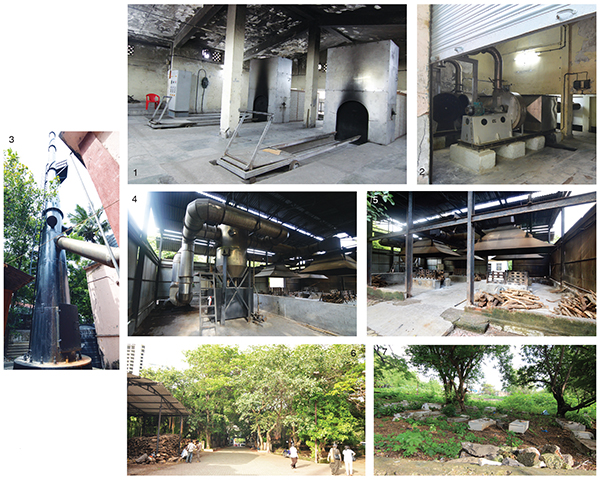
Cremation made convenient
For the prayers contact Ervads Khushroo Madon (mob: 9820170794, res: 23698207, 66641640) or Framroze Mirza (mob: 9821421593, 9821736948, res: 23636524); for Worli crematorium (tel: 24932517); for hearse, Manjrekar Ambulances (tel: 23869215, 23871215) or Antim Samskar Seva (Tel: 9223355500/ 9223355511).
A doctor’s certificate is sufficient when the body is brought to the Worli crematorium for the last rites. The charge for the cremation is Rs 200 but it may be waived for those who cannot afford the amount. After the cremation, a document issued by the Municipal office in the complex near the entrance has to be carried to one’s ward office for issuance of a death certificate.
Those opting for cremation could avail of the not-for-profit community service listed by antimseva.com, the website of Antim Samskar Seva, an initiative of Hiralal Parekh Parivar Charity Trust that seeks to "help the family of a deceased person perform the last rites and facilitate funeral arrangements and transportation to cremation site with decorum and dignity.” Their services are available up to New Bombay and Borivli from 7 a.m. to 7 p.m. on all days including Sundays and holidays. The organization will punctually send an airconditioned hearse with a coordinator, two helpers and a driver with seats for accompanying mourners to carry the deceased to the cremation site against the background sound of spiritual recitations or chanting of religious slokas.
Besides co-ordination services with agencies and hospitals for eye or organ donations they can assist with temporary storage and embalming, if so required. They also arrange for a simple container for the ash remains, with careful delivery to the family plus help with application for a municipal death certificate. Whilst the package of obsequial services from Churchgate to Dadar are available on payment of Rs 4,000, and for longer distances for Rs 5,000, they also offer a hearse only facility for Rs 2,500 up to Dadar and Rs 3,500 for the suburbs.
Since Antim Seva’s establishment in 2008, in the first five years of operations their services were used by all communities: 483 Hindu Gujaratis, 152 Jains, 174 Sindhis and Punjabis, 93 Maharashtrians, 44 South Indians, 40 North Indians, 30 Marwadis, three Muslims, one Parsi and one Catholic, according to their website.