
Professions
Glamorizing the gara
Designer Ashdeen Lilaowala contemporizes traditional embroidery with a modern interpretation
The fourth day of the Lakme Fashion Week Summer/Spring 2013 in Bombay saw, along with others, the launch of Ashdeen Lilaowala’s spectacular gara influenced saris and apparel. The timeless elegance of finely crafted gara embroidery and kors was contemporized evoking the aesthetics of tradition with modern oriental overtures. Lilaowala’s saris featured fluttering butterflies, dancing birds, flying cranes and chrysanthemum motifs in vivid colors, evoking pure beauty in their simplicity! The ASHDEEN label was ushered in to deafening applause on India’s premier fashion circuit.
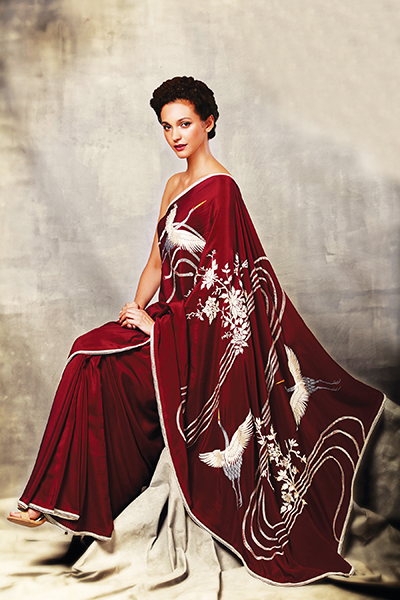

Ashdeen Lilaowala (right); model wearing his famed crane gara
ASHDEEN specializes in exclusive hand embroidered saris, jackets, dresses, pants, shawls, kurtis, clutch bags and gowns featuring the designer’s unique take on gara embroidery. "Basically, I combine Chinese embroidery with Persian, Indian and British traditions, infusing reality,” explains the young, enterprising designer. "I call my creations ‘painting with a needle.’ These saris are meant to be family heirlooms and are a refreshing change from the traditional Chinamen, birds (chakla-chakli) or kaanda-papeta (onions-potatoes) patterns,” he elaborates. His contemporary gara pieces are painstakingly hand embroidered with silk threads, silver and gold zari by a team trained by the designer himself for almost a decade at his studio in Delhi and range in price from Rs 30,000 to Rs 2,00,000 apiece. Precious embroidery, indeed!
The designer has been holding exhibitions in Bombay, Delhi and Madras and was invited for a solo show in Bombay in 2014 to curate the Lakme Fashion Week Textile day. His creations are retailed at Ogaan, Ekaya and Neel Sutra in Delhi, 85 Lansdowne in Calcutta, Cinnamon in Bangalore and Amethyst in Madras. He also receives orders from customers in Singapore, Dubai and Canada on his Facebook page.
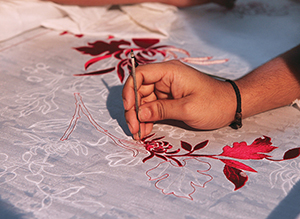
Painstakingly worked embroidery
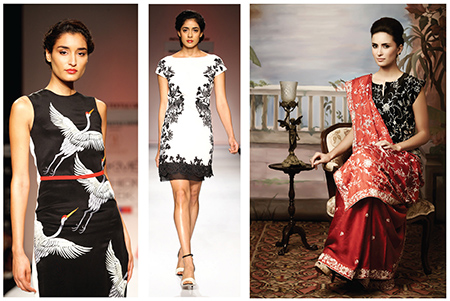
ASHDEEN creations
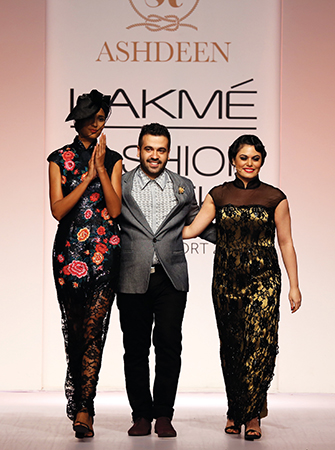
Lilaowala flanked by models at Lakme Fashion Week
Photos courtesy: Ashdeen Z. Lilaowala
Though Lilaowala has now expanded his product range he makes sure there is no compromise on quality and the exclusive hand embroidery for which his label is known.
Since 2007 he has had a studio workshop in South Delhi with over 30 workers who are trained in the "skill of embroidery, though not fluent with the language of the Parsi gara.” He personally teaches them the nuances of fine Parsi embroidery, including the "negative spacing to create an oomph factor.” Lilaowala sources fabrics and draws out the gara patterns himself, deriving inspiration from age-old designs and infusing an oriental touch in them.
While Bombay’s traditional hand embroidered gara sari specialists are his competitors, Lilaowala visualizes his art differently. "I try to make my saris stand out through the placement of motifs,” he explains. "Even a traditional gara in black and white will have red piping — which is my identity! I also do traditional garas with silver and gold zari,” he adds.
"I hope to grow like (fashion designers) Sabyasachi (Mukherjee) or Manish Malhotra,” he confesses when quizzed on future plans for his label. He wishes for more worldwide exposure via the internet and proposes more exhibitions of his collections in Hong Kong, Singapore, Dubai, USA and Canada. Further forays include an expansion in his ready-to-wear garments line and the launch of a bridal collection of lehengas with Parsi embroidery to cater to the ever growing bridal market in Delhi and Bombay.
Thirty-five-year-old Lilaowala was born and brought up in Bombay. His working parents, Zubin and Shernaz, are currently employed with Tata AIG Life Insurance, while his two older sisters, Dilzeen and Ferzeen are married in the USA and Bombay respectively.
Lilaowala attributes his "focus to achieve,” determination, discipline and training to his early student life in Bombay’s Cumballa Hill High School where he was encouraged to reach beyond the curriculum. He also joined the Zoroastrian Bharat Scouts and trained to be an athlete.
Thereafter, the young artist enrolled for the science course in Wilson College, but his creative leanings led him to appear for the entrance examination of the National Institute of Design (NID) in Ahmedabad, which he passed at the first attempt in 1998. For four-and-a-half years he was exposed to graphic design, animation and chose to specialize in textile design. At India’s prestigious design institute, Lilaowala was introduced to the Parzor Foundation based in New Delhi who sponsored a documentation of the art of kusti weaving. His research later culminated in his book Threads of Continuity written jointly with Parzor director Dr Shernaz Cama and published by Parzor in 2014.
After graduating from NID, Lilaowala was employed with Rhoda Textiles in Bombay, focusing on exports from 2003-2005. He moved to Delhi in 2005 to work with RUH, a label specializing in handloom and Indian craft traditions. Concurrently, he worked with the Parzor team, which had just received a grant from the Ministry of Textiles to do a craft documentation on gara embroidery.
From 2007, the master craftsman was developing beautiful hand embroidery for Jil Baracci’s haute couture store on Rodeo Drive in Los Angeles, USA while continuing his association with Parzor and doing research on Parsi garas — collating data, studying motifs, patterns and "the roots and routes” of embroidery in India.
Alongside with writing fashion and travel pieces and teaching at the National Institute of Fashion Technology (NIFT) in Delhi, Lilaowala created his first gara in 2010. With new orders came growing confidence and he began preparing to launch his individual label in October 2012.
At first Lilaowala reinvented the traditional Parsi border — imbuing it with new colors, fabrics and modern designs. Thus was launched his "crane gara” which features on its pallu a lake scene with cranes resting and flying. This unusual design has been his best-seller! Placement of esoteric motifs, bright colors and enigmatic blouses are the hallmark of artistic creations from ASHDEEN.
Lilaowala has a strong bond with the Parsi community and respects the religion greatly, given his deep Parsi roots, "growing up in a Parsi school, living in a Parsi colony and joining the Parsi Scouts.” Though he is sympathetic to orthodox views, he suggests "we seem to be sweeping backward because of controversies.” He opines that children born of mixed parentage should be allowed into the religion, more so after living for eight years amongst the Parsis of Delhi. He is religious and a strong advocate of wearing the sudreh and kusti. "We are a wonderful community. We have a zest for food and life and even poke fun at ourselves. Let’s hold onto our culture and do away with radical dogmatism,” he pleads.
Lilaowala won the design competition for the best logo for the World Zoroastrian Congress in 2013. Though currently single, he would prefer a like-minded Parsi partner in the future.
Lilaowala owes his move to Delhi and consequent recognition and success to the Sethna family and Parzor Foundation. He regards the late Gen Adi Sethna, former president of the Delhi Parsi Anjuman as his mentor who inculcated in him the qualities of insightfulness, discipline, team spirit and the "confidence to conquer any mountain.” These mark the cornerstones of his career, he adds with reverence.
Working with Cama’s enthusiasm and her dreams for Parzor has taught him the importance of being passionate and dedicated to one’s goals and ideals. Dr Nilufer Shroff’s zeal and efficiency in administering the day-to-day functioning and innovations for Parzor crafts (to which Lilaowala contributes whenever required), evokes equal appreciation from him.
◆ ◆ ◆
From the archive