
Books
Provocative portrait
Prophet of Love by Farrukh Dhondy. Published in 2013 by Harper Collins Publishers India, A-53, Sector 57, Noida, Uttar Pradesh 201301. Pp: 314. Price: Rs 299.
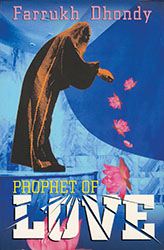 Farrukh Dhondy has to his credit collections of short stories, novels, screenplays for films and television and his opera based on Rudyard Kipling’s Just So Stories premiered at the Riverside Studio in London in 2012. In his recent novel, Prophet of Love, he returns to familiar home ground Poona, the location of his memorable collection of short stories, Poona Company.
 When The Bikini Murders was published in 2008, he vehemently denied that the novel was based on the life of the notorious multiple murderer Charles Sobhraj though there were several parallels and resonances between the two. Now, once again, Prophet of Love has a similar relationship with Bhagwan Shree Rajneesh and his early life in India before he went to the USA and established his ashram at Oregon in the 1980s. The blurb on the rear cover of the book mentions that the novel is "centered on the fictional Bhagwan Saket.” But is he totally fictional? This seems to be debatable.
I am not too sure if Dhondy would welcome parallels drawn between his protagonist Bhagwan Shree Saket and Bhagwan Shree Rajneesh. Both are provocative and volatile speakers, which is evident from the very first line of the novel. Both are dressed in white while their disciples who were dressed in crimson were not permitted to use perfumed soap, aftershave or deodorant. Both studied philosophy and were professors of that subject and both lost their jobs when they came into conflict with the authorities. Both had very prominent and powerful women secretaries.
An inexplicable factor in this novel is the startling introduction of the personal elements of Dhondy’s life. He makes no effort to disguise the ‘I’ of the narrator. He uses his own name, except when he invents the preposterous name of ‘Hiram P. Ingleburger Jr.’ to enter the ashram. He mentions he is the writer of Poona Company and makes no effort in disguising either the names or the address of his aunts who lived in Poona at that time. At one point, he even makes a passing reference to their neighbor, using her real name. Bhagwan Rajneesh’s name was Chandra Mohan Jain and in the novel the name of one of the narrators is Chandrika. Ironically, Dhondy mentions at one point that the name of his ayah (female domestic assistant) was Chandrabai.
The novel has two narrators: there is Dhondy who is investigating the ashram and there is Chandrika who narrates the early life of Rahul who grows up to be Bhagwan Saket. Rahul has been sent to the monastery as a child because it has been prophesied that he would die at the age of seven and hopefully, "his life on earth will be without the sin of man.” When he fails to comply with the prophecy, the abbot, the head of the ashram, orders Chandrika to kill him but Chandrika escapes from the monastery with Rahul and brings him up with great affection.
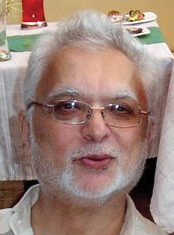
Farrukh Dhondy: skillful narrator
Of the alternating narratives, the efforts of Dhondy to investigate the ashram are livelier and more engrossing than the early life of Rahul as he is then called, which moves at a slower pace. The novel is replete with a motley crew of the most insalubrious characters. There are the money grabbing and insatiably greedy Shanti and Bhavnani who would go to any length to amass wealth. There is the unstable Diamond alias Ma Vidhyadhari, who hurls obscenities at Saket accusing him of vile sexual deeds and also molesting her four-year-old daughter, Sapphire, whom she wants to rescue from the ashram where she is held captive. There are greedy and corrupt lawyers, policemen and journalists and in the midst of all this is Bhagwan Saket who rules the ashram and spouts sermons to gullible disciples. Not even Dhondy or Chandrika, the two narrators, come through as sympathetic characters.
In the early life of Rahul we learn that an unscrupulous pair of people, Bhavnani and Shanti apparently do away with guru Vishvadeep when he becomes old and feeble and unable to attract any rich widows who would leave all their earthly possessions to the ashram. Bhavnani comes across Rahul preaching the virtues of living for the moment and not being fettered by inhibition and the instinct for self-denial and offers him the chance of a lifetime to fill the place of the erstwhile Vishvadeep.
Dhondy handles the two narratives very skillfully and manages to intertwine them as they approach the end of the novel. However, I have always felt that the strength of Dhondy’s work lies in his short stories. The characters he presents us in these are often memorably portrayed and effectively presented. His choice of ostensibly real life characters in the last two novels seems to go against the grain of the ones he created in his shorter fiction. It is strange that the compassion with which he portrays characters in his short stories seems to be totally lacking in his recent novels. I cannot say truthfully that I am waiting for his next novel but I surely look forward to a new collection of short stories.
◆ ◆ ◆
From the archive