
Books
Questions on charity
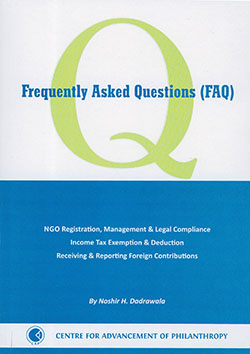
Frequently Asked Questions (FAQ) by Noshir H. Dadrawala. Published in 2014 by the Centre for Advancement of Philanthropy (CAP), Mulla House, 4th floor, 51, M. G. Road, Bombay 400001; email: info@capindia.in, website: www.capindia.in. Pp: 59. Price: Rs 300.
 The voluntary sector in India is growing rapidly. The range and variations within the sector are enormous. There are those who confine themselves to the traditional activities of education and health. And rightly so, since the primary health centers in the villages lack the most basic drugs and many rural pockets do not have a primary school to this day. Small wonder that in the social sector we fare so badly in the ratings list. India ranks at the bottom as far as the human development index is concerned. We are far behind our immediate neighbor Sri Lanka, and even Bangladesh, in any number of parameters, let alone education and health.
Increasingly, the NGOs (nongovernmental organizations) are taking to a broad based range of development work, which includes launching irrigation schemes, managing specialized charity hospitals and developing alternative (appropriate) technologies, among others. And the size of their budgets, not surprisingly, is huge. The recent publication of the Credibility Alliance entitled Development Impact on some of the large voluntary agencies it has accredited, indicates that they have a budget ranging anywhere from two crore rupees to Rs 110 crores. At the other end of the scale there are small groups, working among tribals and Dalits in villages and slum colonies, whose budget is a few thousand rupees to a lakh or so.
.JPG)
Noshir Dadrawala: guidelines for NGOs
All of them will benefit enormously from this slim volume by Noshir Dadrawala that covers most of the issues that concern the voluntary sector, and are a cause of worry to many. It addresses basic items as what is a non-profit body or a trust, to the minimum number of trustees required and whether trusteeship is for life. There is no provision under the several Public Trusts Acts, the author informs us, to dissolve a charitable trust. That can be a problem. I should know for I am a trustee of one that has served its purpose and we can’t terminate it by a resolution of the trustees. We will need to go to court for that and obtain an order to that effect. What a hassle.
So give it some thought before you happily set up a trust. Maybe you are better off registering the non-profit under the Societies Act. Or under the appropriate provision of the Companies Act (Section 25).
On Section 80G that provides income tax exemptions to donors, NGOs are reminded that approvals expiring after October 1, 2009 will require renewal, and once that is done then the 80G is for life. And those that expired before that date need to renew it once, and that certificate is permanent.
There is a section devoted to foreign contributions that will be of much interest to the voluntary sector. If an NGO does not have the Foreign Contribution Regulation Act (FCRA) certificate, it can go in for a one time grant from a foreign donor under Prior Permission. Usually those that have not completed three years of existence apply for this to the Ministry of Home Affairs (MHA). But the rules of the game have changed since the FCRA was amended in 2010. Under the 1976 Act, the FCRA was for perpetuity. Under the new act the FCRA has to be renewed every five years. Hence all those with a 1976 registration must ensure that they apply for new registration six months prior to the expiry date of all such FCRAs which is April 30, 2016.
The one major facility available now is that the renewal can be done online. And unlike in the past, the voluntary agency can view the progress of its application. And if there is delay, the NGO can always take recourse to the Right to Information and duly dispatch it to the MHA.
Questions have been answered whether foreigners, government servants and judges can serve on the executive body of an NGO, whether some of the foreign donations can be transferred to another NGO by the recipient and if it can be "mixed” with local funds, the need to have a separate bank account for such donations, and so on.
A contentious area for NGOs is whether a board member is entitled to an honorarium or a salary. This is a no no, but he can be provided out of pocket expenses. Often this may be air fare to the member who has to travel from another city to attend the board meetings held usually twice a year. A Section 25 company may compensate the member, but this compensation has to be reasonable. This provides considerable leeway to dole out largesse, but that is what defines a good from the not-so-good.
There is an important section on the NGO building a corpus fund, and how it can go about doing so. Dadrawala will do well to also tackle issues of governance, and transparency in his next edition of FAQ. Or he can do so in his quarterly publication Philanthropy. The voluntary sector is by and large unaware of whether the board meetings should discuss the budget, the projects it has taken on, and the methodology adopted for implementing them. The NGOs are equally unaware of what should be the highest and the lowest salary, the need to distribute the annual report not only to the funding agency but the staff and the community it serves and other such issues of governance/transparency.
Of course the bigger civil society groups will be familiar with the FAQ, but not the smaller groups serving in the rural areas. There are, according to one estimate, three million NGOs in the country, but a more reliable estimate puts their number at a third that figure. How does the author intend to get this book out to them? And at least one edition will need to be in Hindi.
Twenty-six years ago Dadrawala set up the Centre for Advancement of Philanthropy (CAP), which has published the book. The CAP has since advised and assisted hundreds of trusts, societies and companies in matters related to charity laws.
So give it some thought before you happily set up a trust. Maybe you are better off registering the non-profit under the Societies Act. Or under the appropriate provision of the Companies Act (Section 25).
On Section 80G that provides income tax exemptions to donors, NGOs are reminded that approvals expiring after October 1, 2009 will require renewal, and once that is done then the 80G is for life. And those that expired before that date need to renew it once, and that certificate is permanent.
There is a section devoted to foreign contributions that will be of much interest to the voluntary sector. If an NGO does not have the Foreign Contribution Regulation Act (FCRA) certificate, it can go in for a one time grant from a foreign donor under Prior Permission. Usually those that have not completed three years of existence apply for this to the Ministry of Home Affairs (MHA). But the rules of the game have changed since the FCRA was amended in 2010. Under the 1976 Act, the FCRA was for perpetuity. Under the new act the FCRA has to be renewed every five years. Hence all those with a 1976 registration must ensure that they apply for new registration six months prior to the expiry date of all such FCRAs which is April 30, 2016.
The one major facility available now is that the renewal can be done online. And unlike in the past, the voluntary agency can view the progress of its application. And if there is delay, the NGO can always take recourse to the Right to Information and duly dispatch it to the MHA.
Questions have been answered whether foreigners, government servants and judges can serve on the executive body of an NGO, whether some of the foreign donations can be transferred to another NGO by the recipient and if it can be "mixed” with local funds, the need to have a separate bank account for such donations, and so on.
A contentious area for NGOs is whether a board member is entitled to an honorarium or a salary. This is a no no, but he can be provided out of pocket expenses. Often this may be air fare to the member who has to travel from another city to attend the board meetings held usually twice a year. A Section 25 company may compensate the member, but this compensation has to be reasonable. This provides considerable leeway to dole out largesse, but that is what defines a good from the not-so-good.
There is an important section on the NGO building a corpus fund, and how it can go about doing so. Dadrawala will do well to also tackle issues of governance, and transparency in his next edition of FAQ. Or he can do so in his quarterly publication Philanthropy. The voluntary sector is by and large unaware of whether the board meetings should discuss the budget, the projects it has taken on, and the methodology adopted for implementing them. The NGOs are equally unaware of what should be the highest and the lowest salary, the need to distribute the annual report not only to the funding agency but the staff and the community it serves and other such issues of governance/transparency.
Of course the bigger civil society groups will be familiar with the FAQ, but not the smaller groups serving in the rural areas. There are, according to one estimate, three million NGOs in the country, but a more reliable estimate puts their number at a third that figure. How does the author intend to get this book out to them? And at least one edition will need to be in Hindi.
Twenty-six years ago Dadrawala set up the Centre for Advancement of Philanthropy (CAP), which has published the book. The CAP has since advised and assisted hundreds of trusts, societies and companies in matters related to charity laws.
◆ ◆ ◆
From the archive