
Events & Personalities
Karani Agiary’s salgireh
Speaking on the "Significance of the Marriage Ceremony in the Zoroastrian Religion” on the occasion of the 168th salgireh of the Seth Nusserwanji Hirji Karani Agiary in Cusrow Baug on February 3, 2015, Dastur (Dr) Peshotan Hormazdiar Mirza said the divo adarni function conducted as part of a Zoroastrian wedding signified the spiritual union of the groom and bride when the latter acquired the religious title of her husband. He explained that the lighting of the lamp and the slipping of silver coins symbolized the spiritual union to take place before Ahura Mazda.
Mirza recited from the Vahishtoisht Gatha which states that the bride and groom need to impress the importance of clothing each other in righteousness in order to be able to lead a blissful life. He said that the religion considers marriage as a sacred duty, a blessing as well as a discipline. Every act of goodness to the partner in a marriage is considered as an act of goodness to Zarathushtra himself.
Mirza recited from the Vahishtoisht Gatha which states that the bride and groom need to impress the importance of clothing each other in righteousness in order to be able to lead a blissful life. He said that the religion considers marriage as a sacred duty, a blessing as well as a discipline. Every act of goodness to the partner in a marriage is considered as an act of goodness to Zarathushtra himself.
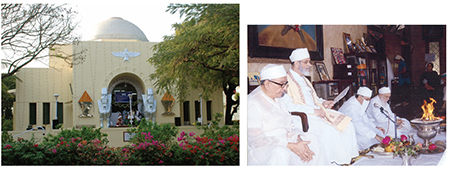
Cusrow Baug’s Karani Agiary (left); jashan in progress
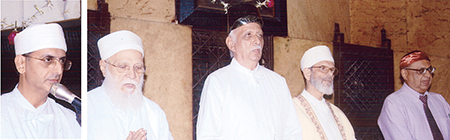
(L-R): Ervad Yazdi Aibara, Ervad Asphandiar Dadachanji,
Bomi Hansotia, Dastur (Dr) Peshotan Mirza and Homi Ranina
Invoking Chapter 3 of the Vendidad, Mirza narrated that therein Zarathushtra enquires of Ahura Mazda which is the second place where one is happiest (the first being a place of worship). Ahura Mazda responds that the second happiest place is where a righteous person establishes a house and has a wife and children and cattle. Mirza explained that the Vendidad too gives this as the reason for marriage: "A greater likelihood for a person to be able to withstand afflictions and to lead a religious and virtuous life.”
He noted that the scriptures considered it a meritorious act and a duty to help co-religionists to get married and explained that child marriages were abhorred in ancient Iran. In the Hom, Tir and Behram Yashts there are passages that exhort marriage after adulthood. According to Herodotus, the Greek historian, marriage was encouraged by the government in ancient Iran.
Mirza explained the significance of the rupiya pehrvanu (pre-engagement) ceremony, revealing that its origin was in the Namzaad Karnan ritual of ancient Iran, the purpose of which was to inform the community of the future intention to marry. Until about 50 years ago, the mandavo sharo ceremony (not mado saro as it is commonly referred to) was accompanied by the recital of the Atash Nyaish and the 54th Ha. He referred to the Varaddh Pattar ni Baaj and mentioned that it was an invocation to and propitiation of Ram Yazad who presides over joy, peace and happiness.
In ancient Iran the ashirwad ceremony was held in the early morning in Havan gah and families who wanted to have traditional weddings still insisted on having a second ashirwad ceremony repeated in the Ushen gah, after the evening’s ashirwad. He then listed the significance of the other rituals like the use of the ghee gor no kasiyo (vessel containing clarified butter and jaggery), the use of rice and the different shapes of the tilas on the foreheads of the bride and the groom. The use of the metal pot in the ghee gor no kasiyo was in honor of Shehrevar Ameshashpand who rules over the material world. Interestingly, Mirza said that under Iranian law it was customary for the groom to give the bride 2,000 silver dinars and two golden coins on the day of the ashirwad ceremony.
Mirza explained that the ashirwad prayers are in two parts: the first is a solemn affirmation of the marriage announcement, which includes the confirmation from the representatives of the bride and groom’s family that they have fulfilled their obligations regarding gifts. The gist of the second part is a special invocation to accept Zarathushtra as the spiritual leader.
The evening began with a Huma Anjuman Jashan and a short hambandagi led by the Karani Agiary’s panthaky Ervad Yazdi N. Aibara who thanked the two trustees of the Agiary, Bomi Hansotia and Homi Ranina, for their ongoing support. Cusrow Baug resident Noshir Balsara then said a few words about the rich heritage of the Parsi community and extolled the virtues of the Wadia family that built this colony and several others. Resident Mani Vazifdar offered a vote of thanks.
Built in 1847 by Nasserwanji Hirjibhai Hodidalal (hodi means boat and dalal is broker/agent) in memory of his late daughters Bhikhaiji and Avabai, the agiary was located in Nigam Street in Null Bazar, writes Marzban Giara in his book, Global Directory of Zoroastrian Fire Temples. The Agiary building in Cusrow Baug was constructed in 1935. Giara believes the name Karani was the occupational surname adopted by the Agiary.
◆ ◆ ◆
From the archive