
Book Notes
Story behind Shahnameh
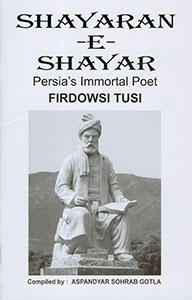
The story of the man who wrote some of the world’s most iconic tales comprising the Shahnameh is the subject of a booklet complied by Aspandyar Sohrab Gotla titled Shayaran-E-Shayar, Persia’s Immortal Poet Firdowsi Tusi. In 50 pages Gotla attempts to outline the life and times of this "poet among poets,” dealing briefly with his family history, place and date of birth, education, marriage and family, personal tragedies, writing of the epic and the political repercussions thereof. Firdowsi’s real name was Abul Qasim Mansoor and a photograph of his imposing statue graces the front cover, while on the rear cover is depicted his tomb, both in black and white.

Aspandyar Gotla: bringing Firdowsi alive
This is the second edition of the booklet which first appeared in 1998, and carries three Forewords, and two each by way of Dedications, Opinions and Prefaces — from both the editions, which provide interesting insights. Noshir Dadrawala, charity management expert, in his Foreword to the first edition writes: "All Zoroastrians should salute this immortal bard for lighting that ever-brilliant flame of cultural pride. Though born a Muslim, he glorified Zoroastrian Iran and immortalized its righteous kings… at the cost of great personal suffering and injustice… What shines out are Firdowsi’s virtues of persistence, dedication, generosity, ready wit and a higher purpose in life.”
Ervad Parvez Bajan, an authority on the Shahnameh, in his Foreword to the current edition explains: "For 30 long years, Firdowsi labored to collect from fables, legends, the fragments of history of the five great Iranian dynasties. With the magic wand of his pen he revived the ancient glory… The Shahnameh is the inexhaustible mine on which the writers and creators of Iran have drawn for their subjects, figures and phrases. From its pages, soldiers have derived martial spirit… kings (their) royal dignity and the whole Iranian nation a pride and patriotism that have kept them together against a thousand calamities for a thousand years… The compiler has tried to bring out the sense of (each) episode by citing couplets in Gujarati transcription from the Shahnameh itself” which he feels will enthuse readers to find out more about the glory of the past.
Gotla, in his Preface to the second edition writes: "It is our great fortune that we have still preserved his epic Shahnameh, but it is sad that the younger generation of Parsis are not aware of any of his couplets, nor have any knowledge about his life history.” It is this lacuna that Gotla has attempted to fill. The booklet has been published by the writer at B-9, Anand Vihar, St Martin’s Cross Road, Bandra (W), Bombay 400050; tel: 9819096359. Price has not been mentioned.
◆ ◆ ◆
From the archive