
Zoroastrians Abroad
Mirroring Mehregan
The Centre for Zoroastrian Culture in Denmark celebrated the festival of Mehregan (mah Meher, roz Meher) or the autumnal equinox on October 4, 2014. Nearly 150 members, from senior citizens to children, joined the festivities that commenced with a lecture on the significance of Mehregan (which according to the Iranian calendar, fell on October 2), followed by brief speeches on Persian culture and history, a short drama, dinner and dancing, related Manijeh Nayeri. Parsis in Bombay who follow the Shahenshahi calendar observe mah Meher, roz Meher (on March 1 this year) by visiting the Aslaji Agiary.
As explained by Dr Khosro Khazai Pardis, director of the European Centre for Zoroastrian Studies based in Brussels, "Mehregan is originally an old-Iranian and pre-Zoroastrian feast” in honor of the sun-god Mithra, protector of promises and contracts. Observed on the 16th day of the seventh month according to the Iranian calendar, "this festival was integrated into the Zoroastrian culture and is celebrated every year as the festival of light, love and gratitude for life.”
"Mehregan is celebrated today by Iranians — both Zoroastrians and Muslims. For the Zoroastrians, a special table is laid with the fire vase or an incense burner, a copy of the Khordeh Avesta, a mirror for self-reflection, water symbolizing the source of life, various grains for prosperity, fruits and flowers, sweets, wine, coins and candles,” states Ali Jafarey, director of the Zarathushtrian Assembly in his article on the subject. A priest recites appropriate prayers, especially Meher Niyaish, a talk and a poem glorify the festival, and thereafter feasting and dancing continue late into the night.
As explained by Dr Khosro Khazai Pardis, director of the European Centre for Zoroastrian Studies based in Brussels, "Mehregan is originally an old-Iranian and pre-Zoroastrian feast” in honor of the sun-god Mithra, protector of promises and contracts. Observed on the 16th day of the seventh month according to the Iranian calendar, "this festival was integrated into the Zoroastrian culture and is celebrated every year as the festival of light, love and gratitude for life.”
"Mehregan is celebrated today by Iranians — both Zoroastrians and Muslims. For the Zoroastrians, a special table is laid with the fire vase or an incense burner, a copy of the Khordeh Avesta, a mirror for self-reflection, water symbolizing the source of life, various grains for prosperity, fruits and flowers, sweets, wine, coins and candles,” states Ali Jafarey, director of the Zarathushtrian Assembly in his article on the subject. A priest recites appropriate prayers, especially Meher Niyaish, a talk and a poem glorify the festival, and thereafter feasting and dancing continue late into the night.
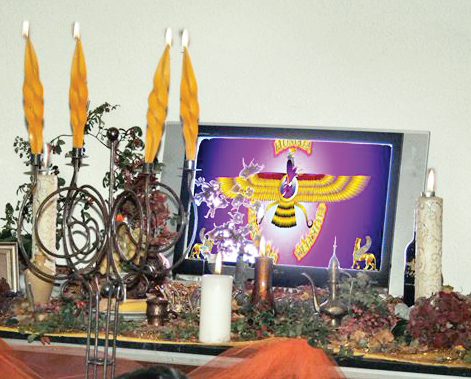
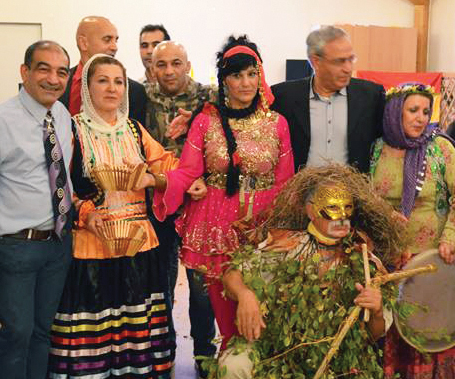
Mehregan celebration in Denmark with traditional table
For the warrior class and the rulers in ancient Iran, Mehregan became the second most important festival after Navroz, the New Year, celebrated as the spring or vernal equinox. Among the multitude of gods and goddesses who were venerated was Ahura Vouruna, King of the Universe whose law of socioreligious behavior had to be obeyed. He had a younger associate, almost a twin, named Mithra, derived from the root mith, meaning "to meet, to unite, to form a social union.”
Mithra was identified by his many attributes: When he supervised the bond that held various tribes together he was known as the god of "contract and covenant.” And since a contract breaker (mithra-druj) was punished by society in the name of Mithra, he evolved into a judge also. When a tribe broke a contract, it was a punitive war that could correct the tribe. This made Mithra a warlord. Since pastoral life begins at dawn, Mithra even became associated with light and consequently with the sun. "Love, light, lordship, judgment and war combined to raise him as the most popular god, a god much revered and much feared,” summed up Jafarey.
Among the six seasonal festivals celebrated by the early Iranians each year was the Ayathrema Gahanbar in autumn (the 24th day or roz Din, mah Meher) to denote the end of trade caravans and a time to mate the cattle before the onset of winter.
◆ ◆ ◆
From the archive