
Politics and Policy
Students’ satyagrah
An unseemly tussle between Bombay Parsi Punchayet trustees and hostel inmates resulted in a revolt along Gandhian lines years ago
Edited excerpts from The Experiments with Gandhi: Reminiscences by Rusi Pardiwala
At the students hostel at Gamadia Colony, there awaited a new chapter which, alas, is now forgotten. The hostel was under the trusteeship of the Bombay Parsi Punchayet (BPP) which was decorated with knights and baronets on its board: Nadirshah Mulla, Sir Cowasjee Jehangir, Lady Hirabai Jehangir, Sir Jamsetjee Jejeebhoy, Sir Shapoorji Billimoria and Dr Saher. The rich and powerful, colored with British imperialism had established the typical rule of aristocrats. In the hostel on the other hand there were youths, mostly from middle class families, tinted with Gandhian ideals, restless with the dreams of independence and self-governance.
 Around Independence there were about 45 boys at the hostel. They found several irregularities and arbitrariness in the management for which they considered the supervisor and the secretary responsible. The trustees were grossly ignorant about hostel affairs. The students tried to bring the matter to the notice of the trustees who, instead of listening to the students, tried to suppress them. Mahatma Gandhi’s lesson instantly surfaced. The trustees failed to move in time to pacify the students and prevent an agitation. They worsened the situation by victimizing the leaders. The officers advised the trustees to dismiss the leaders while the students demanded the dismissal of the supervisor. The tussle grew and took an ugly turn.
To continue this agitation, about 20 students did not go to their home town during the summer vacation. The trustees, misguided, termed this act of the students an offence of criminal trespass. The trustees had expected the students would go home during the vacation and had planned not to allow re-entry to them on the reopening of the colleges. They even maintained special security of professional pathans for the purpose. As they failed in their design, they rushed to the court levelling charges of criminal trespass, housebreaking and what not. The trustees spent huge amounts from the trust funds on these cases. The famous practitioner of criminal law Edulji Ghaswala, barrister, instructed by M/s Craigie, Blunt and Caroe, solicitors appeared for Jejeebhoy and other trustees. Advocate Bejon Dalal defended the students by rendering free services. The trustees’ action invited the ire of the community but they continued to treat the students imprudently.
The cases were first filed in the presidency magistrate’s court at Girgaum, Bombay. During one of the hearings, Billimoria, president of the board of trustees, also attended the court. The learned magistrate ordered a special seat to be arranged next to him on the dais and offered the same to him. The students objected and applied for transfer of the case to another court. The chief presidency magistrate Oscar Brown, accepting the plea of the students, retained the cases on his own board for hearing.
Here the court persuaded the parties to make peace in the interest of the community and the trust funds. The trustees came out with a fresh plea that they did not want the students to leave the hostel permanently but as the hostel building required urgent repair and painting they would like the students to leave only temporarily and assured that they would take all the students back in the hostel after the work was completed. They also assured that the work would be expedited and completed within a month. This fresh plea was made on the assumption that once the students left the hostel they would be dispersed, their unity would break and the trustees would have a free hand to deal with the vacancies. The students had grave apprehensions but after getting the trustees to give their word of honor to the court, they too gave a word of honor that they would vacate the hostel temporarily as expected by the trustees. The court left it to the parties to fix up the schedule. The end of July 1948 was fixed for temporarily vacating the hostel by the students. However the mutual distrust continued. The students had to do some hard thinking. Some leaders of the community (Sir Rustom Masani, Ardesir Wadia and Homi Taleyarkhan) assured the students that they would not allow the trustees to go back on their word.
Around Independence there were about 45 boys at the hostel. They found several irregularities and arbitrariness in the management for which they considered the supervisor and the secretary responsible. The trustees were grossly ignorant about hostel affairs. The students tried to bring the matter to the notice of the trustees who, instead of listening to the students, tried to suppress them. Mahatma Gandhi’s lesson instantly surfaced. The trustees failed to move in time to pacify the students and prevent an agitation. They worsened the situation by victimizing the leaders. The officers advised the trustees to dismiss the leaders while the students demanded the dismissal of the supervisor. The tussle grew and took an ugly turn. To continue this agitation, about 20 students did not go to their home town during the summer vacation. The trustees, misguided, termed this act of the students an offence of criminal trespass. The trustees had expected the students would go home during the vacation and had planned not to allow re-entry to them on the reopening of the colleges. They even maintained special security of professional pathans for the purpose. As they failed in their design, they rushed to the court levelling charges of criminal trespass, housebreaking and what not. The trustees spent huge amounts from the trust funds on these cases. The famous practitioner of criminal law Edulji Ghaswala, barrister, instructed by M/s Craigie, Blunt and Caroe, solicitors appeared for Jejeebhoy and other trustees. Advocate Bejon Dalal defended the students by rendering free services. The trustees’ action invited the ire of the community but they continued to treat the students imprudently.
The cases were first filed in the presidency magistrate’s court at Girgaum, Bombay. During one of the hearings, Billimoria, president of the board of trustees, also attended the court. The learned magistrate ordered a special seat to be arranged next to him on the dais and offered the same to him. The students objected and applied for transfer of the case to another court. The chief presidency magistrate Oscar Brown, accepting the plea of the students, retained the cases on his own board for hearing.
Here the court persuaded the parties to make peace in the interest of the community and the trust funds. The trustees came out with a fresh plea that they did not want the students to leave the hostel permanently but as the hostel building required urgent repair and painting they would like the students to leave only temporarily and assured that they would take all the students back in the hostel after the work was completed. They also assured that the work would be expedited and completed within a month. This fresh plea was made on the assumption that once the students left the hostel they would be dispersed, their unity would break and the trustees would have a free hand to deal with the vacancies. The students had grave apprehensions but after getting the trustees to give their word of honor to the court, they too gave a word of honor that they would vacate the hostel temporarily as expected by the trustees. The court left it to the parties to fix up the schedule. The end of July 1948 was fixed for temporarily vacating the hostel by the students. However the mutual distrust continued. The students had to do some hard thinking. Some leaders of the community (Sir Rustom Masani, Ardesir Wadia and Homi Taleyarkhan) assured the students that they would not allow the trustees to go back on their word.
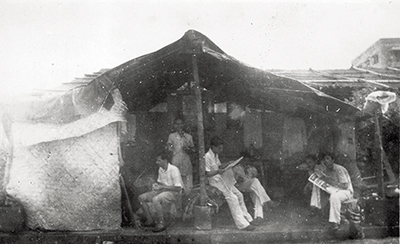
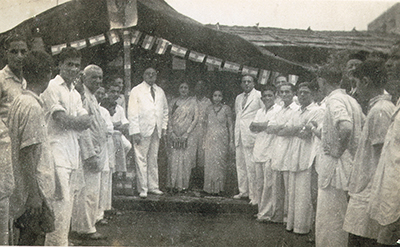
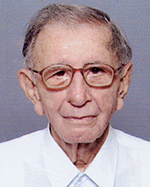
Rusi Pardiwala (top); Parsi students camping in a tent opposite the students hostel (above)
and celebrating Independence Day in August 1948
The trustees did not offer temporary alternative accommodation to the students. Now the students had different ideas. They planned a peaceful Gandhian type satyagrah. In the battle of wits the trustees were at the receiving end.
At the end of July 1948, early one morning the students peacefully and voluntarily vacated the hostel premises en masse, came out on the street with their belongings and pitched a tent on the footpath opposite the hostel building. They hung up in the tent a life size pencil portrait of Gandhi prepared by Earuch Lavangia, a student of Sir J. J. School of Art. This site was a mile from Mani Bhavan and Gowalia Tank Maidan. The news spread like wild fire. A crowd of journalists, VIPs and sympathisers gathered around. The rich of the community came in their cars and offered to leave the cars at the site for the students to use and occupy during the rains. But the students politely declined. Bomansha Bhatporia, president of the All India Postmen’s Union, kept his large house in Shirin Mansion next door open for 24 hours a day for the students to attend to their chores. Burjorji Bharucha brought two dozen bedding rolls. Johnclass, the inspector in-charge of Gamdevi Police Station, who had earlier marched the students to the police station for interrogation on the trustees’ complaint, now posted policemen at the site to watch over their belongings whilst they were at college.
Jam-e-Jamshed displayed a cartoon on its front page showing the trustees digging a mound at the camp and one of them holding a mouse in hand, with a well-known Gujarati saying, "Dug the mound to find the mouse.”
The students’ satyagrah became the talk of the town. The trustees in retribution blocked their scholarships. The students, with the help of Dr Jehangir Wadia, organized a drama at St Xavier’s College Hall. The community over-crowding the Hall made handsome contributions. It was decided to distribute the collection among the victimized students. An independent committee was appointed to ensure equitable distribution.
The committee met in Burjorji Bawa’s Kalaghoda hole (Elphinstone Mansion). Editor Jal Hirjibehdin took the chair, and for want of one sat on a stool. Bejon Desai, Savax Senor and Bawa perched atop a trunk full of kitchenware. I, as the convener, stood with bits of paper in hand for a minute-book to spare. The five-star committee meeting held in pure Gandhian fashion completed its business unanimously and was terminated without a vote of thanks to the chair.
In the meanwhile the trustees had quietly replaced the supervisor and, without any notice to the boys, unilaterally withdrew all the cases against them. On being asked by the court to call the students for re-entry, the trustees agreed to do so and in fact they did. In the meeting they set a condition that the students must tender an apology. The students were in full strength at the meeting. They reminded the trustees of their word of honor. The trustees argued that an apology was necessary because the students’ satyagrah had lowered their prestige in the eyes of the general public. The students pointed out that the trustees themselves were to be blamed for loss of their prestige since they had not offered temporary alternative accommodation to the students. The arguments turned into a commotion and the meeting broke down at the brink of brawl and bruises.
At the instance of some leaders of the community another meeting was proposed for negotiations. The trustees made a condition that they will not meet the full strength but only one representative of the students. The students made their choice and I was asked to represent them and was fully briefed for the purpose. At the round table, there sat the senior trustees, sedate. They repeated their demand for an apology on the ground of their damaged prestige. Speaking for the students, and sticking to my brief, I refused to oblige.
Now the spirit in the ramshackle camp of the trustees was damp. They promptly declared a self-rule in the hostel management.
Then came March and April 1949. The students still camping on the footpath appeared for their examinations studying under the kerosene lamp and in the public library room nearby. Gratified at achieving the object of reforming the administration, they wound up the camp. They rolled up the portrait of Gandhiji and waited for inspector Johnclass to receive it as a present from them. But he had left. The great trial of the students’ fortitude was over. Now all concerned had time to reflect. And they all did.
The lesson for the elders of the institution is: "Refuse to reform and be prepared to face a revolution.”
And for the youths: "Lift yourself with ideals aloft. When you act, pedal it soft.”
This experiment with Gandhi proved that truth always prevails. For the sake of truth one has to undergo hardships with fortitude. Violence is not the answer to injustice and untruth.
The brave students at that time at the hostel were Lavangia, Savax Hilloowala, Phiroz Vaghaiwala, Phiroz Pooniwala, Phiroz Baria, Rusi Dandiwala, Homi Marolia, Tehmton Marolia, Philie Kalwachwala, Homi Gandevia, Manek Chhindiawala, Minoo Gyara, Manek Doctor, Jal Govekar, Phiroz Pithawala, Keki Gowadia, Sheri Tarapore and I. In later life all of them made their mark in their chosen fields. Comrade in arms Vaghaiwala adorned the board of trustees of Bilimora Parsi Anjuman for a record period of over five decades and continues to serve the people of Bilimora.
Among the numerous sympathizers a few to be mentioned are Inspector Johnclass, who subsequently became assistant commissioner of police and a marshall in the House of Commons of the British Parliament. Taleyarkhan became a leading Congressman, Member of the Legislative Assembly, minister, ambassador and governor. Hirjibehdin, became editor of Kaiser-e-Hind weekly. Desai, the well-known Gujarati poet, became the principal of Boys’ Town School in Nasik while Senor was the proprietor of Banaji Homeopathy Pharmacy. And of course Bawa was once very close to Gandhiji.
"Irony of fate” wrote the Kaiser-e-Hind press on my appointment as the assistant house master of the hostels at Sardar Dastur School for boys, Poona. Just as I joined the Law College at Poona in July 1949, the trustees of the School appointed me on the joint recommendation of principal Jamshedji Chizgar and the house master (general) Nani Watchmaker. I was only 21 and was put in charge of over 100 boys, some towering inches above me. They loved me, I loved them and maintained the discipline on the doctrine of "no reward, no punishment.” I taught them that self-discipline was the best discipline.
◆ ◆ ◆
From the archive