
What drives Narendra Modi?
Hindu reformist Swami Vivekananda’s ideals and Chinese traveller Hsuan Tsang have helped to shape the new Prime Minister’s worldview
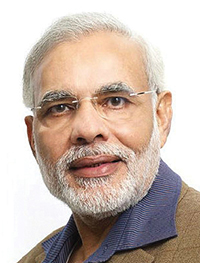
During his lavish praise for the Parsi community and its many contributions to India, Modi could not resist an oblique dig at the original home of Parsis with an offhand comment: "When will Iran be freed of its bondage?” — implying that that country’s loss was India’s gain. Many consider Modi’s background with the Rashtriya Swayamsevak Sangh (RSS) to indicate that he believes in the primacy of Hindus and Hindu culture and the suppression of minorities. Many still look back in horror at the Godhra riots in 2002, when more than a thousand persons — a majority of whom were Muslims — died in intercommunity violence. However, a closer examination of Modi’s philosophical and cultural motivators would suggest a more inclusive worldview.
On entering Modi’s home or office, visitors are struck by bare, unadorned walls — except for pictures of Swami Vivekananda and some gurus — and Spartan living quarters. Modi’s office and desk are also reported as being sparse and uncluttered, a sign, some say, of mental discipline and executive dispatch. Two salient influences seem to have shaped the worldview and career of the Prime Minister of India: the teachings of the 19th century reformer Vivekananda, and being the product of a Gujarati caste with millennia of commercial experience and historic links to the Silk Road and international trade, exemplified by the travels of seventh century Chinese Buddhist monk and scholar Hsuan Tsang.
Born in 1863 as Narendranath Datta to a learned Bengali family, Datta changed his name at age 30 to "Vivekananda,” which means "happiness based on enlightened wisdom.” Datta had early inclinations toward spirituality, as well as toward Indian nationalism. As a young man he linked with the Brahmo Samaj, a Hindu reformist movement that decried idolatry and saw common spiritual bonds that could unify an India that was fragmented across the diverse spectrum of Hindu gods and the patchwork of Indian states ruled by the British.
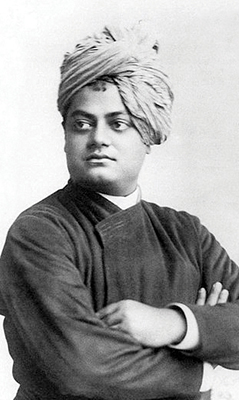
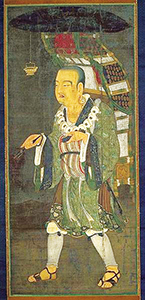
Influenced by Swami Vivekananda (left) and Hsuan Tsang
Vivekananda’s preaching has two main messages. First, that the multitude of Hindu deities, each of which may be favored by a certain subcaste, are merely the varied manifestation of one ultimate God. Dogmas, rituals and idols of various shapes are all but secondary details. Second, Vivekananda taught the achievement of success through mental discipline, purity and abstinence. He said that the way to achieve these goals was to "Take up one idea. Make that one idea your life — think of it, dream of it, live on that idea. Let the brain, muscles, nerves, every part of your body, be full of that idea, and just leave every other idea alone. This is the way to success; that is the way great spiritual giants are produced.”
Many observers have commented on the fact that Modi, once he approves of an idea (or an investment proposal), will pursue it with singular focus and dispatch — and will expect execution of the proposal with the same zeal and speed from his subordinates, as well as from the bureaucracy as a whole.
An irony is that the leaders and members of Modi’s party, the Bharatiya Janata Party (BJP), could be uneasy with Vivekananda’s ideals. While espousing unity across the broad spectrum of Hinduism, Vivekananda would have been horrified at the militant Hinduism practiced by many BJP members and its allies, such as the Shiv Sena. Vivekananda’s vision was not just one of Hindu ideals, but also of Indian identity. It included an India unified not just within the Hindu community, but one that also embraced other religions, including Islam. It remains to be seen how Modi — now that he has achieved the post of Prime Minister through the single-minded mental discipline espoused by Vivekananda — will be able to reconcile and restrain the sectarian and sometimes violent anti-Muslim tendencies of BJP members with the universalist ideals of his guru, who said: "As the different streams having their sources in different places all mingle their water in the sea, so, O Lord, the different paths which men take, through different tendencies, various though they appear, crooked or straight, all lead to Thee!”
Silk Road and Hsuan Tsang
The second and more inborn influence on Modi’s worldview comes from the fact that he was born a ghanchi, a mid-level trading caste of oil pressers and grain sellers in Gujarat. Humble though his family may have been (Modi assisted his father in running a roadside tea stall), the Gujarati trading castes have had a long history of international links with Rome, Persia and China. At one time during the Mauryan Empire, a Persian/Parsi was appointed governor of Saurashtra (part of today’s Gujarat). Mentioned by Pliny the Elder, Gujarati ports such as Barygaza (modern Bharuch) and Cambay (modern Khambhat) were major entrepôts on the Silk Road, as well as centers of Buddhism. Chinese silks, Indian muslin (cotton), spices, and pearls harvested locally and from the Persian Gulf, would be exchanged in Gujarat, which was a logical node at the northeasterly endpoint of the monsoon winds blowing from the Horn of Africa. All over India, Gujarati traders (often labeled banias) are still envied for their commercial acumen and entrepreneurship. The fact that the Parsi community, Zoroastrian refugees who escaped religious persecution in Persia in the ninth century, fled to Sanjan in Gujarat by traversing a long-established trade route, reinforces the view of the state as a welcoming node along a long shipping corridor connecting the Mediterranean, Southeast Asia, and China.
When Modi filed his election papers on April 24, 2014, in his brief speech he invoked Tsang, who had visited Modi’s birthplace of Vadnagar twice during his visit to India, spanning from 627 to 643 CE. Tsang’s visit to India was motivated by a quest for relics and original Buddhist scriptures in the country of that religion’s origin. He followed what were, by then, well-trodden international land routes through Central Asia over the Himalayas into India. Tsang, carrying a large backpack, started out from the imperial capital Chang An (modern Xian). Braving bandits, snows and the Gobi Desert, he made his way through Bamiyan (in what today is Afghanistan) to reach India, where he spent several years going as far south as Kanjipuram in today’s Tamil Nadu. Modi’s birthplace was an important enough Buddhist monastic center for him to have visited it twice during his 14-year sojourn in India.
By then, Buddhism was already in decline in India, although expanding strongly in China and East Asia. Modi’s invoking Tsang’s name was an acknowledgment not only of India’s international trade links, it was also a reference to Vivekananda’s view of the central role of Buddhism in his universalist movement’s thought. This was exemplified by Vivekananda’s lecture entitled "Buddhism, the Fulfillment of Hinduism” delivered in Chicago on December 26, 1893.
Modi’s political base is known for its muscular version of Hinduism. While many BJP leaders have tribal and xenophobic tendencies, and actively denigrate Muslims, Modi’s own philosophical underpinnings and cultural roots may be far more inclusive. In his remarks at Udvada in 2011, Modi made a revealing statement that suggests a sense of introspection about his past, a healthy dose of humility and ecumenical inclusiveness: "I want the gifts of humata, hukhta, huvarashta — to think good thoughts, speak good words, do good deeds with mind, heart and spirit — so that I may not make mistakes, nor do harm to anyone.”
In conclusion
Modi’s philosophy appears to espouse probity, discipline, forthright action, concern for all — including the poor, and an international pro-business outlook. If Modi can keep himself at arm’s length from the baser motivations of his supporters and party colleagues, and energize investment from companies both domestic and foreign, India could see a resurgence of high economic growth that can serve to fulfil the aspirations of the 28 million who reach the age of 18 and join India’s workforce each year.
Dr Farok J. Contractor is Distinguished Professor at the Rutgers University Business School in New Jersey, USA. He holds a PhD and MBA from the Wharton School, an MS in Industrial Engineering from the University of Michigan and a BSE in Mechanical Engineering from Victoria Jubilee Technical Institute (University of Bombay). He specializes in International Business and Economics, and has published extensively on these subjects.