
Books
Poet’s prolific prose
Most people know of Adil Jussawalla as an outstanding poet. He has firmly entrenched himself on the landscape of Indian poetry since the publication of Land’s End (1962) and Missing Person (1976). After a silence of more than 35 years, he has recently published two collections of poems: Trying to Say Goodbye (2011) and The Right Kind of Dog (2013). Few, however, are aware of the outstanding quality of his prose which has been published in several journals and newspapers over the years. Jerry Pinto has recently edited a collection of his prose writings Maps for a Mortal Moon and there was an event to celebrate the publishing of this outstanding work at Kitab Khana on March 25, 2014 where Pinto was in discussion with Jussawalla.
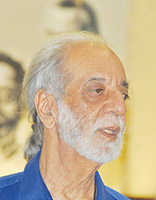
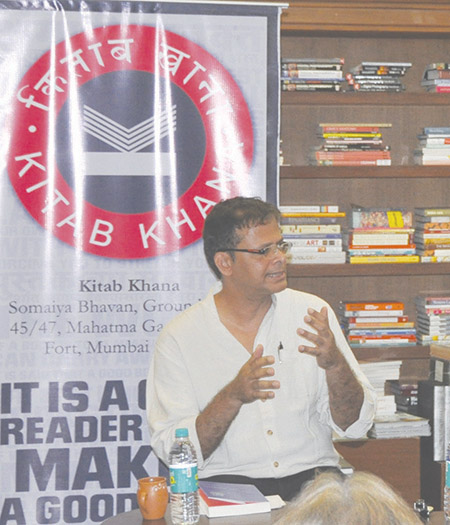
Author Adil Jussawalla with Jerry Pinto at the book launch
Pinto mentioned that it was a great sense of pride for him to edit Jussawalla’s prose works. Never has he performed a more enjoyable and relatively easy task as Jussawalla has an extremely efficient document archival and retrieval system. Everything is very carefully and systematically copied and filed. Not only does this extend to his own work but to all other items of interest, which he has cut out from newspapers and journals and preserved over the years. "I need to access this memory bank to enable me to establish when I am questioned that something I have read or seen has in fact really taken place.”
Jussawalla confessed that as a schoolboy he did not have much to say in his essays but was best at descriptions. This is not quite true as one observes from this collection of his prose writings. One of the earliest pieces in this collection is an extract from his diary; he was 17 and on his way to England when he witnessed a sandstorm at Aden. Pinto and Jussawalla read several extracts from the collections. Some like "A Glass Too Many” in which Jussawalla describes a visit he makes to the offices of Mid-Day to meet columnist and former editor Anil Dharkar are uproariously funny. Others like "A Balancing Act” and "Black Moon Rising” have serious undertones though written in a seemingly lighthearted manner. Some, like the visit to Nissim Ezekiel are extremely poignant. Others like "The Joy of Sensuous Writing” are very personal. However, what runs through all his writing is his compassion and a keen sense of observation, which is a result of Jussawalla’s continual making notes and jotting down of things he has seen and thoughts which occur to him, which occasionally provides the germ for a poem or an essay. He has always kept a diary and has wisely never restricted himself to a single page, which has provided him with a storehouse of inexhaustible treasure he drew on when he was a columnist for several newspapers. Pinto describes him as a "quiet figure in the corner who witnesses everything and takes notes.” Jussawalla replied that he was not a witness one could rely on in a court of law. "What I witness keeps on changing and morphing. It is a question of seeing things in an abnormal or subnormal manner in which way my mind is structured — not necessarily as a poet.”
In addition to being a prose writer and a poet, Jussawalla also ran a publication house. Along with poets Gieve Patel, Arun Kolatkar and Arvind Krishna Mehrotra, Clearing House published several upcoming and new poets and playwrights at a time when it was difficult to publish poetry. (He still has a file of all the correspondence pertaining to this venture as well.) Even today, he asserts that this situation has not changed much and most publishers do not want to take the risk of supporting poetry. In a Preface he wrote to "3 Poets: Melanie Silgardo, Rahul d’Gama Rose, Santan Rodrigues” which Pinto read, Jussawalla emphasizes this very problem: "We are not and never have been the poor cousins of big publishers. We have been the only means by which poetry has been kept alive while the big publishers slept.”
◆ ◆ ◆
From the archive