
Zoroastrians Abroad
Batting and battling
The death of former Pakistani cricketer Rusi Dinshaw on March 24, 2014 at the Parsi General Hospital in Karachi created ripples within the international Zoroastrian community after a local TV channel showed a photo of him begging at the Karachi Parsi Institute (KPI). The reporter further commented that it is a shame that the cricket board does not look after its national heroes. "After that the story played the usual drama many inaccurate news items do these days,” wrote Sunnu Golwalla, editor of What’s On, the newsletter of the Karachi Zarthosti Banu Mandal, in response to Parsiana’s queries. She further assured that Dinshaw was "properly taken care of with a personal attendant and I saw him myself on many days sitting on the Parsi General Hospital bench, clean, peaceful and comfortable.”
Yet another clarification was sought from Toxy Cowasjee, also from Karachi, who is editor of Hamazor, the quarterly publication of the World Zoroastrian Organisation. She regretted that "unfortunately with the death of Rusi Dinshaw, the news about him has gone viral and he has created more drama in his death than during his life.” She also brought to our notice a posting by his Canada based niece, author Farishta Dinshaw on Facebook.
Yet another clarification was sought from Toxy Cowasjee, also from Karachi, who is editor of Hamazor, the quarterly publication of the World Zoroastrian Organisation. She regretted that "unfortunately with the death of Rusi Dinshaw, the news about him has gone viral and he has created more drama in his death than during his life.” She also brought to our notice a posting by his Canada based niece, author Farishta Dinshaw on Facebook.
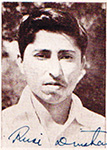
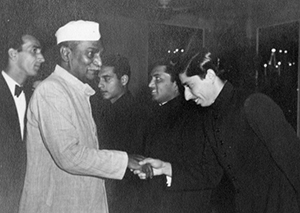
Rusi Dinshaw with the President of India Dr Rajendra Prasad
Farishta mentioned, "I am a teacher bred to the bone so I want to take this opportunity to share about Rusi Kaka’s illness…Rusi Kaka’s begging was never about not being taken care of financially; it was a manifestation of his illness as was his lack of hygiene. In fact, one of the early warning signs of schizophrenia is a lack of personal care.
"As a teenager, I was embarrassed by his begging and by his dishevelled state and furious with kindly meant, if insensitive people who would offer us money to take care of him. However as I grew older and more educated about schizophrenia, I realized that many of us cage ourselves by our fear of mental illnesses — by our ignorance and more so by the social stigma attached to them. Schizophrenia is a chronic brain disorder that significantly alters the person’s contact with reality. With support, medication and therapy many people with schizophrenia are able to function independently and live satisfying lives. Unfortunately when Rusi Kaka became ill in the early 1960s these kinds of help were not available. If his story leads to any one of you reading up more about schizophrenia, it will be his legacy beyond that of a talented cricketer.”
Farishta had earlier penned an extensive article that was carried in Hamazor and FEZANA Journal (the quarterly publication of the Federation of Zoroastrian Associations of North America) and thereafter included on the website of Bai Virbaijee Soparivala School in Karachi as a tribute to its alumnus. She refers to the cricket legends in her family starting with her paternal grandfather Nadirshah Maneckji Dinshaw who was on the Parsi team from 1907-08 to 1927-28 that played against the British team and the Hindu team in the Bombay Triangular. This popular match later came to be known as the Quadrangular with the inclusion of the Muslim team and the Pentangular with the constitution of "The Rest” team. Nadirshah was also the president of the KPI team and represented the Karachi Cricket Association as well.
Of his four sons, Farishta’s father Murzban was "the most stylish batsman” who with Boman Irani held the Karachi Inter-School record for the highest partnership. Rusi though was a steady left-hand batsman and also did slow left-arm bowling. In 1946 he led Karachi University to victory against the Bombay University. His flair for the game was soon recognized and he was sent by the Pakistan Cricket Control Board for training to Alf Gover’s cricket school in Wandsworth, England. He was included on the first Pakistani Test squad that toured India in 1952-53, the only Zarathushti to be on the team.
Wrote Farishta, "Everyone who knew Rusi in his heydays remembers him to be easygoing and jovial with a love for what his friend Soli Mavalvala calls ‘nalli khochrai (little mischief)’… In the early ’60s…Rusi began to show signs of depression and was diagnosed with schizophrenia. The electric shock treatment prevalent in those days broke his spirit and he never recovered…
"Of all the things I have ever written, this article has touched my heart the most because it gave me a chance to discover my Rusi Kaka. To me he is once more a dashing, high-spirited young man who was the object of many young women’s affection and young men’s inspiration.”
◆ ◆ ◆
From the archive