
Attitudes
Representational research - II
A cross section of the Bombay Parsi community believes the term of the Bombay Parsi Punchayet trustees should be shorter
In "Representational research – I” (Parsiana, March 7, 2014), we had presented the Bombay Parsi community’s views on social issues as gleaned through a poll commissioned by the magazine as part of its golden jubilee initiative. In this issue we are carrying the respondents’ views on the functioning of the Bombay Parsi Punchayet (BPP).
Nearly 90% of the respondents declared that Universal Adult Franchise is a better system of electing trustees of the Bombay Parsi Punchayet. Only 63% of the Donor Register agreed with the adult franchise. All the youngsters, 100% in the 18-25 age group support adult suffrage as compared to 88% of those aged between 41-55 and 89% amongst those in the 55+ age bracket. There was no noticeable difference between males and females on this issue. Amongst the socioeconomic classifications, the middle group had 95% showing a preference for voting rights for all as compared to 86% from the higher group and 92% from the lower category.
Nearly 90% of the respondents declared that Universal Adult Franchise is a better system of electing trustees of the Bombay Parsi Punchayet. Only 63% of the Donor Register agreed with the adult franchise. All the youngsters, 100% in the 18-25 age group support adult suffrage as compared to 88% of those aged between 41-55 and 89% amongst those in the 55+ age bracket. There was no noticeable difference between males and females on this issue. Amongst the socioeconomic classifications, the middle group had 95% showing a preference for voting rights for all as compared to 86% from the higher group and 92% from the lower category.
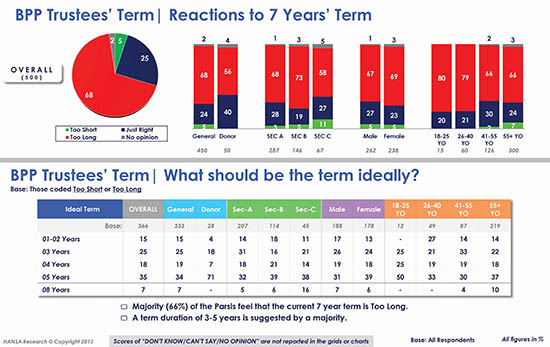
Over two-thirds, 68%, believe that a seven-year term for a trustee is too long whilst 25% are of the opinion that it is just right. Five percent feel it is too short and another two percent chose not to express their opinion. Five-years’ trusteeship tenure is ideal felt 35% of the respondents, with 25% preferring three years, 18% opting for four years 15% for one or two years and seven percent for eight years.
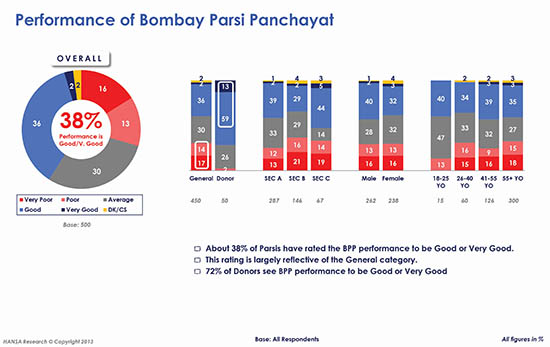
The performance of the BPP was rated as "good” by 36% of the respondents and "average” by 30%. Only two percent described it as "very good” as compared to 16% who said it was "very poor” and 13% who felt it was "poor.” The Donor Register gave a particularly good report card to the Punchayet with 59% rating them as "good,” 26% as "average” and 13% as "very good.” Whilst 40% of males assessed them as "good,” only 32% of females did so. Amongst the different socioeconomic groups, 44% from the lower category said the BPP performance was "good” as against 29% from the middle section and 39% from the higher section. Across all categories, the maximum number from the middle section, 21%, gave them a "very poor” rating as did 19% from the lower section. None of the respondents from the 18-25 age group considered the performance as either "very good” or "very poor,” with the maximum, 47% rating them as "average,” and another 40% as "good.” In all the other age groups, the maximum number rated the performance as "good,” with "average” getting the second highest rating.
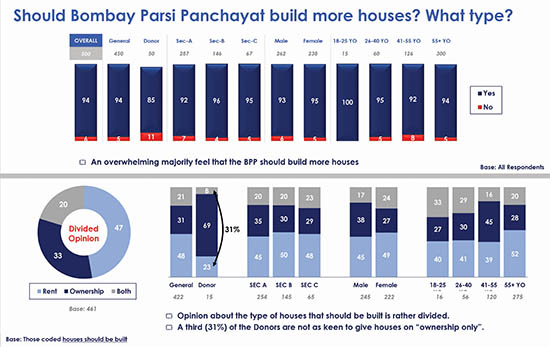
It was not only all the respondents in the 18-25 age bracket who felt the BPP should build more houses but over 90% in all the categories, barring the Donor Register members where 85% indicated that the Punchayet should construct more tenements. Whilst 33% feel the Punchayet should offer ownership apartments, 47% advised more rental accommodation, and 20% would have liked a mix of both. Amongst the Donor Register members though, 69% advocated a need for ownership houses as against 23% who asked for rental flats, and eight percent for both.
To be continued
◆ ◆ ◆
From the archive