
Business
Credit and critique
The World Zarathushti Chamber of Commerce annual global meeting and awards night also featured panel discussions on innovation and risk management
"This is the first time we have a lady as our chief guest (at a world awards function),” stated World Zarathushti Chamber of Commerce (WZCC) global president Minoo Shroff introducing chief guest Meera Sanyal, chief executive officer and chairperson, Royal Bank of Scotland (RBS), India, who was just a week away from stepping down from her post after a 30-year banking career. At the Ballroom of the Taj Lands End at Bandra in Bombay on December 26, 2013, Sanyal presented the WZCC Outstanding Zarathushti Professional award to Dr Beheruz N. Sethna of the US and the Outstanding Zarathushti Young Entrepreneur/Professional award to Kobad Bhavnagri of Australia.
Sanyal has shown "a rare commitment for public service. Her charm makes her stand out among her peers. Despite her impressive professional achievements, she has plunged into public life,” Shroff said. But she’s no armchair politician, he added, noting she has extensively toured rural areas as part of her philanthropic work with the RBS Foundation, India, studying the spirit of enterprise among women in remote villages.
Sanyal has shown "a rare commitment for public service. Her charm makes her stand out among her peers. Despite her impressive professional achievements, she has plunged into public life,” Shroff said. But she’s no armchair politician, he added, noting she has extensively toured rural areas as part of her philanthropic work with the RBS Foundation, India, studying the spirit of enterprise among women in remote villages.
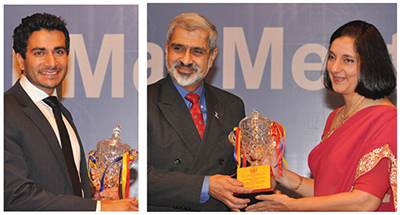
Honoring enterprise: Kobad Bhavnagri (left) and Dr Beheruz Sethna (center) receiving
Outstanding Zarathushti award from Meera Sanyal
Parsis epitomize more than many others values, intellect and integrity, opined Sanyal. Intellectuals in public life are the need of the hour but why should anyone enter politics? she queried. Looking to contest the forthcoming Lok Sabha elections as a candidate of the Aam Aadmi Party, Sanyal said her decision to enter politics was "catalyzed by the terrorist attacks of 26/11 (2008). The person who had hired me in ABN AMRO was killed in the attack. I want to roll up my sleeves and do something.”
As WZCC stands for and supports enterprise in business or profession, Sanyal proved to be an apt choice as an inspirational narrator. In the last few years she has visited 120 villages in 15 states, staying briefly in the homes of women in forest and tribal areas. The predominantly affluent, urban and urbane audience of Zarathushti businessmen and professionals, their families and guests watched in awestruck silence as Sanyal showed a pictorial presentation of her personal interaction with solo-preneurs (one woman businesses) in rural India and narrated their success stories. "The small and marginal farmers are all women because their men have migrated in search of work. There is this lady near Nalanda in Bihar who successfully grows white mushrooms and exports several tons to Bhutan, Tibet, Japan and other places. She has been a catalyst in her village and spawned a mushroom revolution,” she related. In the buffer zone of the Bandhavgarh forest in Madhya Pradesh, for example, women still spend hours in dark huts cooking on chulas, leaving home at 4.30 a.m. to collect dung and firewood. "What should take 20 minutes to cook takes one-and-a-half hours on the chula and is a leading cause of TB, lung cancer, etc. We have the largest amount of cow dung in the world. An enterprising woman set up a small biogas plant, generating enough 24x7 gas for her family of seven. Dung can be turned into vermi compost, a good organic fertilizer. By cultivating large earthworms the solo-preneur could buy a tractor for the field. There are no finer examples of entrepreneurship than the women of India,” stated Sanyal who has mentored a micro finance program for over 650,000 women entrepreneurs in rural India. She has also helped provide direct seed funding and skill based training for 75,000 solo-preneurs.
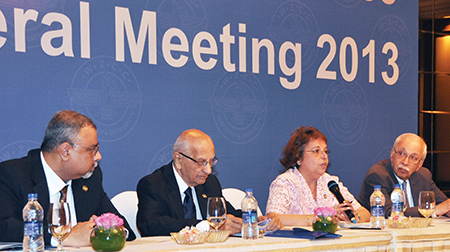
At the WZCC AGM (from left) Bomi Patel, Minoo Shroff, Behroze Daruwalla and Temo Arjani
There were only two winners of the Outstanding Zarathushti awards in 2013, in contrast to earlier years. Sethna is the first known person of Indian origin to become president of a US university and the first from any ethnic minority to be made president of a college or university in Georgia other than a historically black college. From 1994 to June 2013, Sethna was the president of the institution now known as The University of West Georgia. When he retired, he was the longest serving university president (public or private) in the state. Bhavnagri is head of Australia at Bloomberg New Energy Finance and is based in Sydney. A clean energy analyst and multi talented professional, Bhavnagri’s specialties include energy economics, environmental issues, carbon trading, electricity market analysis, policy development, etc.
"My parents migrated to Australia two years before I was born. Their sacrifices and values have driven me. Right from the time I was a child I have been going to community functions and most of my close friends are Zarathushtis,” Bhavnagri stated after he was presented his award. As far as climate change (his area of expertise) is concerned, the biggest part of the puzzle is energy, he believed, impacting the issues of global poverty, equity and development. "Sanyal’s work inspires us young people. You have to have passion for the cause.”
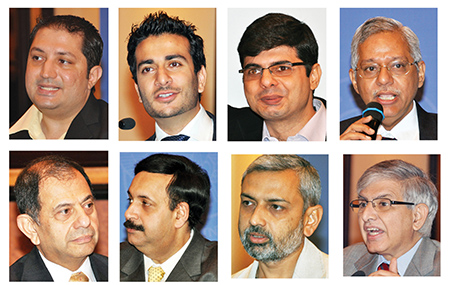
From left (top row): Burzin Engineer, Kobad Bhavnagri, Maher Dhamodiwala, Yazdi Tantra;
(2nd row): Edul Daver, Dr Rohinton Karanjia, Kanchan Kumar and Sam Balsara
"All blessings flow from Ahura Mazda. I grew up here in Bombay, in a family of modest means. I was given huge opportunities through the enormous sacrifices of my parents who are now deceased,” Sethna told the audience after receiving his award. An alumnus of the Indian Institute of Technology, Bombay and the Indian Institute of Management, Ahmedabad, Sethna did his Ph.D at Columbia University and has lived in the US for 40 years. During his tenure as president, the institution he headed saw a transformative change from a college to a state university to a Ph.D granting SACS (Southern Association of Colleges and Schools) Level VI university. He increased endowments by more than 10 times their 1994 level and almost 40 new buildings were added, which is more square footage than every other president combined since the institution started in 1906, as per his bio data. "Life has not been easy. There has been enormous personal cost. In my 19 years as president, I could have counted the number of times my wife Madhuri and I have had dinner at home together. In the few months since my retirement we have dined together many more times!” From his own resources Sethna has set up a trust fund in India from which he donates towards the education of children. He has personally sponsored eight girls and boys at an orphanage school in Lonavla and has raised thousands of dollars in the US towards the purchase of computers and solar safety lights for the school. "I’m going to devote part of my summers to teaching the children science, computers and spoken English,” he stated. Sethna perhaps well personifies the professional and the entrepreneurial spirit of the WZCC.
Trends and truths
The AGM began with a moment’s silence in memory of former WZCC president Bomi Boyce who passed away in Canada. In his opening remarks, Shroff stated: "Jobs everywhere are drying up. Today is the time to get into business. There is a lot of discretionary income. There is enormous latent demand, visibility and availability. There are 53 cities in India with a population of one million and that may be doubled by 2030. People spend Rs 10,000-15,000 on clothes. Youngsters want to make a statement (of aspiration) and are not interested only in the price.” Zoroastrians, however, are still terribly cautious about investment, he noted with disappointment. "In the last 13 years the WZCC has done a good job but more needs to be done,” he observed.
The AGM began with a moment’s silence in memory of former WZCC president Bomi Boyce who passed away in Canada. In his opening remarks, Shroff stated: "Jobs everywhere are drying up. Today is the time to get into business. There is a lot of discretionary income. There is enormous latent demand, visibility and availability. There are 53 cities in India with a population of one million and that may be doubled by 2030. People spend Rs 10,000-15,000 on clothes. Youngsters want to make a statement (of aspiration) and are not interested only in the price.” Zoroastrians, however, are still terribly cautious about investment, he noted with disappointment. "In the last 13 years the WZCC has done a good job but more needs to be done,” he observed.
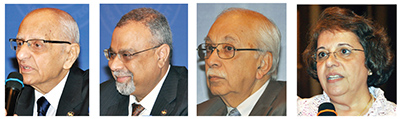
WZCC office bearers Shroff, Patel, Arjani and Daruwalla
The Annual Report 2013 presented at the AGM was prepared by global corporate secretary Behroze Daruwalla. The minutes of the global AGM held on January 4, 2013 in Singapore were approved. Temo Arjani of the US presented the treasurer’s report, noting that there was no major development in accounts. "Maybe we should have two sets of accounts, on calendar year and on March 31 basis,” he put forth, as different regions have different year endings. Board meetings were regularly held through Skype. A four-member sub-committee consisting of Rohinton Rivetna, Rustom Engineer, Farrokh Rustomji and Daruwalla had been entrusted with "the heavy task” of amending the bye-laws in keeping with the needs of evolution and growth. "This committee did a marvelous job of drafting the amendments to the bye-laws of the WZCC in record time and after approval of the international board of directors these amendments are now being placed before the general membership for ratification at this AGM,” Daruwalla noted.
"There were many changes we studied in great detail. We have emphasized that WZCC is for the professional as well as the businessman,” Rustomji told Parsiana later in response to our query. "Through the amendments to the bye-laws two new positions have been added on the board – director of Information Technology and director of communications and publications.” Directors who have served two consecutive terms may be re-nominated after a lapse of one term (three years), Daruwalla noted. Membership numbers, regrettably, had not seen much growth, with chapters diminishing as well. A new South East Asia region, which has good potential for business, has been added. "With chapters opening and closing, one representative of a particular country or region could be a point man in that country. If not a chapter, let there be a representative,” suggested Rustomji.
The international board currently comprises Shroff as president, Daruwalla as corporate secretary, Adil Sarkari (Australia), Jamshid Dindar (Iran), Rumi Sarkari (Middle East) as regional directors and Faribourz Rahnamoon, Rustomji, Minoo Mody and Shahram Jiveh as directors into their second term which is up to 2015. Coming on to the international board in place of outgoing directors are Bomi Patel of the US as vice president, Arjani as treasurer, Neville Shroff as regional director, S. E. Asia and Pheroze Kharas, Nozer Maneksha and Natalie Gandhi as directors. Umeed Kothavala takes on responsibility as director for youth affairs in place of Eric Engineer. Kersi Limathwalla is immediate past president, as per the information in the annual report.
The next AGM will be held in Dubai on December 18, 2014 to coincide with Enterprise Dubai, scheduled to be held from December 19 to 21, 2014. This mega event will bring under one roof some of the most respected names in the world in the fields of technology, business, the arts and sciences, trade and telecommunications, stated Meher Bhesania, chairman, Synergyz, the WZCC journal which has completed nine years of publication. With Dubai also winning the right to host Expo 2020, the region is looking at another development boom, with employment opportunities, infrastructure development and a greater influx of visitors. Zoroastrians should seize this opportunity to further their business/profession more compellingly, she exhorted.
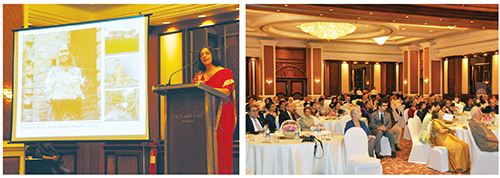
At the Awards night: Sanyal making a pictorial presentation and (right) the elegant Ballroom at Taj Lands End
Dindar noted in his published report: "The year 2013 for WZCC Iran on international field was not a good year due to economic sanctions and isolation… We are optimistic that with the new government and lifting of sanctions we (will) see bright economic prospects for Iran.” The Iran chapter is keen on "close cooperation especially with WZCC India as we see vast potential available in the fields of commerce, investment, joint ventures… which if taken seriously will be a blessing for our young Iranian entrepreneurs. One of the topics discussed and in mind is to avail the services of Zoroastrian Bank for commercial transaction between Iran and India.” Suggestions and comments put forward by Iranians from the floor of the house included the need for a website where a group of experts could guide and advise Iranian youth, be they professionals or those in need of a job, and help overcome the problems of language barriers, shyness, etc. They were requested to get in touch with Yazdi Tantra, technical sub committee chair, to discuss feasibility. The December 2013 issue of Barsam, the advertising magazine of WZCC Iran region was readily available at the venue, containing messages from Babak Khodaparasti, managing director, WZCC Iran, Khodayar Attaie, chairman, as well as pictures and contact details of office bearers, directors and business persons.
Rustom Engineer of Houston, Cyrus Bagwadia (president, India Chamber), Adi Siganporia, Bombay chapter chair, Viraf Deboo, head of the Poona chapter, Dolly Dhamodiwalla, chairperson, Women Entrepreneurs, Attaie and others acquainted members about ongoing activities, with suggestions coming in from the audience as well. The annual report carries details from various regions, with the Bombay and Poona chapters being among the strongest. The Bombay chapter Newletter has now become a global newsletter, available on the WZCC website www.wzcc.net The WZCC Group on Facebook and on LinkedIn receive a large number of hits from members and non-members and SynergyZ continues to be online, reported Tantra.
Choice and circumstance
Speaker after speaker from different continents stressed that success comes not by chance or circumstance but by choice. The youth panel session entitled "Challenges of being an entrepreneur” featured Bhavnagri, Burzin Engineer and Maher Dhamodiwala. Australia born and bred Bhavnagri was nominated by the Sydney chapter for the Outstanding Young Zarathushti award. "I am an odd ball on this panel. I am a cut and dried professional operating in the energy sector. The environmental movement can co-exist with economic development. But the world is not on course to reduce climate change. Countries are acting unilaterally. We have to evaluate costs of climate change versus preventing climate change,” the engineer explained, reeling off figures and percentages as "we (the company where he works) are analysts, producing documents and forecasts” to help make the world a greener and better place with less fossil fuels and more use of renewable technology such as solar energy and wind power. In a few years’ time, solar will be cheaper than coal, gas and nuclear generated power. Traditional energy models will be left behind and micro grids (villages and surrounding houses) will be more commonly in use, he declared. Other sources are organic compounds made from corn and sugarcane waste, algae, tidal and wave energy. "You can make the breakthrough or invest in the guy who makes the breakthrough,” Tantra, who was moderating the session, told the listeners.
"Today with four people you can do business of a million dollars. Confidence in yourself is one half of victory; the other half comes from preparation,” averred entrepreneur Burzin Engineer who gained valuable work experience with Microsoft in the US before returning to India in 2009. His passion is technology, design and real estate. A good product with excellent sales strategy, going local first before going global, visiting firsthand the country you are doing business with, putting process not bureaucracy into your company, making your logo visible on email signature, business card, envelope, disseminating the ideas in your head to your employees – these are some of the ingredients of success, he observed.
"Being a financial consultant and certified financial analyst, I don’t typically face the problems other entrepreneurs face,” declared Dhamodiwala. "See failure as an event. Rejuvenate with loss. Utilize the power of now. Feeling too old to change? Keep waiting and you will become a fossil!” While trying to raise the level of business from one crore rupees to 10 crore "I was a little lost. I could not handle it. I found my mentors in WZCC for business and personal growth. WZCC is nectar which is ready. Be a bee and absorb just as much as required!”
Speaker after speaker from different continents stressed that success comes not by chance or circumstance but by choice. The youth panel session entitled "Challenges of being an entrepreneur” featured Bhavnagri, Burzin Engineer and Maher Dhamodiwala. Australia born and bred Bhavnagri was nominated by the Sydney chapter for the Outstanding Young Zarathushti award. "I am an odd ball on this panel. I am a cut and dried professional operating in the energy sector. The environmental movement can co-exist with economic development. But the world is not on course to reduce climate change. Countries are acting unilaterally. We have to evaluate costs of climate change versus preventing climate change,” the engineer explained, reeling off figures and percentages as "we (the company where he works) are analysts, producing documents and forecasts” to help make the world a greener and better place with less fossil fuels and more use of renewable technology such as solar energy and wind power. In a few years’ time, solar will be cheaper than coal, gas and nuclear generated power. Traditional energy models will be left behind and micro grids (villages and surrounding houses) will be more commonly in use, he declared. Other sources are organic compounds made from corn and sugarcane waste, algae, tidal and wave energy. "You can make the breakthrough or invest in the guy who makes the breakthrough,” Tantra, who was moderating the session, told the listeners.
"Today with four people you can do business of a million dollars. Confidence in yourself is one half of victory; the other half comes from preparation,” averred entrepreneur Burzin Engineer who gained valuable work experience with Microsoft in the US before returning to India in 2009. His passion is technology, design and real estate. A good product with excellent sales strategy, going local first before going global, visiting firsthand the country you are doing business with, putting process not bureaucracy into your company, making your logo visible on email signature, business card, envelope, disseminating the ideas in your head to your employees – these are some of the ingredients of success, he observed.
"Being a financial consultant and certified financial analyst, I don’t typically face the problems other entrepreneurs face,” declared Dhamodiwala. "See failure as an event. Rejuvenate with loss. Utilize the power of now. Feeling too old to change? Keep waiting and you will become a fossil!” While trying to raise the level of business from one crore rupees to 10 crore "I was a little lost. I could not handle it. I found my mentors in WZCC for business and personal growth. WZCC is nectar which is ready. Be a bee and absorb just as much as required!”
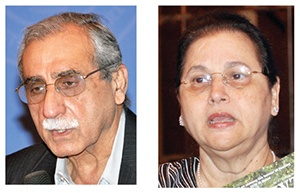
Rohinton Rivetna (left) and Meher Bhesania
Post lunch, Shroff’s lengthy discourse on "Overview of global/Indian economy” brought to the fore his economic erudition and world vision. "Innovation – key to success” saw USA’s Edul Daver narrate his personal story. From employee to owner/manager/employer, Daver described how he bought the company where he worked, giving a personal guarantee to get a substantial bank loan. "We worked through open book management. All financial results were open to all employees. We promised to share a part of the pre-tax profit with all, so each employee had a stake in the company’s success. From a resource-driven corporation it became an opportunity-driven organization. The union became a partner and within two years there was no union. The pursuit of opportunity beyond resources currently controlled – that is entrepreneurship.” And that is how, he added, we have gone about building the new darbe mehr in New York. "The trustees didn’t want to start till funds had been collected. Having broken ground, there is motivation to generate the last million dollars.”
"The other side of innovation is risk. There are types of risks and manager accountability,” said Dr Rohinton Karanjia of North America who was visiting Bombay after 22 years! Following the debacles in the US banking system, the mortgage crisis, the credit crunch and the drying up of liquidity, the Federal Reserve has put in place a system of checks. In the banking sector risk management is not an individual task but a group task, said Karanjia speaking on his area of expertise. Added to the ‘old’ risks – credit risk, market risk, operational risk (failure of internal processes and policies) — there are now new ones as well, being compliance (violation of rules and regulations), liquidity, legal, strategic and reputational risks!
Kanchan Kumar of TiE (The Indus Entrepreneurs, of which the WZCC is an institutional member) noted that typically, innovation comes about when people from an outside domain break conventions, introduce disruptive thinking and challenge traditions to succeed! Innovation comes from people not carrying the baggage of experience and expertise in that field and so they don’t have prejudices against it! Jack Dorsey (co-founder of Twitter and founder and CEO of Square, a mobile payments company), Brian Chesky (who started Airbnb, a hospitality exchange service), Phani S. (founder of redBus, India’s biggest online bus ticketing company), Bhavish Aggarwal (CEO and co-founder of Ola Cabs) are all examples of this kind of innovation, he stated.
An informal round table discussion just before the Awards function brought forth criticism and credit for the WZCC from its members. Functioning as it does from regions geographically distant, it strives hard to bring together faces familiar and unfamiliar, working voluntarily towards common goals, functioning as a mix of chamber of commerce cum organization looking to community welfare.
◆ ◆ ◆
From the archive