
Zoroastrians Abroad
Food for thought
More than the morsels of food, it is the nuggets of information liberally sprinkled across the 100 pages of the e-cookbook Eat, Live, Pray that will be relished by the prospective cook. Offered as "a celebration of Zarathushti culture and cuisine” to mark the silver jubilee of the Federation of Zoroastrian Associations of North America (FEZANA) in 2012 "Eat traces the various social and geopolitical influences on Zarathushti cuisine over a span of 3,000 years; Live describes some of the celebratory occasions in our lives and the accompanying foods that make them special; and Pray contains information about our rituals and holy days,” declares Farishta Dinshaw who has compiled the e-cookbook.
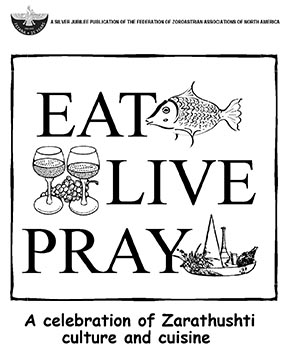 Having derived her inspiration from the food-themed issue of FEZANA Journal (Summer 2011), Dinshaw approached FEZANA Journal editor Dolly Dastoor and chair of the FEZANA publications committee Behram Pastakia with her vision to make an e-cookbook "available on the FEZANA website for people to download for free and print out at home so that people across the globe would have access to it,” conveys Dinshaw.
The cookbook includes an assortment of over 70 Parsi and Persian recipes contributed by community members from Australia, Britain, Canada, India, Iran, Pakistan and the USA. Adding spice to the presentation is the grouping of recipes with 16 listed under the Eat section wherein dishes like Candied Turnips feature under the ‘Achaemenians’ head, Eshkeneh under the ‘Parthians,’ Boz Ghormeh under ‘Sassanians,’ Gos noo Bufaat under ‘Land of Milk and Sugar,’ Zereshk Pulao under ‘Irani Nu Hotel,’ Caramel Custard under ‘Colonial Influence’ and Chai Crème Brule under ‘Global Influence.’ Another 29 recipes are listed in the Live section with 10 classified as sweet, the rest being meat, fish, chicken, vegetarian, rice, gravy and condiment. In the Pray section come 28 items listed under the heads of ‘Stum,’ ‘Pir E Sabz,’ ‘Gahambar,’ ‘Norooz,’ ‘Mah Bahman’ and ‘Eggs.’
Whilst Parsi recipes listed here have featured in many cookbooks what gives this book its distinctive flavor is the historical perspective that offers food for thought. The traditional thanksgiving prayer also known as Jamvani Baj that was recited before and after a meal in Zarathushti households in earlier times, may not be seen in prayer books but finds a place here with its translation in English. The other pages are peppered and spiced with other little known information concerning Zoroastrian practices like chom-e-swaa in Sassanian times that subsequently translated to kutrano buk where as a gesture of thanksgiving, a bit of the meal was fed to stray dogs. The origins of Vaal no Gahambar (Feast of split beans) to celebrate the valor of women during the Battle of Variav accompanies the recipe of Vaal that is sure to make the reader derive greater enjoyment from this dish.
Besides Dinshaw’s research that complements the recipes, she has drawn on selected articles from the FEZANA Journal of Summer 2011 where Arnavaz Chubb, Benafsha and Sarosh Khariwala of Melbourne had put in considerable effort to explore the concept of "Food as our Identity.” Dinshaw has also given credit to "other cooks, particularly Dolly Dastoor, Minoo Mehrayin and Diana Katgara” in the compilation of this book.

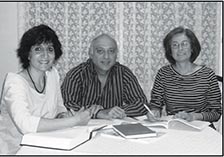
(from left) Farishta Dinshaw, Benafsha and Sarosh Khariwala, Arnavaz Chubb
"Food plays a very important role in our Zarathushti psyche. We create all varieties of food for different occasions; special food for happy occasions and we also have food for the dead in our religious ceremonies,” notes an introduction by Dastoor thanking Dinshaw for "collecting recipes from Journal readers and using her love of history to add the cherry on the top.”
A resident of Toronto, Dinshaw’s interest in Zarathushti history and religion began at age 15 when she started volunteering at the Friday School for Little Zarathushtis in Karachi. She has presented papers on Zoroastrianism at several congresses and is the author of Discovering Ashavan, a story about a young boy befriended by Zarathushtra. She holds a master’s degree in institutional food management from the University of Karachi.
◆ ◆ ◆
From the archive