
Zoroastrians Abroad
Numbers swell in Sweden
The fire temple in Sweden that was due for inauguration on Navroz, March 21, 2012 will now be opened in the last week of May "due to unfinished construction work,” reported Andaz Hawezy who states he has personally researched and financed the cost of this temple. In his e-mail response to Parsiana Hawezy explained, "The temple is a result of a 25-year-long journey. (As) our numbers became more and more, the need for a place to perform our religious ceremonies increased to necessity.” He apologized for the delay in replying to Parsiana’s queries mentioning that in addition to a "full-time job I am fully occupied with organizing our new community’s various needs.”
The temple occupying 220 square meters of space is divided such that 120 square meters is assigned for ceremonial use, 60 square meters for the agri or fire room, and the balance for reception and library, Hawezy wrote. Volunteering to bear the expenses for the first 12 months, he hopes that subsequently the other members will take over the responsibility. In addition to serving as a temple, the structure is also proposed to be used as a school and library.
Since January 2012, 173 individuals have been initiated with a navjote ceremony by Kurdistan’s Zarathustrien Assembly in Sweden "but we have a list of 3,000 persons…waiting to be initiated. To get permission to establish the fire temple we provided the responsible department with a petition signed by 3,000 Kurds who presented themselves as Zoroastrian or becoming Zoroastrian.” Whilst preparing to initiate the 3,000 members with a Zoroastrian ceremony, "our goal is two million Zoroastrian Kurds in five-year period.”
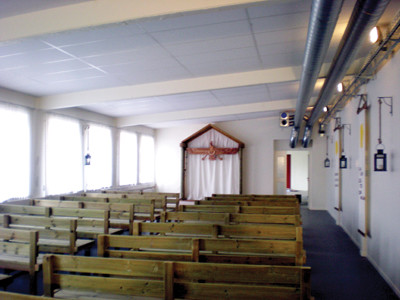
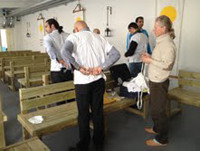
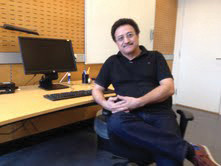
(Top): Andaz Hawezy; (above) devotees at the fire temple in Sweden
A resident of Sweden since 1986 Hawezy who has done his postgraduation in international economic history and holds a full-time job as advisor in a Swedish organization declared, "I am originally from the Iraqi part of Kurdistan and I was politically active. Under Saddam Husain’s (regime) I left Iraq for Iran in 1985 and in the same year, thanks to my Zoroastrian friends in Tehran became Zoroastrian through a…secret navjote ceremony.” After migrating to Sweden he started an informal group of Kurds interested in their old religion "which was the beginning of re-establishing Zoroastrianism in Kurdistan…”
"I have visited the temple a few weeks ago — beautifully decorated with a huge fravahar with seating for 50-60 people or so,” responded Gautam Bhattacharyya from the Stockholm Zoroastrian Association. "We have maximum 10-20 or so Parsis in all of Scandinavia so understandably evolution here is mainly driven by Iranians, Kurds (born and converts) and various other nationalities converting to Z — very different from the realities of India of course,” noted Bhattacharyya.
News of the proposed temple had been in circulation since February when the article "Kurds Open Zoroastrian Temple in Sweden” was posted on the website www.rudaw.net/english According to this article by Nasrin Rojkan, the temple displaying paintings of Zoroaster, Avestan texts, the holy book written in Kurdish and a Kurdish flag is located north of Stockholm.
"The Kurdish identity is in the Zoroastrian religion,” Hawezy was quoted by Rojkan. Convinced the Kurds must return to the Avesta in order to find themselves, Hawezy who daily prays from the Avesta but does not regularly wear the sudreh-kusti, translated for the first time the Gathas to Kurdish. When confronted with the criticism that Zoroastrian Kurds are promoting Kurdish nationalism in the guise of religion, Hawezy argued, "Kurdish nationalism has always existed. We are saying that we can add knowledge to Kurdish nationalism, move it forward.” Revival of Zoroastrianism is important for the Kurds, believes Hawezy, because "the historic and cultural language of the Kurds was taken away from us. We know we are the most ancient inhabitants of Mesopotamia and the Zagros mountains but back then we didn’t know where the roots of our language had come from, what was our culture because it was hidden from us.”
Since many believed that this project might have been blessed by the liberal scholar Ali Jafarey, Parsiana’s request for further information earned this e-mail response from him: "The temple belongs to the Kurds of Iraq and…I have been told that…they want to keep it for themselves for certain political reasons. My Iranian Zarathoshti friends in Sweden have added that they would, if permitted, soon visit the place and take photos and send me the report…”
As analyzed by scholar Farrokh Vajifdar, "The Kurds have a long and tragic history, for being bordered in their homelands by Turkey, Syria and Iran, they have suffered from bitter persecutions right until very recent times. Economically flattened, socially outcast and religiously harassed (regarded as heretics), and even denied the use of their languages…The Kurdish diaspora into Europe in hope of better lives has resulted in their old political differences, complete with internal contradictions, being burdened onto a religious plane where their aspirations are seen fulfilled in Zoroastrianism. Their claims that their ancestors were Zoroastrian seem doubtful. Being denied their Kurdish state (Kurdistan) makes them seek legitimacy in religion, and Zoroastrianism seems to fit the bill for some…
"Many of them are Yezidis, socioreligiously opposed to Zoroastrianism. Of course it is possible that the younger generations will find their fulfilment in our religion when not materially preoccupied…”
According to Wikipedia, "The number of Kurds that adhered to the Zoroastrian faith throughout history is unclear. Modern Kurdish Zoroastrian communities still exist and more recently, small Kurdish Zoroastrian communities have established new temples and have been attempting to recruit new members to their faith.”
The Kurds are a non-Arabic people who speak a language related to Persian, explains The Washington Post website. "There are 15-20 million Kurds who live in a mountainous area straddling the borders of Armenia, Iran, Iraq, Syria and Turkey with most adhering to the Sunni Muslim faith.” As explained by Rohini Priya in her article on "Kurds and Vedic India,” some Kurds are nominally Muslims, but they have their own cult the center of which is the sanctuary of Sheikh Adi, a Sufi saint. "The Kurds may be direct descendants of the Old Persians who used to call themselves Yezidis (the word Yezidi comes from the Avestan yazata and Persian ized, meaning ‘worshippable,’ and having its origin in the Sankskrit word jayatah, also meaning worshippable, i.e. deva). There are traces in the Yezidi cult of not the Avesta of Zarathushtra, but of later Persian religious speculations called Zurvanism. The Zurvanite speculation is basically dualism, with constant struggle between Light and Darkness, forces of good and evil. Since these powers are equally strong, as they believe, there is no hope for peace in the near future.”
According to Hawezy though, "Zoroastrianism is a religion without boundaries…It is a religion that pushes a human being to make his own decisions.” He stated that the temple would welcome anyone interested in becoming a Zoroastrian as long as they practice the main tenets of the faith — good thoughts, words and deeds. Hawezy considers the building of a temple synonymous to the completion of a human body because they have now a place where they can commune with Ahura Mazda.
Supports Alexander Bard, a convert to Zoroastrianism who lives in Stockholm, Sweden, "The fact is that if we were to invent an entirely new world religion based on modern science and in accordance with what we now know about the world, we would end up inventing something that already exists, namely Zoroastrianism. There is therefore no need to invent a New World religion. Our mission is instead to raise Zoroastrianism to its proper status as the world’s dominant faith and the way forward is to go back to its roots, the message of Zarathushtra, and show the world the genius at work in the Gathas…” A composer and record producer for Stockholm Records, Bard’s intensive study of religions convinced him to convert to Zoroastrianism when he was in his thirties.
Whilst claims to their Zoroastrian roots are yet to be established, on behalf of the North American Mobeds Council, president Ervad Kobad Zarolia sent them a congratulatory message for "enhancing Zoroastrianism in Sweden. May Ahura Mazda bless you all.”
Compiled and written by Parinaz M. Gandhi
◆ ◆ ◆
From the archive