
Zoroastrians Abroad
Kurds turn to Zoroastrianism
"For the first time in over a thousand years, locals in a rural part of Sulaymaniyah province (in Iraq) conducted an ancient ceremony on May 1 whereby followers put on a special belt that signifies that they are ready to serve the religion and observe its tenets… The newly pledged Zoroastrians have said that they will organize similar ceremonies elsewhere in Iraqi Kurdistan and they have also asked permission to build up to 12 temples inside the region which has its own borders, military and parliament,” noted a news report by Alaa Latif titled "Fed up with Islam and Sectarianism, some Iraqis embrace Zoroastrianism” that appeared on The Daily Beast, an American news reporting and opinion website. Over the next few days, this item and related posts were continually in circulation in community circles.
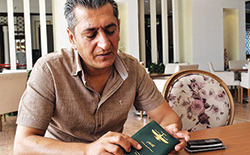
Nouri Sharif with copy of the Gathas
Although there is no official count of how many Kurds are turning to Zoroastrianism, the locals are impressed when they are told that Zoroastrianism is more Kurdish than other religions. An ethnic group numbering around 30 million, Kurds are spread over northern Iraq and Syria, western Iran and eastern Turkey. They are considered the largest stateless ethnic group in the world.
The report quotes Luqman al-Haj Karim, a senior representative of Zoroastrianism and head of the Zoroastrian organization Zand as stating, "This religion will restore the real culture and religion of the Kurdish people. The revival is part of a cultural revolution that gives people new ways to explore peace of mind, harmony and love.” They have approached government departments in Iraqi Kurdistan seeking official recognition for their religion for which they have composed their own anthem and social events.
"The people of Kurdistan no longer know which Islamic movement, which doctrine or which fatwa they should be believing in,” mentioned Mariwan Naqshbandi, spokesperson for Iraqi Kurdistan’s Ministry of Religious Affairs who felt that interest in Zoroastrianism reflected disagreements within Islam and religious instability in the region. "There are many people here who are very angry with the Islamic State group and its inhumanity,” he added. Karim though maintained, "It’s illogical to connect Zoroastrianism with the ISIS (Islamic State of Iraq and Syria) group. We are simply encouraging a new way of thinking about how to live a better life, the way that Zoroaster told us to. We don’t want (this faith) to be a substitute for any other religion.” Since those who have adopted Zoroastrianism are not denigrating any other religion, "this may be one reason why, so far, Islamic clergy and Islamic politicians haven’t criticized the Zoroastrians openly,” writes Latif.
Yet another report by Judit Neurink mentions that in April a Supreme Council of Zoroastrians in Kurdistan was founded. It quoted Nouri Sharif who returned five years ago from Germany to Sulaimani to bring back the religion: "Kurdistan has passed the era of secret practice. We follow the rules and legislations.” Referring to the sacred Gathas which answer questions on existence, religion, God and the universe, Sharif further declared: "We believe in peaceful coexistence. There is no violence in the origin of our culture. This is another wisdom by Zardasht (their nomenclature for the founder of the Zoroastrian religion) who says ‘I will not draw my sword in troubled times but light a candle.’” (Zoroastrianism exhorts its followers to righteously take up cudgels for worthy causes – editors)
It was subsequently announced that the European Centre for Zoroastrian Studies (ECZS) in Belgium sent them 1,000 copies of the Gathas and have now been requested to help them in building a Zoroastrian temple. Dr Khosro Khazai Pardis who is director of ECZS, "a cultural, secular and free-thinking institution,” clarified in an email to Parsiana: "They were translated to Kurdish language from the Gathas I published about 10 years ago. Unfortunately, the introduction of this book that is essential for understanding the historical context in which these 17 songs of the Gathas have been composed, the key concepts and words, their signification and the world vision… have not been translated. Hopefully with the help of some friends who have already shown willingness to help we (will) try to translate this introduction to Kurdish in a separate booklet and send it to them.” Pardis is a researcher and teacher in Iranian, Middle Eastern and Central Asian archeology, history of civilization and linguistics with his main interest in Zoroastrian studies.
Recommended Dr Dolly Dastoor editor of FEZANA (Federation of Zoroastrian Associations of North America) Journal, "It is better to establish some links with them. I know you will say that we need to be very careful with the backlash from the Muslim countries but sooner or later something is going to happen… We need world leadership in our community. This is not going to come from Mumbai!... I hope people like Lord Karan Bilimoria, Dr Cyrus Poonawalla, Ratan Tata are aware of this. They are the people with financial and political clout to take some behind-the-scene action. We are living in fast changing times and we need to prepare for what is coming.”
Dr Ardeshir Damania, associate research geneticist with the University of California Davis who had spent several years in Syria wrote, "Small groups of Zoroastrians exist in Russia, bigger groups in the Central Asian Republics, plus the Kurds. Their rituals and prayers may not be the same as (our) Parsis’. Thousands of years and effects of diverse political systems that Zoroastrianism had to endure make the groups vary…But one thing is certain; they all revere Zarathushtra and follow his teachings.”
◆ ◆ ◆
From the archive