
Books
(Un)happy and gay
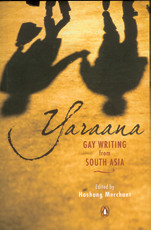
Yaraana: Gay Writing from South Asia edited by Hoshang Merchant. Second edition published in 2010 by Penguin Books India Private Limited, 11 Community Centre, Panchsheel Park, New Delhi 110017. Pp: xxvi + 264. Price: Rs 350.
It is always difficult to review an anthology. Not all the contributors can be discussed and they remain subject to the fancies of a capricious reviewer who is forced to make a selection and comment on a few at the expense of the others. One wonders at Hoshang Merchant’s choice of the title as he informs us that the term yaraana actually means "youthful friendships up to but not including homosexuality… a blutbruderschaft, a blood brotherhood, a bond between males of equal stature and social standing usually.”

Hoshang Merchant: Retaining the flavor of gay lives
In his introduction, Merchant is very critical of the portrayal of the lunatic fringe of homosexuality as if it were the mainstream. He is very against stereotyping and makes a valid comment when he says, "Your baker, butcher, banker, bus conductor, neighbor and brother could all be very ordinary and very gay.” He makes an interesting comment when he states that there is a great deal of hostility between gays and women whereas actually they should be allies fighting against the macho male, the bisexual lover. He is perceptive in his statement that the passive homosexual is often possessed by the mother image. In her warning to her son not to have sex with women, she often forgets to mention that he should not have sex with men as well. Merchant also examines the attitudes of various religions to homosexuality. Whereas Hindu culture treats homosexuality with secrecy but not with malice, the Judaic, Zoroastrian, Christian and Islamic religions believe that it is sterile and unproductive.
It is a well-known fact that most homosexuals in India are forced to get married on account of the pressure from parents and society. It is this premise which is often reiterated in several of the extracts. Beta, a poem by Rakesh Ratti, dwells on this theme as the protagonist does not know whether to concede to the wishes of his parents — his mother who has kept her jewels for her daughter-in-law and his father who is waiting for him to bring a bride. Like a good Indian son, he has so far obeyed their every command and now wonders if he can go against their wishes. His dilemma is poignantly captured in these lines:
Should I listen to my heart/and wrestle with this guilt?
Should I lock myself inside/the walls they would build.
I want to fill their eyes with joy,/yet let my spirit run wild.
How can I find the love I seek/And still remain their child?
At the very beginning of the extract from Belinder Dhanoa’s novel Waiting for Winter, the bridegroom Hans "notices little about his bride-to-be.” He lost his mother when he was a child and his entire world has centered on his father who is now sick and dying and wants to see his son married before he dies. In a flashback, Dhanoa describes a holiday when Hans, aged 14, returns home and spends his time with Billu, the 19-year-old son of the estate manager. What ensues is a torrid and passionate affair between the two boys. However, when it is time to return to school, Billu tells Hans that the next time he returns for a holiday, Billu would have a girlfriend in Delhi with "nice big boobs and a juicy red mouth.” Hans is furious and lashes out saying that he will never need a woman. The end of the extract brings Hans back to the present wondering if Billu was right after all as he seems to be compelled into a marriage merely to satisfy his father.
In the extract from Trying to Grow, Firdaus Kanga describes Brit Kotwal’s confusion as to whether he is gay or not; in Shyam Selvadurai’s Funny Boy, there is a moment of epiphany when the fact that he is Tamil and his lover, Seshan, is Sinahlese stares at him in the face like "a translucent screen.”
In the verses from Vikram Seth’s The Golden Gate, we are introduced to three marvelous characters: Ed, Phil and an iguana named Arnold Schwarzenegger. In Seth’s verses, the language is easy and mellifluous, the tone conversational. Ed and Phil after a drinking spree spend a night together. The sex is cleverly hinted at and not overtly described as when before going to bed Phil notices Ed says his prayers and asks to be forgiven for his sins. Hence, it is no surprise when the next morning, after so much of bliss and happiness, religious sentiments take over Ed and he is overcome by feelings of guilt and unhappiness. He is haunted by the fact that "the Bible says, if a man lie/With a man, he must surely die.” Though Phil tries to convince him of a God who is kind, just and loving, Ed is not convinced. He finally leaves Phil "with nothing more to say/the two shake hands and turn away.”
Most of the contributions describe homosexual relations as perfunctory, hurried and episodic; it seems to be a world of casual encounters with no hope of a lasting affection or a permanent relationship. In Bhupen Khakkar’s Pages from a Diary, the narrator meets Jitubhai in a garden and they make their way hurriedly to a location where they can have sex. The conversation between them is staccatoed and stilted and Jitubhai is full of "impatience, curiosity and eagerness to arrive.” The narrator is sure that the entire episode will be over in half-an-hour and both of them would forget each other within the day. The affair takes place not in a bedroom but in a dismal office with a covered typewriter on the table. There is a sense of mechanical sex without joy or excitement as the narrator has no interest and finally stays back "for the sake of a man I would never meet again in my life.”
Moments of happiness or satisfaction as portrayed in the anthology are few and far between. In R. Raj Rao’s, Moonlight Tandoori, a restaurant in Coventry, the protagonist embarks on a long and protracted courtship/seduction of a waiter, Khalid. He spends much of the time in the restaurant where Khalid works and even takes him for a film. This results in a brief and rather sordid one night’s stand before the narrator leaves for India and the two go their separate ways. In Mahesh Dattani’s play Night Queen, Raghu picks up Ashwin in a garden and brings him home. A shrub of raat ki rani (night queen) can be seen through a window. The title has many implications: the word ‘queen’ is often used as a euphemism for an effeminate homosexual; there is also a myth that the plant, on account of its sweet smell, attracts snakes, an archetypal and classic phallic symbol. Ashwin has been convinced by his brother that he is ugly because of his homosexuality and he now tries to escape this stigma through marriage. The play ends on a relatively positive note but there is no knowing how lasting it will be. One of the most thought provoking and sensitive contributions is Ashok Row Kavi’s account of growing up as a gay young man in Bombay. What is most endearing is his sense of candidness and honesty.
At one point in his introduction Merchant mentions his objection to the word ‘gay’ and quotes from the 1960s homosexual Broadway play Boys in the Band: "show me a happy homosexual and I’ll show you a gay corpse.” Merchant also mentions that he has met "reasonably happy” homosexuals. Judging from this selection and the powerful but unhappy extracts, one doubts if this could be true and ends up wondering if the word ‘gay’ is a misnomer.
FIRDAUS GANDAVIA
◆ ◆ ◆
From the archive