
Books
Painful, violent, comic
The Secret Writings of Hoshang Merchant edited by Akshaya K. Rath. Published in 2016 by Oxford University Press, YMCA Building, 1 Jai Singh Road, New Delhi 110001. Pp: 225. Price: Rs 650.
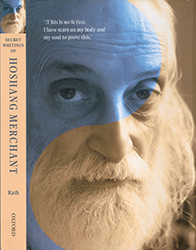 In addition to being a frank and no holds barred autobiography, The Secret Writings of Hoshang Merchant is also a collection of various interesting essays on literature, sexuality and matriarchy. The volume is edited by Akshaya Rath who teaches English at the Department of Humanities and Social Sciences, National Institute of Technology, Rourkela.
In his Introduction, Rath makes a very perceptive comment "Writing, loving and living are three linked activities in Merchant’s life. Not to love is not to live; not to write is to die.” How well these sentences encapsulate the writings which are to follow!
As he is a poet and a professor, Merchant writes sensitively about literature as is to be expected. Rath rightly comments that it is no coincidence that Merchant writes with great feeling about Rabindranath Tagore and William Butler Yeats; both straddle the east and the west. Merchant’s comments on Sophocles’s Oedipus Rex and William Shakespeare’s Hamlet are unusual. He analyzes them as "detective fiction;” what he finds interesting and highlights is the idea of "finding out” the sense of discovery in these plays. The idea of detection and discovery is echoed at several levels: Oedipus discovers that he is really the son of King Laius and Queen Jocasta; and Hamlet the truth about his father’s death. He extends the metaphor of discovery to Earnest Jones who detected in Hamlet the possible reason for "the neurosis caused by the family romance” and the rivalry of the father and the son for the mother’s affection; once again this is reflected in Merchant’s own "detection” of the parallels in these works.
Some of the subject matter and Merchant’s sexual experiences described in the chapter "1,001 Nights: Queer Places, People, and Politics,” have already been read in The Man Who Would Be Queen, which Merchant describes as autobiographical fiction. Gay life for him started early in school where the principal sodomized his students. His own experiences with the priest must have so traumatized the young boy that he appeared to Merchant in his earliest wet dreams. This was followed by a series of amusing encounters with classmates. The book is replete with funny incidents. Merchant never allows his humor to abandon him even when the situations can be quite traumatic; hence the warning "This is no fiction. I have scars on my body and soul to prove this,” printed on the dust jacket of the book is quite relevant. Merchant loses his virginity at the age of 12 in a carpenter’s loft "amid sawdust and woodshavings” and, the second time, the perpetrator gave him candy to alleviate the pain. Even when he is badly beaten and bruised with six facial fractures and a dislocated cheekbone, he "chased a friar who had come to give (him) succour” at the sickbed out of the hospital. In true Merchant style, the painful and the violent are mingled with the comic. The first time he went to a sauna in USA, he refused to undress and screamed when he was fondled. He describes gay toilets at Purdue which "were partitioned head to calf-level” and which provided scope for several sexual encounters with boys kneeling.
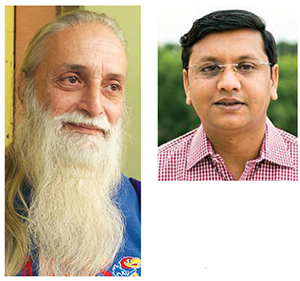
Poet Hoshang Merchant (left) and Akshaya Rath
Merchant is very understanding of the opposite sex. He believes that only a queen knows what a woman suffers when she is catcalled or jeered or followed in the streets. He quotes Boris Vian, a French poet:
"O God do not let me die
Without first knowing
What it is to walk up a street wearing a skirt.”
In "Indian homoeroticism,” Merchant regrets that fact that there has not been any gay movement in modern Indian poetry, though many poets are now coming out and writing poetry which has homosexual content. Merchant stresses the fact that it is totally erroneous to say that homosexuality was a western import. Androgyne, transvestites, eunuchs, homosexuals are all mentioned in "Hindu India’s creation myths.” The walls of the Khajuraho temples are a case in fact. Merchant traces this history through Medieval India up to the current day. Sex, not necessary gay sex, has been a part of Indian fiction right from Raja Rao’s The Serpent and the Rope (1960) to Namita Gokhale’s Paro (1984), the novels of Shobhaa De ("India’s Jackie Collins”) or Raj Rao’s The Boyfriend (2003). On the other hand, pornography, he believes, is a result of society and not of a single human being. It is simply "a symptom of a deeper social — specifically, a sexual — malaise.”
Modern Indian poetry did not start with Nissim Ezekiel as is often thought. Merchant reminds us of the little known Sultan Padamsee, a gay Bombay man at Oxford in 1939 who returned to India during the war and committed suicide at the age of 24. It is evident that Merchant did not see eye-to-eye with "Nissim Eziekel and his Bombay coterie” and, as a possible result of feeling excluded, he does not have very kind comments to make about him. But Merchant often makes sweeping statements. He feels that Eziekel is heterosexist and homophobic and agrees with poet and art historian Ranjit Hoskote who says that Ezekiel did not understand surrealistic writing. He states that Eziekel along with Dilip Chitre, Arun Kolatkar and Arvind Krishna Mehrotra all relied on English models like T. S. Eliot, W. H. Auden, Philip Larkin and Ted Hughes. Merchant does not provide any justification or reasons for his views.
Once again a similar situation arises on his comment on Paul Verlaine, Arthur Rimbaud, Paul Gauguin and Vincent Van Gogh: "Four gay lives wasted.” Whereas he certainly justifies this view in the case of Verlaine and Rimbaud, no explanation is held for his inclusion of Van Gogh and Gauguin. This is particularly in view of the fact that a few lines earlier he has mentioned that Gauguin dreams of women and Van Gogh had chopped off his ear to send it to a prostitute. It is such sweeping statements without really giving any rationale for his judgment that mar what is a revealing and interesting read. F. G.
◆ ◆ ◆
From the archive