
Events & Personalities
Humane alternatives
When the Beauty Without Cruelty (BWC) publication Compassionate Friend switched from paper envelopes to plastic covers for despatching the magazine, a reader, Vasanthi Rajiv from Madras wrote complaining: "Why the change from a paper envelope to a plastic one? Even if paper means cutting trees down it’s still a renewable source, whereas plastic does more lasting damage to the environment. Ironically, you had an article inside urging us to reduce plastic use! Why the anomaly?” (Compassionate Friend, Winter 2011 issue).
The editors replied "The recycled plastic envelope was free of animal substances and saved money on postage for more optimal use. More greenhouse and toxic gases are emitted during paper manufacture than in the production of packaging plastics and, from the environmental viewpoint, recycled plastics are preferable to paper. In our last issue, an item under ‘BWC news and views’ suggested readers not throw plastic garbage away unthinkingly, where it may be consumed by animals. We didn’t urge anyone to reduce plastic use, but to be careful how and where plastics are disposed of. Consequently, we don’t see any inconsistency in our use of recycled plastic envelopes.”
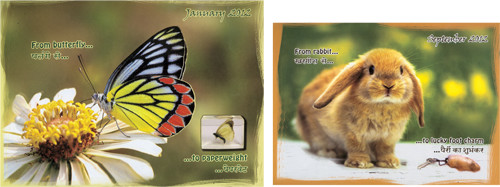
Top: Butterfly, and entombed in paperweight; right: rabbit and "lucky” rabbit’s foot key chain
The BWC 2012 calendar displays photos of various animals and the commercial use of their bodies/body parts. For January, a colorful butterfly is shown nestling on a flower and also entombed in a paperweight while for September, a cuddly rabbit is pictured alongside a "lucky” key chain of a rabbit’s foot.
"The products depicted were at one time living creatures,” notes the calendar’s preface. "They were animals, birds and water-life, quite likely bred and raised to be killed for their flesh, and their skins and other body parts sold for just as much. To be precise, animals mercilessly slaughtered for human greed and vanity.
"Instead of joining the masses that overlook the living origins of countless products made from animal body parts, we, as sensitive human beings, can make a difference. We can play our part in bringing down the number of animals killed and converted into frivolous items by resolutely shunning objects made from them.
"A fall in demand for animal products will in turn result in a fall in demand for animal body parts, resulting in those many lives not being cut short. With very little effort, a suitable humane alternative of non-animal origin can be located and used instead.”
For details contact www. bwcindia.org
◆ ◆ ◆
From the archive