
Zoroastrians Abroad
“Challenging and rewarding”
Medical science has benefited greatly from the presence of Parsi doctors in Hong Kong
"For the first time a drug developed entirely in Hong Kong is poised to attain global status as a prescription medication,” reports Dr Cyrus Kumana. To him jointly goes the credit of developing an oral arsenic solution for treating hematological malignancies for which a US patent was granted in 2009. With this breakthrough "patients with leukemia will be virtually cured,” Kumana is optimistic. Hitherto patients with blood cancer would be intravenously administered arsenic daily for six weeks which, costing about US $ 50,000 a month was only affordable to a few and hence became "a burden to the health system. The new oral drug that can be taken at home is just as good as the one given intravenously and safer. There is a lot of global interest in this drug,” mentions Kumana, with the "Sloane Kettering Hospital being after us to produce it.” Former chair and founding professor of clinical pharmacology and therapeutics as also chief of division, department of medicine, The University of Hong Kong, Kumana is particularly happy that patients in developing countries will benefit from this treatment.
Oral arsenic was used in the Department of Medicine, Queen Mary Hospital (QMH) for treating patients in the late 1940s and early 1950s but with the arrival of newer drugs its use was forgotten for nearly half a century. Once intravenous arsenic was found to be effective to treat acute promyelocytic leukemia the QMH team turned to archival medical records in the Hong Kong Medical Museum to determine the safety dosage for the oral drug since an overdose can adversely affect the heart. Its beneficial effects are acknowledged for the initial and continuous treatment of patients in remission and those in relapse. It has also come to replace bone marrow transplantation and is being used in the treatment of other kinds of blood cancers like lymphoma and myeloma.
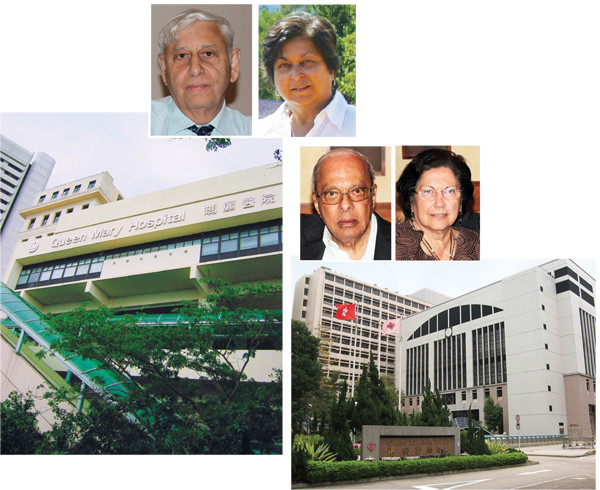
(Top) Dr Cyrus and Nina Kumana; (below left) Queen Mary Hospital; (next) Dr Fali and Thrity Shroff Photos: Jasmine D. Driver; (bottom) Queen Elizabeth Hospital
Practising clinical pharmacology in Hong Kong was "challenging and rewarding,” comments Kumana. He makes sure we understand the difference between pharmacology and clinical pharmacology. Whilst pharmacology is largely a non-clinical discipline that entails the study of drugs mainly in animals and in the laboratory, clinical pharmacology is an academic and pragmatic discipline linking pharmacology to clinical specialties. Being associated with therapeutics, clinical pharmacology requires collaboration with prescribing doctors, medical professionals and basic scientists. Promotion of rational and cost effective prescriptions by doctors is of vital concern to clinical pharmacology, a specialty established in most prestigious medical schools throughout the world.
Kumana’s research interest also extended to drug utilization research, clinical trial methodology, cardiovascular clinical pharmacology and therapeutics, and rational antibiotic prescribing. Observing "antibiotic resistance all over the world and particularly in India,” Kumana refers to their efforts to "convince doctors not to use/abuse antibiotics and to resist patients who always want some medical dose.”
The Division of Clinical Pharmacology at the Hong Kong University’s department of medicine has formulated an Antibiotic Guidelines booklet, the first in Hong Kong. The introduction of Medication Prescribing Forms as a distinct item in each patient’s hospital record, drug container labeling, medication error reporting system, were some of the reforms pioneered under Kumana’s stewardship, as notes his curriculum vitae. In fact there are antibiotic regulations specially developed for use in hospitals. "It is good to come up with guidelines. The difficulty is in getting others to observe them,” he says. At the QMH, the oldest of major public hospitals in Hong Kong, where he is currently honorary consultant physician, the authorities have been "reasonably successful” in monitoring usage. They observe every patient in hospital to determine whether the antibiotic is being administered appropriately. They additionally wrote to every single doctor to advise the medico to restrict prescription of antibiotic medication and found that "most seniors were very good” whilst the middle ranking doctors felt offended for being "told what to do.” This line of treatment not only augured well for the patient’s physical well-being it also resulted in "considerable financial saving, leaving the patient money for something else.”
On several occasions he served as World Health Organisation consultant and has been extensively involved in drug regulatory matters, the evolution of drug prescribing policies/guidelines, drug formulary development and drug administration systems and related processes, serving as chairman or member of different professional societies and committees. A prolific author who has contributed to several medical journals and publications, he was editorial director of JAMA (Journal of the American Medical Association) South East Asia.
Wanton consumption of multivitamins makes Kumana comment, "Poor pharmacists make money from selling multivitamins.” Yet another issue of concern is the free availability of prescription drugs without doctors’ prescriptions. "In Hong Kong there is a lot of awareness about it.” Authorities send people in disguise to find out whether chemists are observing laws and defaulters are made to close down their business.
Having spent the last 29 years in Hong Kong, Kumana says he was in Canada when a former professor of his recommended that he relocate to Hong Kong to assist in the setting up of the clinical pharmacology department.
Born in Bombay Kumana was around eight years old when his father Rustam who was working for Scindias was posted overseas. Cyrus thus completed his schooling and university education in the UK. He subsequently qualified as a Fellow of the Royal College of Physicians (Canada, London, Edinburgh, Glasgow), as also Fellow of the Hong Kong College of Physicians and Hong Kong Academy of Medicine. For many years he has been an examiner for the UK-MRCP as well as the Hong Kong College of Physicians Specialist examinations. For the department of medicine’s postgraduate diploma courses, Kumana organized the clinical pharmacology module.
Without mincing words Kumana gives his reading of the pulse of the Parsi community: "It’s a schizophrenic community. Very anachronistic. The original precepts of Zoroastrianism were wonderful but the way the orthodox interpret it is disappointing…The fervor for dakhmas and so on is completely misplaced. The community has become very rigid. I don’t think men and women are treated equally which is against the religion. We can’t blame others. We brought it on ourselves. We should have the courage to change it… If we don’t change some of our rules and regulations we will disappear.”
Referring to the late marriages, subfertility of the community and childless couples, Kumana remarks, "We have hardly ever heard of unwed teenage pregnancy. We just don’t have the drive.”
"If you read the famous cylinder of Cyrus the Great you will realize how far we have fallen back.” On his visit to Iran he says he was impressed with the simplicity of Cyrus’ tomb. His ability to appreciate Cyrus’ lifestyle could perhaps be because they both share the same name, he declares before adding that Achemenian influence can be witnessed in his family. He has a son named Darius who is a logistics and information technology specialist in London. His son-in-law is Xerxes Mehta married to his daughter Tinaz (working for a company in Oxford that monitors medical devices). Another daughter Larissa is a beauty therapist. The children "think of me as a dinosaur,” reveals the father. His wife Nina used to work for the boutique resort Aman Resorts until they moved their headquarters from Hong Kong to Singapore. She was a table tennis champion in her hey days as was her mother Gul Nasikwala. At 71, Kumana’s physical activities have reduced to walking, traveling and enjoying opera. He used to play squash in his younger days.
Whilst he does not wear the sudreh believing "it’s entirely symbolic,” he refers to Darius and his German wife Carolin’s efforts to get their children Eleana and Maya initiated as Zoroastrians. "He did a lot of research on the net,” mentions Kumana senior.
Would he encourage other members of the community to join the medical profession? Prompt comes the response, "I wouldn’t encourage. It has to come from within. I always wanted to do it since I was seven and persisted despite adverse comments like ‘You are not suitable for university.’ ‘You will be a dropout.’ I am by and large against sons and daughters (following the footsteps of their doctor parents). They make bad doctors though there may be exceptions.
"It’s a hard life to get to the top. You don’t have a normal life. You are imprisoned in the hospital for a large part of your most productive life.”
"Keen to use my hands”
"Nobody suffered a stroke among the Parsis. We are such a small community,” states Fali Shroff referring to the time when he practised as a neurosurgeon in the British controlled Hong Kong territory. Members of the community may never have felt the need to seek his expertise but the British realized the worth of the genial neurosurgeon who was "honest, responsible and cared for the patients,” adds the octogenarian, now retired.
When he arrived in Hong Kong in 1972 after spending some years in the UK he joined the neurosurgical department of "Queen Elizabeth Hospital which was then the largest hospital in the British empire and very very busy.” But after four years he opted for private practice as he realized he could "never become a consultant” since he did not speak Cantonese.
"I knew 100 percent that I would become a surgeon and not a physician,” mentions the doctor who was "always very keen to use my hands.” In his younger days he would immerse himself in manually creating model aeroplanes. Schooling had become a difficult proposition for boys in Macau during World War II days, he recalls. Theirs was the only Parsi family with a home in Macau, his father Jamshedji owning a textile shop there. He was sent to La Salle College in Kowloon but as luck would have it, even that school had to close down in 1941 following Japanese bombing.
Once the war ended Fali’s parents decided to go to Bombay so he enrolled at St Xavier’s College from where he completed his Inter Science. His contemporaries were Drs Noshir Wadia, Dara Anklesaria, Adi Dastur, Bejon Parekh, reminisces Shroff. In the intervening years before settling in Hong Kong, he traveled back and forth between Bombay and England.
Wife Thrity (née Baria) joined the hotel industry when they went to England and continued her career in the hospitality industry in Hong Kong working as director of sales and marketing for chains like Regent Hotel, Sheraton, Aman Resorts, Beaufort Hotel. Finally when her German boss retired around the same time that Fali discontinued his medical practice, she put in her papers too. This gave the couple a chance to travel and enjoy western classical music. In fact they plan their holidays such that they get an opportunity to attend the best operas. They own one of the best hi fi music systems and have a collection of around 2,500 LP (long playing) records.
Thrity is an accomplished pianist having been a fellow student with Zubin Mehta when he was training with Daulat Nanavati in Bombay and has vivid memories of Yehudi Menuhin practising at the Mehta home before his Bombay concerts. Thrity and Zubin’s dads were at university together. Thrity’s father had an agency for Woodward’s Gripe Water which was very popular in those days. After her initial schooling at J. B. Petit High School in Bombay she went to Kimmins in Panchgani. Her father being a very staunch Zoroastrian, her navjote was done in Udvada and she still knows all her prayers.
Ashem Vohu and Yatha Ahu Vairyo prayers are the only ones Fali remembers. He wears the sudreh "because it serves as a vest,” he candidly admits, adding "wearing the sudreh-kusti is not important. I think religion is all man-made and I regret the fact that we don’t know the birth date of Zarathushtra in spite of intensive research.” Neither is he comfortable reciting prayers in a language he does not understand.
Fali and Thrity have no children but they belong to the Shroff family that has 30 members residing on the island. Occasionally attending some of the functions at the Zoroastrian Building, they are happy that the "small Zoroastrian community in Hong Kong is very friendly, ever helpful, always willing to rally around in times of difficulty.”
◆ ◆ ◆
From the archive