
Events & Personalities
Burzo Namoo reprint
The ancient Iranian epic, Burzo Namoo, reprinted in Gujarati after nearly 50 years, was released at a function at Sethna Agiary hall on January 28, 2011. Shernaaz Engineer, editor of Jam-e-Jamshed was chief guest, with Ervad Aspandiar Dadachanji and Adi Doctor as guests of honor on the occasion, community historian Marzban Giara informed Parsiana via e-mail.
In continuation of his ancestors’ legacy, Viraf Chiniwalla resurrected Burzo Namoo, the epic story of the family of the Iranian hero Rustom written by two disciples of Firdausi, Abu Taher and Atai. Burzo, a warrior during the reign of Shah Kaikhushru, was Sohrab’s son and Rustom’s grandson. Chiniwalla’s ancestors were in contact with Ustad Saheb Behramshah Naoroji Shroff at Surat. Of the three Chiniwalla brothers, Jehangirji was the orator, Faramroze the author and Rustomji translated Burzo Namoo into Gujarati after 50 years of labor. The story of Burzo starts with the Rustom-Sohrab episode, states Giara. Burzo had three sons whose names priests recite in our prayers though the community mostly remains ignorant about them. Reading the epic will enlighten readers about major wars fought between Iran and Turan, notes Giara. The book also contains reference to woolen and silk clothing, gems, jewelry, metals and wine making in those times.
Dadachanji lauded the writings of the Chiniwalla brothers who were reportedly blessed by the abed sahebs. Reciting couplets in Gujarati about the combat between Rustom and Sohrab, he recalled that in the early part of the 20th century kirtans would be performed at night by lantern light near the Bhikha Behram Well. Dr Dhanjibhai Patel had translated couplets from the Shahnameh into Gujarati and popularized his work through such kirtans, writes Giara.
Doctor informed the gathering: "Burzo Namoo was serialized in Parsi Awaz weekly in 274 installments over five years between 1947 and 1952. It mentions about Shah Kaikhushru’s ascension to heaven. The son would ask his mother about his lineage which today we the present day Parsis have forgotten. He narrated how Tehmina proposed to Rustom: ‘I am infatuated with you and want to be your spouse. I desire to bear a brave son like you.’
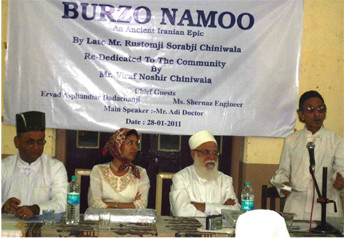
(From left): Viraf Chiniwalla, Shernaaz Engineer, Ervad Aspandiar Dadachanji and Adi Doctor at the mike
"Our empire flourished thousands of years ago. There was no established religion, only Madayasnis and Devyasnis. Rustom was born in the reign of Shah Minocher and passed away during the reign of Shah Bahman. There are beautiful admonitions by Firdausi in Persian verse and Gujarati couplets in Kutar brothers’ Shahnameh. Detailed narration of warriors from Shah Kaoos up to Shah Bahman of Kayanian dynasty is found in Shahnameh. These namehs are factual and not mythical. Names of these warriors are found in our Avesta prayers. Ten thousand years ago our ancestors were spiritually far advanced and not barbarians as some think.”
Engineer lauded the contribution of our priests in preserving the religion. "Let us build bridges, not burn them. Let us brainstorm and reinforce effort. Let us preserve and protect our tenets and traditions. It is education and awareness that will open the windows of the mind. Uphold what is right and true,” she exhorted.
Since many Parsis are unable to read Gujarati, the book needs to be translated into English. Homiar Mistry who digitized the pages of Parsi Awaz assisted Viraf Chiniwalla in the current effort. The CD is available for Rs 100 while Burzo Namoo in three volumes in Gujarati is available for Rs 1,500. The first 100 copies are being offered at a concessional rate of Rs 900 by Chiniwalla at Cassinath Building No.1, Cassinath Street, Tardeo, Bombay 400034.
◆ ◆ ◆
From the archive