
Zoroastrians Abroad
Alone in Azerbaijan
"Though Surakhani is one of the main historical sites in Azerbaijan, despite its religious background sometimes inside the fire temple some entertainment events such as music concerts are being held…” regrets Jal Rayi who in an e-mail to Parsiana describes himself as one of only four Zoroastrians in the country, the other three being his uncle Jamshed Rayi and his cousins Dariush and Manucheher.
"I have converted to Zoroastrian religion five years ago because I have been searching and reading about the only truth… We have never done our navjote because we never got a chance,” reveals Jal. Referring to his "Parsi” roots he mentions that despite "forced conversions later” the town people "totally look like Parsis and the language they speak... is called Parsi” which is similar to present Persian and quite different from native Azeri, the local language of Turkic origin. "I cannot understand our Parsi brothers, with their conservative policy, keeping their doors shut to many Persians, non-Persians who want to come back to this beautiful religion,” he writes.
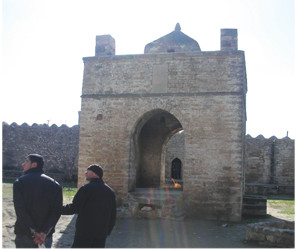
Jal and Jamshed Rayi outside the fire temple in Surakhani
Surakhani, previously populated by Zarathushtis, is a small town located near the Azerbaijan capital Baku. The name Surakhani is derived from Persian language, surakh meaning red and khani meaning place, states Jal. The fire temple of Surakhani that draws tourists is rectangular in shape which clearly indicates "that it is a Zarathushti temple, being previously used for fire rituals.” He further refers to "seven fire holes in this temple” and maintains that Alexander Dumas wrote in his book that the entire world is aware of the fire temple in Surakhani. In earlier times the townspeople would celebrate certain holidays in the outdoors, carrying symbolic fires in their hands, he has heard from his forefathers.
Just as organizing music concerts in a fire temple is considered disrespectful by Jal, he refers to the humiliation he felt when the ministry of culture in Azerbaijan planned to erect a statue for Zarathushtra viewing him as a poet rather than a prophet born in Azerbaijan. Insisting that such a gesture was demeaning for a prophet, "We personally went and complained,” writes Jal who is presently studying in Bangalore, "and finally they cancelled (the plan). We have always tried to help our religion as much as we could.”
◆ ◆ ◆
From the archive