
Zoroastrians Abroad
Mitigate munitions
"In my travels I have seen a lot of poverty but when one sees the land of Laos scarred with craters and vast areas contaminated with unexploded ordnance (UXO) in a country where the majority live off the land, one felt this was enforced poverty, a cruelty to the gentle people of Lao,” declared Jehangir Sarosh of London who attended the First Meeting of States Parties (1MSP) to the Convention to ban Cluster Munitions from November 9-12, 2010 in Vientiane, Laos. The Convention on Cluster Munitions that was adopted by 107 states in 2008 prohibits all use, stockpiling, production and transfer of cluster munitions whilst promising assistance to victims, clearance of contaminated areas and destruction of stockpiles.
Representing the Zoroastrian faith, Sarosh was included in the delegation of the European Council of Religious Leaders (ECRL) and Religions for Peace (RfP). Nearly 1,000 persons, including political leaders, diplomats and representatives from civil society participated in the meeting, noted a report by Sarosh. The ECRL and RfP delegation additionally included Bishop Ioannis Sakellairiou representing the Greek Orthodox Church, Mohinder Singh and Nirankar Singh from the Sikh community, Vy Sovichea from the Buddhist faith.
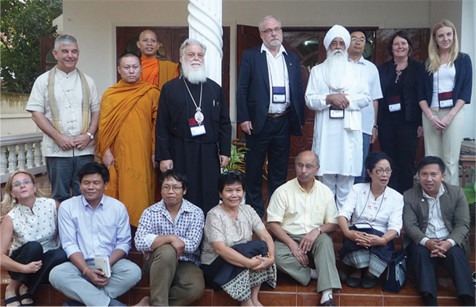
Jehangir Sarosh (sitting third from right) with the interfaith delegation representing the European Council of Religious Leaders and Religions for Peace
At the end of the conference the delegation visited Xiengkhouang Province that has seen the worst repercussions of cluster munitions to witness the rehabilitation work undertaken there. They encountered a 22-year-old man who had been blinded by an unexploded ordnance just a few days earlier. Their presence was meant to give "comfort and hope that people from far away lands cared and especially to see that religions were working together with NGOs to change what they are enduring,” conveyed ECRL co-moderator Sarosh who was distressed that even during the conference a girl of 10 was killed by a cluster bomblet and her sister seriously wounded.
Cluster munitions are large weapons containing dozens to hundreds of smaller submunitions, often called bomblets within a larger container. They are dropped from the air or fired from the ground when the container opens and scatters bomblets over a wide area, sometimes the size of two or four football fields. As some of the submunitions fail to work immediately they continue to lie on the ground, remaining a fatal threat to those residing in the area. Continuing with their work the ECRL and RfP will persevere in their endeavors to raise awareness of the threat to civilians and bring more countries to align themselves with the Convention.
◆ ◆ ◆
From the archive