
Events & Personalities
Serum Institute’s vaccine
India’s first intranasal H1N1 (swine flu) vaccine, Nasovac, developed by Poona based Serum Institute of India (SII) was launched in Bombay on July 14, 2010 by Adar Poonawalla, executive director — operations of the Poonawalla Group, and his wife Natasha. "All one has to do is just take a sniff of the liquid vaccine” for it to be effective, Dr Cyrus Poona-walla, chairman and managing director of SII had informed The Indian Express (IE) as reported in its edition of June 26, 2010. Since then the company has been busy administering doses of the vaccine to their staff, children, doctors and friends. Cyrus Poonawalla intends to distribute vaccines worth one crore rupees free of charge, according to IE. However, though 30 percent of deaths from the H1N1 virus have been of pregnant women, the vaccine has not been approved for use on this vulnerable segment, reports IE.
"This is a user friendly vaccine... (We) will initially manufacture half-a-million doses in July and another million in August. We will test market conditions before manufacturing on a large scale,” the senior Poonawalla said. The vaccine, priced at around Rs 190, will be available in a syringe and administered via a pump-like mechanism atop the syringe, IE noted.
On July 14, SII informed Mumbai Mirror (MM) that it had obtained the final clearance from the Drug Controller General of India. The new vaccine has been tested on 370 people and found to have no major side effects, MM reported. However, Dr Abhay Chaudhari, director of the Haffkine Institute cautioned, "Though the new vaccine is safe, a long term study is still in the offing.” The Bombay Municipal Corporation’s executive health officer, Dr G. T. Ambe told MM, "We have not been officially intimated by the state government about the correct mode of administering this intranasal vaccine. In any case, our doctors will not prescribe any other vaccine for swine flu and only follow the WHO (World Health Organisation) guidelines.”
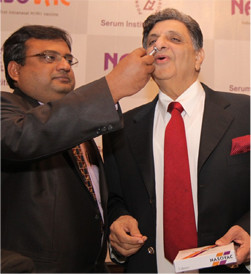
Dr Cyrus S. Poonawalla being administered a dose of swine flu vaccine by Dr Prasad Kulkarni
Meanwhile, scientists at SII have resumed work on a vaccine to counter another deadly killer, the H5N1 virus that causes avian influenza, commonly known as bird flu, Mid Day reported on July 15. Work on this vaccine had been put on hold when the swine flu epidemic broke out. Project director Rajiv Dhere confirmed that they "were developing the H5N1 vaccine and had reached the clinical trial in March 2009 (when) swine flu struck and the WHO instructed us to concentrate on developing a vaccine for the problem in hand.” Clinical trials on animals for this will begin soon. Executive director, SII Dr S. S. Jadhav told Mid Day: "We are also keenly working on developing a vaccine for swine flu that can be administered to children below the age of three. The present nasal spray is not suitable for children. There should be some progress by the end of this year.”
Kapadia pays for copies
When the Parsiana office received a phone call from the Supreme Court of India we were a little concerned. Subsequently the caller clarified that he was from Chief Justice Sarosh Kapadia’s office inquiring where in Delhi they could purchase copies of Parsiana (Kapadia was featured on our July 7, 2010 cover).
We replied that issues were on sale only in Bombay and would gladly courier copies to him. The caller though insisted that two copies would be collected against payment from our office by someone from the Bombay High Court!
Kapadia is known to be a stickler for propriety; accepting complimentary copies could go against his grain.
◆ ◆ ◆
From the archive