
History
Justice for all
Punchayets and dharmasabhas offered a viable alternative system to settle disputes
Before the British introduced the system of civil courts in India, legal, financial, family and caste disputes were often referred to punchayets and dharma-sabhas.
These quasi judicial, alternate, community based, dispute resolving systems served to provide relatively, quick, cheap and accessible justice. But they also had their disadvantages. Two academicians analyzed the role played by these institutions. On December 3, 2009 James A. Jaffe, professor of History at University of Wisconsin, Whitewater, spoke at the K. R. Cama Oriental Institute (KRCOI) on arbitrations and punchayets in early colonial Bombay while Rosalind O’Hanlon, professor of Indian History and Culture, Oriental Institute, Oxford University, delivered the Fourth Dr Mani Kamerkar Endowment Lecture on December 7, 2009 at the Y. B. Chavan cultural hall on "Anutapa, prayascitta, suddhi: the work of Maharashtra’s dharmasabha assemblies in the 17th and 18th centuries.”
While Britain had an active arbitration system in place, they saw the Indian punchayets as "an advanced system of arbitration” said Jaffe. It was "a popular and cheap way to solve problems out of court.” The method was also "efficient and just,” he added. In the 1820s to 30s the British "gave unqualified support” to the punchayets, seeing them akin to the British arbitration system.
There was "no single model of punchayets. They were different in size, organization and administration.” There was a "voluntary and consensual selection of members, submission of bonds to ensure participation and local officials could compel and enforce awards.” Interestingly, though the term punchayet indicates "an assembly of five chosen and elected by the community,” as noted former Supreme Court Justice Sam Variava who chaired the session, Jaffe mentioned he "never came across a punchayet of five members.” There were six or three.
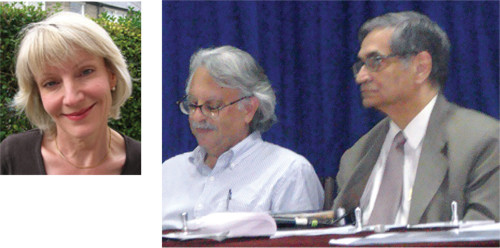
From left: Rosalind O’Hanlon, James Jaffe and Sam Variava: informal resolution of disputes
The disadvantages of the system, however, included a "lack of compulsion” for making people attend and give testimony, a slowness to assemble and a reluctance to serve because they were "busy” with other matters. These were "constant problems,” explained Jaffe. "Punchayets could be costly. The plaintiffs had to pay for food and lodging of the members,” though this was compensated at the award time. "Many people resisted submitting disputes to the punchayets… Indians crowded the British courts forsaking the punchayets,” observed the professor.
"But if the British wanted punchayets, why did they disappear?” people ask. "There is no clear answer why the shift occurred. Maybe punchayets did not decline at all,” countered Jaffe. In the 1820s the punchayets handled 80 cases a year in the Bombay province. In 1826 the number was four times that. But when the British introduced the system of munsifs around 1823, by 1850, 71 percent of the case load shifted to them. The punchayets "were swamped by the munsifs.” They "opened the floodgates to litigation,” remarked Jaffe. "The demand for justice increased with the supply of justice.”
The British courts offered more facilities to litigants and by the mid-20th century the system included the element of compulsion.
People assumed that given a choice between punchayets and courts, the punchayets would tend to favor a compromise so as not to offend either party while the courts favored "the winner takes all” approach. But this was not the case. The punchayet decisions also favored one party.
Jaffe did not expand on the topic of "caste punchayets” such as the Bombay Parsi Punchayet but instead sent Parsiana a paper by Christine Dobbin, a research fellow in the Department of Pacific History at the Research School of Pacific Studies, Australian National University titled "The Parsi Panchayat in Bombay City in the Nineteenth Century.”
Dobbin noted, "By the middle of the 19th century it seemed that the cohesiveness of many castes and communities was breaking down.” But at the same time, "awareness of community identity was being heightened by the competitiveness of urban life.
"From time to time members of the Punchayet were forced to petition the Government of Bombay complaining that many Parsis were infringing the rules of their religion, and asking for the power to punish them…
"In 1837 a leading Punchayet member Bamanji Hormasji Wadia, approached one of the Supreme Court judges for suggestions for placing the Punchayet on a footing which would enable it to regain respect.”
Wadia stated, "The Punchayet, we regret to inform your Lordship, is now almost powerless either for good or evil, and unless that body is made respected by the Act of Government, the most serious consequences must ensue to the best interests of our caste.”
Dobbin, however, noted that, "the government could do nothing, and the prestige of the Punchayet was meanwhile being further weakened by the increase of education in the Parsi community, and the rapid growth of the Gujarati Press.”
As far as arbitration was concerned the parties "did not have to leave (written) records (of the testimony, etc). It was informal, not to be written down.” Jaffe showed the audience the sole of a shoe on which the arbitration award for a shoe factory in Norfolk England was written with the signatures of the representatives of the trade union and the manufacturer’s federation.
The goal of arbitration was to ensure the decision reached was in keeping with the canons of "justice, equity and good conscience.” But these terms needed to be further defined and in the 1780s to 90s there was a public debate on how to improve the British legal system. Arbitration was voluntary and used in all disputes save criminal matters and crimes against the church and state.
Arbitration was "a good improvement over the courts as there were no proceedings and no lawyers… Theoretically anybody could become an arbitrator. Some one with expertise in the field or skilled craftsmen” could be arbitrators as could "a worker or a respected person. But most tended to be educated, respected people because they had the time to spare. No women were appointed arbitrators though they were independent litigants,” noted Jaffe.
The disadvantages of the system were a "lack of compulsion to initiate proceedings, to enforce awards, to compel attendance and testimony, and to administer oaths.” In addition, "parties could revoke arbitration till the last minute.”
Caste compulsions
Dr Mani Kamerkar "always goaded students into research. She was very approachable. She generously gave donations for projects,” said Vimal Shah, public lectures chairperson of the Asiatic Society of Bombay. One of those undertakings was the endowment lectures for which the late scholar donated six-and-a-half lakh rupees and under whose auspices O’Hanlon spoke. Kamerkar, who was honorary professor of history at the Asiatic Society, stipulated the subject of the talks pertain to Maharashtra and Gujarat.
O’Hanlon spoke about the rigidity of the caste system in the 17th and 18th century in Maharashtra, an area on which she is an authority. If a person violated any of the caste restrictions he or she had to undergo six penances to seek atonement. Short cuts were not permitted and through a network of "gossip and information” the concerned authorities soon came to know of any transgressions.
The professor related the story of a father and son who during a famine dined with members of a lower caste due to hunger. Despite the extenuating circumstances, they were required to serve the penances. Even childless couples had to seek sanction to adopt a child of a lower caste.
The cases appeared to be decided on an ad hoc basis. O’Hanlon stated she had seen no reference to written or other procedures to be followed in the hearings. One determining factor was whether the persons accused of violating the caste norms "show remorse.”
The rise of the British courts of law and the growing influence of newspapers lessened the influence of the dharmasabhas.
Aroon Tikekar, president of the Society, thanked O’Hanlon for providing "glimpses of what we were.”
◆ ◆ ◆
From the archive