
Books
A life for Lucky
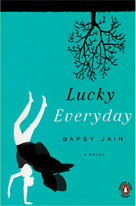
Lucky Everyday by Bapsy Jain. Published in 2009 by Penguin Group (USA) Inc, 375 Hudson Street, New York 100014, USA. [First published as The Blind Pilgrim by Penguin Books (India) 2008]. Pp: 309. Price: US $ 14.
In the 1990s there was a sudden spurt of Parsi fiction writers. There were splendid novels published by Rohinton Mistry, Boman Desai and Bapsy Sidhwa. Though these have continued to enthrall their readers, we seldom see new writers of Parsi fiction — apart from short stories by Sohrab Fracis and Murzban Shroff — and, hence, it is a pleasant surprise to read Bapsy Jain’s novel Lucky Everyday which was earlier published as Blind Pilgrim. Jain seems to be a woman of several talents: she is a chartered accountant, an entrepreneur and educator, and she divides her time between Singapore, Dubai and Bombay. After doing her articleship for chartered accountancy in the United Kingdom, she lived and worked in New York. Leading such a hectic life and bringing up two sons, it is little wonder that it has taken her 10 years to complete this novel.
The central character of the novel is Lucky Boyce. We meet her at the most unlucky period of her life. She has left Bombay after her wealthy and apparently charming husband Vikram Singh has not only divorced her but has also decimated her business venture and has forced her to retreat to New York to lick her wounds. The novel starts with Lucky trying to pick up the threads of her former life in New York with the help of her friends Alec and Susan. Alec takes Lucky to a prison where he encourages her to teach yoga to the inmates. The apparent calm of the state penitentiary which Jain builds up so effectively in the first few pages of the novel is suddenly shattered when Lucky is physically threatened by three of the prisoners, Rooster, Rob and Steve. It is possible that it is this encounter which tilts the balance in favor of taking up a job.

Bapsy Jain: using professional skills in writing
Through a series of flashbacks which are skillfully introduced the reader learns about the early life of Lucky, her successful career in New York, her affection for Amay and her eventual marriage to the handsome, debonair and charming Vikram who sweeps her off her feet and takes her off to Bombay where he marries her against the wishes of her family.
Jain being a chartered accountant certainly brings her skills in finance and business in creating a very plausible career for her protagonist. Lucky’s promotion in Paterson and Company is convincingly portrayed when she works overnight in the conference room and divides the accounting functions of outstandings, bank reconciliation statements, accounts payable and advances among various members of her staff and ensures that the job is completed before the deadline without the support of her missing boss. Once again her professional skills do not let her down when she portrays Lucky’s return to Bombay. Though Lucky is told she cannot get involved in the family business she revives the old jewelry business and turns it around with hard work and a fair amount of wheeling and dealing. Her sound knowledge of business matters is evident in her transactions with one of her customers, Mike Lockwood, and the hard bargain she drives with him. The business she runs so efficiently unfortunately takes a toll on her private life and the final straw is her refusal to accompany her husband to Hong Kong for a meeting with the president of an electronics company and his wife, who are especially flying in from Japan for this purpose, as Lucky has an appointment with important foreign buyers.
The novel is very tightly plotted, in fact too much happens in the span of a mere 294 pages. Lucky’s mugging, Mike’s devious two timing, the introduction of the shady detective Perkins — all complicate the plot to a needless extent and leave the breathless reader swinging from one incident to another. The relatively slower pace of the first half of the book seems to give way to so many twists and turns in the plot that Jain’s attention is more drawn to events and incidents rather than the creation of credibility which she conveys so successfully in the earlier section of the novel. The "thriller” takes over the novel with a result that the characterization suffers and this section of the novel is not very convincing.
This is a pity because Jain is certainly capable of creating very realistic and plausible characters, which is certainly true in the case of Lucky where the reader gets instantly drawn to her struggle to create a life for herself and find happiness. One admires Lucky for her tenacity, her indomitable spirit, her refusal to accept defeat and sympathizes with her for her shortcomings and blind spots. The minor characters are also very convincingly portrayed, whether it is the convict Steve who starts off on the wrong foot with her in the prison but then becomes a good friend, the suave Vikram who in spite of his education in the USA is so deeply bound to tradition and to the requirements of an Indian family, the staunch and ever faithful Amay who is ready to follow Lucky to the end of the world, or the vicious and domineering Geeta who will go to any extent to ensure that the marriage between Lucky and Vikram does not succeed.
Jain certainly has a firm grip on the locales in which she sets her fiction and the scenes — whether set in the bright lights or the shady streets of Manhattan or in the homes of the rich and the powerful in Bombay — smack of authenticity.
Jain mentions that she is a thinker who is compelled to write and the novel has a message which she communicates effectively without didacticism. At the center of the novel is the parable of the Blind Pilgrim who was a disciple of Buddha and whose only desire was to overcome his blindness and see the Buddha’s face. The Buddha advises him to wash his eyes with the holy water at Kedarnath which the pilgrim eventually manages to do though the path is perilous and it takes him all of 14 years. When he is not cured of his blindness, he is initially very upset and angry but later realizes that there is more than one way of seeing. Walking the path of the Buddha had provided him with the opportunity of enhancing his spiritual vision. One does not choose a certain way of life, it chooses you and the message the Blind Pilgrim transmits to his disciples is that it is "internal engineering that gives happiness and not external trappings.”
One understands that Jain is presently involved with a sequel, Night Vision, the rights of which have already been taken by Penguin. One only hopes that she does not make her readers wait another 10 years!
FIRDAUS GANDAVIA
◆ ◆ ◆
From the archive