
Events & Personalities
Red Cross initiatives
The Poona branch of the Indian Red Cross Society, under the chairmanship of Noshir Nanavatti has started a number of activities at its new center in Rasta Peth, which was inaugurated by Homai Modi, honorary secretary of the Maharashtra Red Cross Society. With the advent of many blood banks over the years (the first one in Poona was established by the Red Cross Society at Sassoon Hospital), a situation review was undertaken and it was found that there was no center dedicated to the 550 recorded cases of thalassemic children in the city.
Thalassemia is a genetic disorder in which hemoglobin is not manufactured in the body resulting in the child becoming weak and pale with chances of complications developing. The only treatment available is regular transfusions of blood and blood components (approximately every fortnight, depending on the child’s age). These transfusions start when a baby is just 45 days old and become more frequent as the child grows. "At the newly constructed building, arrangements have been made to transfuse blood and components through our blood storage center. Even after these transfusions, the problems of thalassemic children are not solved entirely. There are certain risks involved… reactions and infections are high so medical care for that is also provided for,” mentions Nanavatti who has been actively involved with Poona’s Red Cross branch since 1988 and has headed it as chairman for the last seven years, this being his third consecutive term.
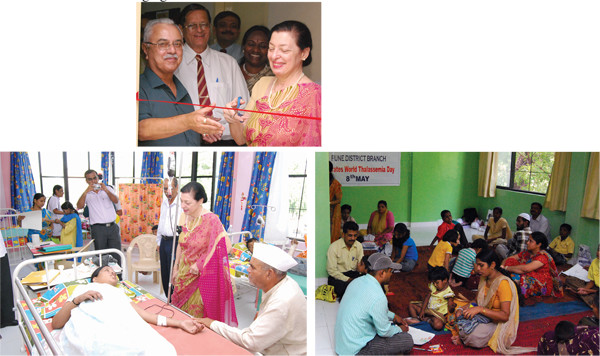
Top: Noshir Nanavatti (left) and Homai Modi inaugurating new Red Cross center Bottom (left): Modi with thalassemia patients; (right) thalassemic children and their families
Repeated transfusions also lead to an accumulation of free iron molecules in the child’s system that cause enlargement of the heart, pressure on kidney and liver functioning and symptoms of jaundice. To take care of this a treatment known as chelation is resorted to, where via medicines and injections the accumulated iron is removed. This is a lifelong treatment and expensive, so poor families have been known to stop it midway resulting in the child’s death.
Each blood transfusion takes around four hours at a stretch, which is torture for children aged five and six years. To lessen their agony, entertainment facilities like a plasma TV, music system, crayons and drawing paper are provided. Parents are allowed to remain with their children during the transfusions.
A diagnostics center has also been started with a digital X-ray machine, sonography and a pathology lab. Dental, eye and ENT outpatient care is provided at a nominal cost and on the anvil is the procurement of a CT scan machine. "Just because the charges are so nominal doesn’t mean the facilities are substandard. Providing the best possible treatment, medicines and facilities is our aim. Zoroastrians can avail of these facilities to their advantage. The charge for an X-ray is Rs 80 and sonography is for Rs 180,” notes Nanavatti.
The HIV/AIDS awareness program conducted in Poona, Nasik and Kolhapur districts has a widely accepted Youth Peer Education Program (YPEP) where awareness is created through lectures as well as educational specialized material and game methods. A self-help group comprising 25 HIV positive families is given free medicines throughout the year and sent to vocational workshops to learn skills so they can earn their livelihood. Counseling is provided to them once a month. A unique feature here is that the family supports the patient whereas in many instances the patient is abandoned because of the stigma attached to HIV/AIDS.
Khursheed Dinshaw
◆ ◆ ◆
From the archive