
Zoroastrians Abroad
The Bella connection
The Parsis of Rangoon had fought and won a place in Parsi history by disputing the right of Bella, said to be the child of a Parsi mother and a Goan father, to worship in the fire temple there. The internecine fight had reached the Privy Council in London whose judgment of 1925 declared that Bella was not entitled as of right, to use the temple or to attend or to participate in any of the religious ceremonies performed therein... But the judges added that it was within the powers of the trustees to permit a non-Parsi admission into the fire temple.
Bella had been adopted by Shapurji Cowasji Captain who had had her navjote performed in 1914; his elder brother Merwanji had opposed her initiation; their younger brother Bomanji, initially the sole trustee of the fire temple, had welcomed Bella there until he was accused of behaving like a dictator and forced in 1919 to accept other trustees of orthodox thinking who eventually outvoted him.
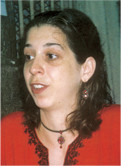
Mitra Sharafi: two lessons from the Bella case
History scholar Mitra Sharafi has been researching the case and its implications for her PhD dissertation through official records as well as oral history among those still alive who remember the events. In the Ninth Memorial Dasturji Dr Kutar Lecture at the School of Oriental and African Studies (later published in abridgement in Hamazor, issue #3, 2006) she had shared her findings:
Bella’s mother, the young Rebekah Jones, had been befriended by Bomanji, a wealthy barrister who had single handedly funded the reconstruction of the Rangoon fire temple in the late 19th century. He claimed to have believed her story that she was of Parsi descent. She became pregnant in 1899 — about the same time that her husband died of tuberculosis. Rebekah was looked after by Bomanji who left for Britain about the time she gave birth. At his bidding, Shapurji looked after the mother and child and when the lady also fell ill with TB she was provided medical care while the child was placed in the care of wetnurses. Rebekah died in the Rangoon General Hospital. Her body was not claimed though Shapurji had been visiting her regularly till then and she was eventually laid in a mass paupers’ grave, identified in the records initially as of "other caste” and later as "Eurasian.” Shapurji and his wife of part Burmese parentage took the child in and raised her as a "de facto Parsi.”
Why was Rebekah so abandoned in death? And why were no Zoroastrian death rites provided for her though most Parsi communities across British India had funds to pay for the purpose? asks Sharafi and notes, "My theory all along was that Ms Jones was not in fact Parsi. I also suspected that Bella’s biological father was not Mr Jones but Ms Jones’ benefactor, Bomanji. This alternate account appeared nowhere in the legal record. There were references to some shameful and embarrassing accusations made by Bella’s opponents, but Bella’s lawyers had succeeded in having these removed from the legal record and the newspapers had only alluded to the accusations in vague terms. I suspected that this version of the story could be valid, but had not a scrap of evidence to back it up.”
Early in 2006 Sharafi says she met the son of Bella’s lawyer who recounted old rumors that Bella was the result of a relationship between a sweeper woman and a member of the Parsi family that adopted her. Thereafter two other Parsis from former Rangoon families reiterated the same story, she notes.
Sharafi claims to have learnt two lessons from the Bella case. First, that this case is part of the ongoing 18th and 19th century conflicts relating to the children of Parsi men and non-Parsi women — usually outside of marriage. It should be cordoned off from the Parsi Punchayet case and from the modern debate on conversion, she states. Second, the case carries a lesson for historians who privilege written sources and fail to seek out living people who may retain some knowledge of the event in question. "It may be collective memory that provides the final piece of the puzzle…”
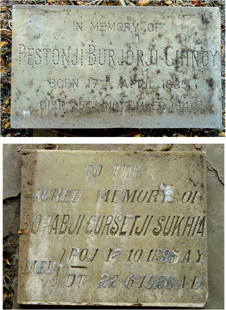
Tombstones from the Parsi aramgah in Rangoon
Presently Jamshedjee jee Bhoy (sic), who claims to be the managing trustee of the Parsee Fire Temple and Burial Ground Trusts, seems to be the only surviving Parsi in Yangon (Rangoon). According to Sharafi he is the great great great grandson of Merwanji. His hold on English is tenuous. In a letter to Parsiana dated September 3, 2007 acknowledging receipt of the magazine he notes, "I request you to explain and inform to some Parsee Zarathushti that our properties are in a very bad situation because of lack of fund which is very low (sic)…My main ideals not disappear it. I will like some parsee to visit me and visit Yangon.” He also types his name as Jamshed Jee Jeebhoy.
Sharafi says she had met Jamshed and his mother Boma, a Parsi with Burmese ancestry, about a year ago. His father Framroze was a radio repair man who was a trustee of the Fire Temple and Burial Ground Trusts. When he inherited the papers at the age of 25 years, he wrote to all the addresses therein asking for funds, Jamshed had told Sharafi. The fire temple was said to have been demolished around1960-64. The one acre burial ground, situated 40 minutes drive out of Rangoon, was nationalized with two weeks notice in 1995. The family saved half the tombstones and needs money ( US$150-200) to restore them. Framroze died in 1996. When Jamshed’s grandmother of Parsi lineage, identified by Sharafi as P. K. Jee Jee Bhoy, died two years ago, Jamshed told Sharafi the family could not afford the US $ 100 cost of a tombstone. Sharafi says that the Fire Temple land with flats built on it is supposed to belong to the Trusts; the annual income the Trusts receive is barely US $ 40.
According to Sharafi, Jamshed is employed doing odd jobs for a construction company. The only child of his parents he had to drop out of school at the age of 15. He had been practicing Zoroastrianism as his grandmother had taught him, communicating with her in English. With his Burma born parents he spoke Burmese. Jamshed needs money and loves to read, says Sharafi. Only registered airmail reaches him. He can be addressed via the Parsee Fire Temple and Burial Ground Trusts, No 44, 36th Street, Room 17/18, 12 Katata (P) 000876, Kyauktada Township, Yangon, Myanmar. Money can be sent via the Myanmar Foreign Bank
Sharafi, who has been surfing oral history in various parts of the world, could get no answer why this family did not flee Rangoon as the others did at the time of the coup in 1962. According to her reading of the situation a couple of Parsis there had converted to Christianity and married Burmese women.
◆ ◆ ◆
From the archive