
Readers' Forum
School centenary
It all began in 1908, when Billimoria High School was established with just eight students, as the then Parsi Boys High School in Panchgani. Since that humble beginning at Hollywood Bungalow on Chesson Road, the School has grown to accommodate about 300 students a year on acres of prime property.
The School building was constructed by Pallonji Plumber at a cost of about five lakh rupees in 1923. When we travel by car from Poona the first thing we notice as we near Panchgani is the famous Sydney Point to our right while the black stone building resembling a fort to the left is the Parsi Boys High School, whose name was changed to Billimoria High School (BHS) after India gained independence.
I joined the Parsi Boys High School as a boarder in 1935. The monthly fee for boarding, lodging etc was Rs 100. A few Parsi families who could not afford to pay Rs 100 were permitted to pay just Rs 60 as the School’s founder, Nowroji Billimoria was eager that many Parsi boys should take advantage of education at the School and grow up to be good citizens. It was Nowroji’s wish that his School should have at least 100 Parsi boarders. Unfortunately, this was not realized and the number of boarders hovered between 80 and 95. Nowroji concentrated on looking after the administration while his two sons, Burjorji and Rustomji supervised teaching and allied matters.
Whenever Nowroji entered the dining hall and sat there for a few minutes there was instant silence. Nobody, not even the senior boys dared speak even in a whisper. Such was the awe in which the founder was held. After Nowroji’s death, the baton passed to his sons who ran the School as joint principals. In this onerous task, they were greatly assisted by the headmaster, Darabshaw Edibam.
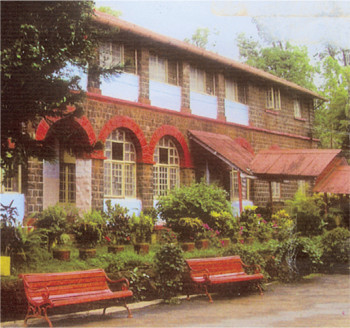
Panchgani’s Billimoria High School is 100 years old
I often wondered why the School had a fascination for the number three. There were three dormitories, three rows of dining tables, three teams of boys, three short bridges to cross over — the only exception being that the boys were divided into four houses known by their colors: Blue, Green, Red and Yellow.
In April 1944 I had to leave my beloved School to appear for my matriculation examinations which were being conducted by the University of Bombay. The nine years I spent as a boarder at the School were the best and happiest that anyone could hope for with dedicated teachers who imparted knowledge which still remains fresh in the mind.
Some of the Parsi boys from the School who later became famous were Sohrab Kotwal, the first Parsi Chief Justice of Bombay, Aspy Engineer, Air Chief Marshall and Ambassador to Iran, K. Satarawala, a bureaucrat who became Lieutenant Governor of Punjab, Jimmy Pocha, leading light of Adi Marzban’s Parsi Gujarati plays and Behram Contractor, better known as Busybee, whose popular column "Round and About” appeared daily for over 25 years (in which he often wrote about his alma mater) and who founded the Afternoon Despatch and Courier, an evening tabloid.
In 1958 and 1968, the School celebrated its golden and diamond jubilees respectively. This being the centenary year, the School invited ex-students to participate in the three-day celebrations. When I went, I saw several changes. The famous black stone façade of the School building was colored with different hues. However, the most important change was the passing of the management from a Parsi family (the Billimorias) to a non-Parsi family (the Goradias), and the introduction of coeducation.
Alas, as often happens, an institution started, nurtured and well established by Parsis has passed into non-Parsi hands.
BHIKHAJI M. ADENWALLA
◆ ◆ ◆
From the archive