
XIV NAZC
Talk with the Titans
Five outstanding Zoroastrian achievers advise the community youths to aspire globally
It had sounded like a pipe dream, getting India’s business icon Ratan Tata to interact at a Zoroastrian congress. When the idea was first mooted, the concept of an interactive media session hadn’t dawned on the community at large. But the XIV North American Zoroastrian Congress has scored a resounding first that will now be emulated again and again at various venues.
With two high profile Zoroastrians — Bombay Parsi Punchayet (BPP) chairman and management guru Minoo Shroff and Bomy Boyce, president of the World Zarathushti Chamber of Commerce (WZCC) — to liaise with Tata and Nadir Godrej, managing director of Godrej Industries, a household name in India, and two Zoroastrian technocrats on either side of the Atlantic — Bombay’s Yazdi Tantra and Toronto’s Kevin Mancherjee — Congress chair Phee Vania came smiling through. Also partaking of the multimedia discussion was former Rajya Sabha member and one of India’s leading jurists, Fali Nariman, from the Taj Mahal Hotel in Delhi. Beer baron Lord Karan Bilimoria of Chelsea, the first Zoroastrian member of Britain’s House of Lords, had a pre-recorded presentation, being out of contact in South Africa at the time.
The Grand Richmond Ballroom of the Sheraton Parkway Toronto North Hotel and Conference Centre held a capacity crowd with two large screens linking two continents arranged perpendicular to the dais on either side. Joining the event’s moderator, Shroff, on the podium was the fifth big name in the internationally spread out community, Byram Avari, chairman of the Karachi based Avari Hotels Group. With business interests in Toronto where he says he is building 1,000 condominiums, Avari was present in person to partake of the discussion. Indeed, after Shroff’s initial introductions, he was the one to kick off the proceedings.
"One million Muslims are obsessed that they are under threat and we 1,20,000 Parsis are obsessed with survival!” Avari jestingly played around with the numbers. Describing himself as one who may "still be orthodox” despite the moderating impact of his wife and daughters-in-law, Avari addressed the question of conversion — a favorite topic with North American liberals. Accepting the concept of adaptability but refuting conversion as a means to that end, Avari noted flatly, "You cannot convert in an Islamic country. Don’t think only of North America (NA). Think of other countries like Pakistan and Iran.” Zoroastrians there will be massacred if the international community accepts the idea of converting others to the faith, he averred. But Avari, once a die-hard orthodox in his approach to the question of Zoroastrian women marrying men of other faiths, noted "let us agree to disagree” and offered a "public apology to Rubyna (Patel) Lovelace for preventing her from praying in an agiary” in Karachi. Though he regretted the incident which occurred several years ago, Avari’s basic message was "concentrate on matchmaking between Zoroastrians in NA.”
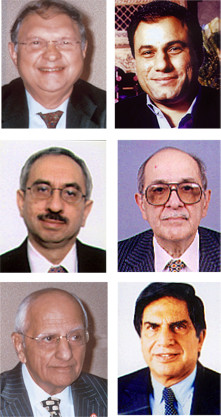
Photos in alphabetical order left to right: top row: Byram Avari, Karan Bilimoria; second row: Nadir Godrej Fali Nariman; third row: Minoo Shroff Ratan Tata
Nariman, senior counsel in India’s Supreme Court who has recently retired from the Rajya Sabha after completing a six-year term as nominee of the President of India and has been internationally acclaimed for his fight for civil rights, was the first one to share his thoughts. "We are indistinguishable (from the host community),” he noted. "We Zoroastrians don’t project ourselves as different. Zoroastrianism today is not a religion but a way of life…(Like the Poles who were once staunch Catholics before they became communists) we believe in the religion of our forefathers but do not practice it.” Though Nariman’s son Rohinton, also a leading advocate, is an ordained priest and scholar, Nariman referred to the overarching articles of the Zoroastrian faith — humata, hukhta, hvarashta — noting that Zoroastrianism makes the least demands on those who belong to it. The conduct and general behavior of parents is assimilated by their children. It is the religion of the good life where service to fellow beings is a part of life. "A Zoroastrian’s word is sacred, not to be broken…I have never met a single Zoroastrian who was not proud to be one. Are we a vanishing species? Not so long as Zarathushtra’s moral teachings inspire those who adhere to it. Despite our dwindling numbers, Parsi Zoroastrians have remained in the mainstream (of Indian social, economic and cultural life)…Let us maintain our character for which we are respected. I know only one truth: ‘Except the Lord build the house, they labor in vain that build it.’”
By the time Nariman finished, Tata had joined Godrej at Bombay’s Taj Mahal Palace Hotel whence they were connected to the gathering in Toronto. Introducing Tata as chairman of Tata Sons and chairman of the Government of India’s Investment Commission, and Godrej, an alumnus of Stanford and the Massachusetts Institute of Technology, as a published poet who is president of the Alliance Francaise in Bombay, Shroff queried them on the future of Zoroastrian participation in India’s economic development. Predictably, both spoke of tremendous opportunities for investment and entrepreneurship in India’s growing economy. "There are a lot of foreigners working now in India,” noted Godrej, attesting to the globalizing process under way.
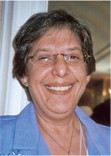
Rubyne (Patel) Lovelace: a wrong righted
Bilimoria described the commonalities between the Parliaments of India and UK, right down to the green seats and carpets in the lower houses, the red in the upper ones. He spoke of Dadabhai Naoroji’s "pride to be elected as the first Indian in Westminster” and his own feelings when he made his maiden speech in the House of Lords. Recalling that his maternal grandfather Dinshaw Italia had been a member of India’s Rajya Sabha, Bilimoria extolled the "legacy of our ancestors, renowned through history for putting back into the community.” Declaring his own immense pride at being British, he added, "I am also very, very proud of my Parsi Zoroastrian roots.” His advice to Zoroastrian youth world wide was, "It is not enough for us to be the best in the world. We need to be the best for the world. Wherever you live, integrate, but never forget your roots.”
Hereafter the Titans fielded questions posed by Shroff on behalf of the assembled community. Addressing the question, "How do we get the Parsi diaspora integrated with the Parsis in India?” Nariman noted that this session between two continents was an "eye-opener.” He urged the successful Zarathushtis of NA to reach out to the younger members of the community in India in their fields of interest. "Furnish a link. While maintaining traditions and culture you could help each other. The young in India need the fillip.”
As a "global person,” as Shroff described him, Tata suggested that the community "should consider itself a global community…integrate in the community wherever you are but do not lose sight of your heritage. Those who’ve risen should help those seeking to rise.” Describing individuals as "centers of excellence,” he advocated that they come together, integrate on a global basis.
On socioeconomic issues Godrej referred to the community’s dwindling numbers and endorsed what Nariman had said earlier: "It is more important that Zoroastrian values survive than Zoroastrians surviving.” He also seconded Avari’s suggestion that "we should listen to each other and accept all views.”
Rejecting the notion that values survive beyond the people who hold them, Avari was adamant on the question of lineage: "We cannot and should not convert. The way to get together is through business. Provide opportunities and interaction. NA can offer technology to Indian and Pakistani Zarathushtis. Pakistan could (accommodate) individuals who have certain qualifications.” More than once he emphasized the need for youths to get to know each other as he was convinced that the young outside India and Pakistan are more religious: "They need the religion to survive.”
Asked to comment on the steel plant that Tatas had considered locating in Iran, Tata referred sadly to "Iran’s negative spotlight” in the world today. "It is a country with tremendous natural resources, skills, a strategic location. It could play a pivotal and important role in the world,” he noted, referring to business possibilities in petrochemicals, gas and iron ore among others. "One could make a contribution to its economy. But politics affects economic viability. Let us hope the present confrontation will be resolved soon.”
Taking a hardheaded look at history, Nariman didn’t want to go back into the "so-called glorious past. The Sasanians showed that religion and politics mix too well. We were as inconsiderate (as others) when we had the power… (Instead) show what the Gathas stand for. How they have helped a small group of people all over the world…The WZCC is a binding force, keep it up and don’t indulge in mindless quarrels on how to dispose of the dead. It doesn’t behove us.” And, on the question why there were no Parsis in politics, he factored in the dwindling population somewhat facetiously, claiming that Parsis are people who cannot survive in this muddied milieu. He claimed he tells his non-Parsi friends, "There are so few places in heaven, only Parsis can go there… everyone else is damned because we can’t have heaven cramped!” Then, more soberly, he noted, "Politics in our country does not have the fascination it has in the West. That’s true of Pakistan too. We don’t have enough vote banks to vote for us.”
Asked to comment on the unique selling point of Parsis, Tata stated, "The underlying value systems are similar with most religions. That high values and integrity have become embedded in our small community is a tribute to our ancestors and forefathers who set the value systems.” Asked if Bill and Melinda Gates can be considered Parsis because of their charity, Tata, a trustee of their foundation, noted, "Philanthropy is not a religion. It comes from the heart. (We can’t) compare with Bill Gates. He is one of the world’s great philanthropists today. He will go down in history as someone who has made a difference.”
While Godrej noted his concurrence with the XIV Congress’ aim to set up a formal process for mentoring in the community, Avari suggested that the WZCC could be a great body for developing Zoroastrian entrepreneurship through mentoring. The snag is that "Parsis are so happy in jobs…In the entire country (Pakistan) Parsi professionals have the highest respect. They are offered 50 to 100 percent more salary!”
Responding to a question, Tata noted that while his source of inspiration had changed with time, J. R. D. Tata had been a "major role model.” In keeping with the Tata tradition, he noted, "I told my AGM, don’t consider Tatas as a Parsi company. One thing we should move away from is isolating ourselves as a Parsi group or enterprise or company. Be courageous enough to compete with the best in the world,” he advised his listeners. "Godrej has competed against global companies. So have we. Karan’s (beer) is a global enterprise. Parsis should consider the world as their target. Help each other, but don’t turn to each other for shelter. Lend funds and expertise to create more enterprise…”
"We have agreed to disagree. I wouldn’t want my group to be called a Pakistani group. I would prefer to be known as a Parsi group,” maintained Avari. "My duty is to support the Parsi community…I don’t say we should not compete internationally, but we must push for Parsis. I’d let them jump the queue if I can.” But he agreed with Shroff, noting, "I am sorry to say (Pakistani Parsis) are spoilt…Every single Parsi gets money for education, including education abroad, medical benefits, etc. They have a high standard of living but they want the rent to be subsidized!” Concurred Shroff, "Parsis are a great community but spoilt.” Noting that the community’s self-confidence in India has taken a beating, he added. "We have to keep the flag flying. We are attempting to get a few seats for the youths in institutions established by Parsis. We have to maintain not only economic but socioreligious well-being. Values for which the community is known, must prevail.”
The event had been held on Canada’s National Day. Lawyer and Crown prosecutor David Zimmer, a member of parliament and secretary to the deputy governor of Ontario, noted with surprise and approval that the event he had witnessed and the discussion he had listened to was an ancient one. He was currently reading a biography of the great philosopher of the 17th century Benedict de Spinoza. "The book stresses on integration and ethnicity in the 17th century. You are discussing the same issues here: the preservation of ethnicity and culture together with integration…”
◆ ◆ ◆
From the archive