
Religion
“Go, be successful”
Childhood influences and the trials of youth are hard to forget
Now touching 81 years, 40 of which were spent in the Army and the last 25 in public service mostly for the community, I venture to put forward a somewhat unusual perspective paying my homage to the temple of our faith.
My early childhood was typically Parsi, in the mo-ffusil of the then Bombay Presidency. I was born in a railway household, where within two years of my birth my father was elevated to the rank of an officer (a rare privilege in those days). I was brought up mostly at my maternal grandparents’ home in Valsad where Khan Bahadur Cawasjee Dhan-jishaw Billimoria was a revered name both within the police as also the general public. My father, like most people of that era, spent an hour or two each day reading from the Khordeh Avesta. On the other hand, my mother unlike ladies of the time did not believe in rituals. It was, however, she who stamped the basic philosophy of the tenets of the Zoroastrian faith on us and influenced our spiritual upbringing.
We children once asked her what to pray for at a fire temple. Her answer was very simple and direct: "Tandarosti ané buddhi jé thi ké hun maari faraj bajaun. (Good health of body and mind so that I can perform my duty).” The Gujarati words give a far greater impact than their English translation and became our sheet anchors of duty which at a later date we could extrapolate from the Zoroastrian texts.
There were however one or two basic rituals which stuck firmly in the mind. On our birthdays we children were taken to the agiary, clutching firmly in our fingers the two anna coin to be put in the chamach (ladle). Our elders ensured that they carried clean handkerchiefs to dry our hands after the ceremonial entrance wash. Another now forgotten ritual, was a visit to the agiary not only on Pateti day but even more importantly on Amardad Sal thereafter, to pay homage to the departed souls of the community whose lotas (now modernized into vases) were to be taken down after the muktad ceremonies. The family’s own departed were remembered in their own homes. The 18 days of the muktad were very special. The ladies of the household got up very early in the morning and there was great activity not merely for the prayers but for the preparation of the tempting chasni (consecrated) eats. These were much better remembered by us youngsters than the Gathic prayers preceding them.
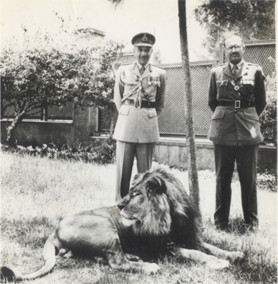
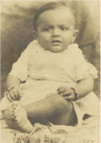
Sethna (top) as a one-year-old and (alongside, far right) with Gen Wadalia in Ethiopia
Is there a symbiotic connection between food and rituals amongst the Parsis? Is there not also a requirement to better understand the changes which have kept taking place, almost inobtrusively over the years based on practical considerations and their ultimate acceptance by the community?
My maternal grandmother used to read aloud to me from the Kaiser-e-Hind Weekly reports on cricket matches and other news items of interest. One hot topic for debate was the women being kept secluded during their "period.” She had firm views on it. At my paternal grandparents’ house this custom was observed but they exempted my mother from it. We children saw for ourselves the special rooms and crude iron furniture on which our aunts were forced to spend their "time.”
A few years ago Jamshed Guzder (chairman emeritus of the Bombay Parsi Punchayet) told us of the revolt in his father’s household by his mother and aunt. He recalled the utter horror of his father, when on returning from the agiary one day, he found his mother, aunt and other ladies with their hair no longer covered in the traditional mathu banu. The ladies said that they had decided to keep their hair uncovered in the house but would cover it decorously under the sor of their saris when going out. They declared that they would no longer observe the barbaric customs forced on them by the men and be secluded during their "time.” They added that they had spoken to their friends who would follow suit. The men could keep away from them if they wanted to be "so pure!”
Over a quarter of a century earlier, the education of Parsi women had been started by Dadabhai Naoroji and his band of reformers who had introduced female education. They had put a stop to child marriage and ensured that widows could remarry. This was a part of the reform process in India, and western India in particular. The Parsis had been in the lead in this. Change has therefore been a part of life. The community has played up controversies but finally accepted change.
I refer to these matters as they were the urgent topics of discussion which even we children learnt to live with and they became a part of our upbringing.
I attended Sir R. J. J. Middle School and later spent one year at Bai Avabai (Petit) High School in Valsad and studied Gujarati, English as the second language, and Persian. My early childhood was therefore in a typical Parsi ambience. Although my father was now an officer of the BB & CI Railway and was brought increasingly close to British and other Indian Railway officers, his frequent transfers had kept me with my maternal grandparents where I had a chance to interact with my uncles and cousins — my eldest maternal uncle being a policeman who ultimately become the Inspector General of Police, Bombay Presidency and the youngest, one of four Parsi officers sent to Sandhrust to be commissioned as one of India’s seniormost King Commissioned Officers. His son, my late cousin, retired as Lt Gen Faridoon N. Billimoria and his son Karan has recently been elevated to the House of Lords in the United Kingdom.
We grew up in Valsad with these indelible Parsi impressions. It was only thereafter that they were overlaid by a much vaster patina of all India culture and religions showing our inherent Parsism in its overall perspective.
Expanding canvas
My grandmother had presented me with a Khordeh Avesta on my navjote. I used it to recite my prayers at the Doon School every evening to the amusement of my roommates, a Hindu, a Muslim and a Sikh. I not only wore my sudreh and kusti but showed it off under my PT singlet where it ballooned out most prominently.
Cowas Adenwalla, now Seth Cowas-jee Nusserwanji Dinshaw, a great orthodox akabar of Bombay and Bangalore similarly showed off his sudreh with pride! Some two years ago he invited me to speak at Allbless Baug but warned me not to be too reformist in my approach!
At the Doon School we wore Parsi daglis as part of our Indian national costumes at the Saturday night’s entertainment. The Khans from Swat, the Lalas from Delhi, the Sardars from all over and the princes of Mysore, Baroda and other states came out in their traditional finery. At a pageant in 1937, we Parsis presented a tableau of the Bombay Stock Exchange for which some of us had to borrow our father’s phetas because at school we only had Parsi caps.
The School permitted and even encouraged us to hold on to our own beliefs. Mr Ashraf, our Persian master, helped me to understand in plain language the Pazend paragraphs from the Din No Kalmo — one of our basic tenets, almost the catechism of Zoroastrianism. By the time I was an adolescent I had begun to understand how a proud Parsi could also be a proud Indian.
As a student at Allahabad University, then regarded as the Cambridge of India, my most memorable experience was to go to the agiary on my birthday in 1941. The young priest there was chanting his prayers so beautifully that I believe he may not even have noticed my presence. I sat and listened in rapt attention and was so moved that I did not go through any of the normal rituals of a birthday at an agiary.
We were three Parsi students at Allahabad University at that time and through the good offices of Dr Pheroze Dastur, Feroze Gandhi’s mother had us all invited to her son’s wedding to Priyadarshni Indira Nehru, later to be the Prime Minister of India. Jawaharlal Nehru’s card was in Roman Hindustani. We were received by Vijay Lakshmi Pandit, but only with "gulab jal” and a petal of flower. We had all hoped for a Parsi meal!
Strength from spirituality
My 40 years in the Army would have ended within the first four weeks. At the Officers Training School (set up on the campus of Formen Christian College, Lahore) was an imposing obstacle course. The first obstacle was a jump over a six-foot-deep ditch. One had to take a leap to cross it and then go over the other obstacles which followed. Most cadets literally walked across. Some took a broad jump and were over. I just could not begin the course and froze at the very first obstacle. After three weeks, the staff sergeant gave me a warning and said that unless I was over it the following Monday he had no option but to recommend my withdrawal; in plain words, send me home.
The preceding Sunday Gulam Gillani Khan (Jill to his friends) took me by the hand and said he would make me jump the first obstacle that very day, come what may.
I stood on its edge quaking. He asked me if I could hear the Gurbani from the nearby Gurdwara. I said, it was beautiful but it had no meaning for me. He put out his hand from the other side and asked me to grasp it. I tried but fell into the ditch. He pulled me out and sternly made me get back.
He threatened, cajoled and then pleaded asking me, "Don’t you remember anything your mother taught you?” In my befuddled state I suddenly remembered my mother’s instructions before I set out for Lahore, "Jao faté karo (Go, be successful),” "Atha ni madad (God’s blessings).” To that has been added in later years her additional injunction "Bhala kam karta rehjo (continue doing good work).”
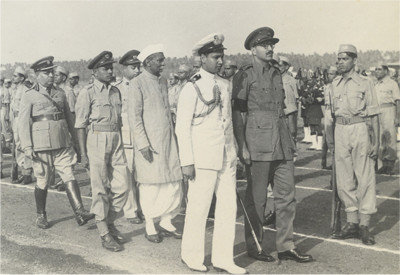
Adi Sethna with Dr Rajendra Prasad inspecting guard of honor
Rather than break her heart if I were to get the sack, Jill suggested I get back to the starting block and shout "Atha ni madad.” "Run, do anything but jump,” he advised. I jumped at a run, then at a walk, then from a standing jump and yet Jill kept me jumping with both of us shouting "Atha ni madad.”
Next morning Jill was with me when the staff sergeant asked "Are you ready?” At the first attempt I once again fell into the ditch. Jill started laughing and told the sergeant how I had crossed the obstacle the previous day, telling him "Now watch.” He pulled me out, made me get back to the starting block and ordered me to jump once again shouting "Atha ni madad.” And jump I did, and laughingly asked the sergeant, "Shall I do it again, and again?” which also I did. He told me that now that I had crossed the obstacle he wanted me to cover the whole obstacle course, which too I did.
Not only that, but I went on to complete the remaining Officers Training School course at the Indian Military Academy with flying colors and got the regiment — The Rajputana Rifles — of my choice, which I had the honor to serve with distinction for 40 years ending up as its colonel, the highest honor a regiment can bestow on its officer. I completed my career as vice chief of the Army Staff with the Padma Bhushan, Param Vishist Seva Medal, Ati Vishist Seva Medal after my name.
Soldiers over the ages have learnt to believe that without His help nothing is possible. A businessman can go bankrupt, a politician can lose elections but for a soldier and an officer of the Indian Army the words of Lord Chewood at the entrance of the Indian Military Academy are deeply engrained in his conscience: "The safety, the honor, the welfare of your country come first always, every time; the honor, the welfare and comfort of the men you command come next; your own ease, comfort and safety come last, always and every time.”
Jill and I served together in the old Indian Army until Partition. In Pakistan, he became the first lieutenant general from our batch and ended up as the governor of West Pakistan. I wonder if he ever received my many letters of congratulations and thanks after our armies were divided. It was only due to his insistence in making me remember the tenet of my faith — "Atha ni madad” — that I could persevere, otherwise I would have been given an ignominious sack in October 1943.
And all this can only come about by the grace of Ahura Mazda, the spiritual sheet anchor on which I believe my life has depended ever since that fateful day in October 1943. Much has happened since then but this sheet anchor still remains the foundation of my spirituality. It is not mere religiosity but stems from a much deeper invocation.
◆ ◆ ◆
From the archive