
Health
“An angel with broken wings”
The travails and joys of bringing up a ‘special’ child and the importance of a support group are related by Gulshan Kavarana
"We consider Zara a blessing in our lives. Even though she doesn’t speak a single word to us, she speaks to us through her silence. She’s taught us the true meaning of life…of unconditional love…not to judge people…to stand up for people who have special needs. She’s taught us to take one day at a time and to take small steps. It’s because of her that we have learnt to appreciate life and not to take things for granted. She’s brought us closer to God,” notes Dubai based Gulshan Kavarana, mother of a nine-year-old "angel with broken wings.”
From the time Zara had her first seizure at four months of age within a few hours of being administered her second dose of DPT (diphtheria-pertussis-tetanus) vaccine at a clinic in Dubai, the family has been on a roller-coaster ride, their elations and depressions linked to Zara’s progress and regression, the mother sent a detailed account to Parsiana of the many upheavals in their life. To see their once happy, bubbly baby become a zombie overnight due to severe brain damage was traumatic for the parents. Even worse was to see the multiple seizures cause her to stop doing the things she once could. "She stopped playing with her toys, she stopped saying the six meaningful words she used to, she stopped eating and drinking by herself, she stopped walking, she stopped sleeping all night, she stopped making eye contact with us, she stopped crying and the hardest blow was when she stopped smiling…
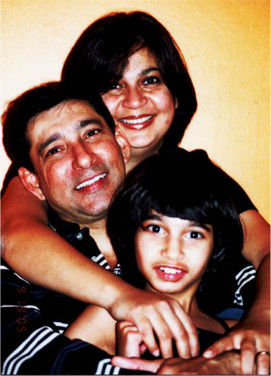
Gulshan, Zeheer and Zara Kavarana
"I think if I did not have the strong support of my husband Zeheer, elder daughter Jenai, 16, and my family and friends, I would have had a nervous breakdown,” candidly admits Gulshan who went down the road of guilt, denial, self pity, anger, helplessness until she reached the acceptance stage. Desperate to find a cure for Zara, the Kavaranas, based in Dubai, succumbed to "doctor shopping,” sending her reports to doctors in America, Canada, France, United Kingdom, Australia and all over India but none of the medicos gave any positive reply. "I believed there would be a doctor somewhere in the world who would have a cure for my Zara…I still have that belief…I will never give up,” writes Gulshan.
"It’s so hard to explain to doctors whom we have seen so far that my husband and I are not blood relatives. The doctors always have tried to push my daughter’s condition to our ‘bad’ genes… I have been told very often by these doctors, ‘Oh! You Parsis always marry your cousins so your children are disabled’…Not a single doctor has accepted that Zara is a vaccine injury case and nor have they come to any conclusions on what her condition is or why she is the way she is. That’s why I owe it to Zara to make people aware that vaccine injuries do happen” even though very rare. Zara receives treatment for Dravets syndrome — a severe epilepsy that causes seizures but "all the so-called anti-epileptic drugs that are supposed to control seizures have been tried out with no positive results. Zara continues getting an average of about five-six seizures every month…” Gulshan narrates so that others can learn from their experience.
With the patience of occupational therapist Saif Beejliwala and Zara’s efforts she managed to relearn to sit on a swing, to crawl and even to walk and eat by herself again. Unable to communicate her basic needs the family tries to "keep to a routine so she eats when we feed her, she drinks when we give her water. The only thing we know for sure that she enjoys eating is dhansak which we eat every Friday… Sometimes we do catch a glimpse of a smile and that moment brings a smile to our faces.”
Jenai learnt to play the guitar and has even composed songs because Zara loves music. Gulshan says, "Zara has helped spur my creative side even further.” Presently teaching art to children with special needs, she notes, "Initially I thought I was at the Dubai Centre for Special Needs as a volunteer so that I could help the children but very soon…I realized that the children at the Dubai Centre were actually helping me. The children taught me to smile again; they taught me that nothing was impossible. Being with them made me feel whole again.” She is planning to bring out an illustrated book so that ‘normal’ people can better understand children with disabilities. As Gulshan recalls, "Every time we went out in public, the stress, the questions and the reactions were extremely hard to handle…The stares sometimes are the cruelest things.
"I have come this far only because of the support I got from all my family and friends,” Gulshan gratefully acknowledges the very many ways in which those concerned have helped her family through prayers and thoughtful deeds.
The lessons Gulshan learnt along the way she tries to share with ‘special parents’ of ‘special children’:
Believe you were chosen to be the parent of your child. He knows you had the strength, the will, the patience and immense love.
Take one day at a time. Don’t waste time worrying about the future.
Be honest with your feelings. Allow yourself jealousy, anger, pity, frustrations, tears, depression in small amounts, whenever necessary. Answer only to your conscience.
Surround yourself with positive people.
Keep and use a sense of humor; cracking up with laughter keeps you from cracking up from stress.
Accept that you are in a difficult situation. Remind yourself that things could have been worse.
Keep in mind the feelings and needs of your spouse and your other children.
You can’t be a super-parent 24 hours a day. Take your break and do not have any guilt.
Accept your child and love him/her unconditionally…only then will the world accept him/her.
Never underestimate your child’s potential.
Learn to appreciate the little miracles in your life that others take for granted.
Be a part of a support group. If you can’t find any, then simply start your own.
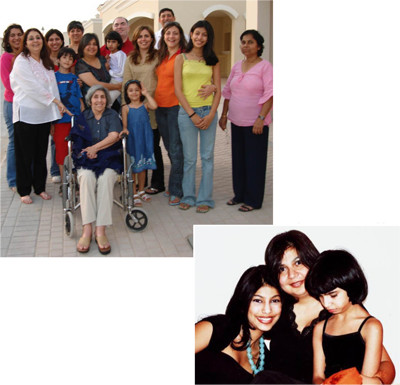
Above: Gulshan carrying Zara values the support of family and friends; (right) with Jenai and Zara
Vital Support Group
"Before Zara came into my life, I was living in a cocoon (living only for my family and friends). Zara helped me spread my wings…helping me reach out to many, many people,” relates Gulshan, explaining how the Special Families Support (SFS) group started in her house in Dubai on December 9, 1999 when about a dozen families came with children with different disabilities. "Finally I felt that I was not alone in this world. There were other people too who were going through difficult times… I have parents call me any time of the day or night when they feel that they need to talk to someone…So many families have continued to stay on and benefit from SFS.”
In Bombay, Kavarana, Kumi Daroo-wala and Hutoxi Doodhwala, assisted by a couple of experienced personnel have joined hands and the Rustom Baug Association has formed a Support Group to bring together parents and children in need of special care. Kavarana addressed the first get-together to raise awareness and to bring laughter and joy back into the lives of these ‘special’ families. They have organized a few sessions on physical training, occupation therapy, self reliance, etc. The poor, needy and uneducated parents of special children do not know how to handle their problems. These children may attend special schools but the families require financial support and guidance. They are apprehensive of what will happen after them. The Support Group welcomes enrolment from families with children in need of special care to facilitate interaction and for their better future. Those who wish to give or receive help may contact the following Kavarana (e-mail: gulshankavarana@gmail.com, Tel: 009714-2712348, Doodhwala (Tel: 23722859) or Daroowala (Tel: 23724492).
◆ ◆ ◆
From the archive