
Demography
2.5 million Zoroastrians?
The figures cited by the World Christian Encyclopedia for the international Zoroastrian community have no basis in fact
One of the major objections to the formation of the proposed world body has been the fear that millions of converts would converge on Bombay and usurp our assets.
In support of this concept orthodox leaders such as Khojeste Mistree have been citing statistics which they claim are from the World Christian Encyclopedia (WCE).
In his power point presentation made to the trustees of the Bombay Parsi Punchayet and subsequently at Bardoli, Mistree had stated, "According to the World Christian Encyclopedia, Oxford University Press, 2001, conversions to Zoroastrianism are taking place in Afghanistan, Tajikistan, Uzbekistan, Iran. We also know that non-Zoroastrians are being converted and accepted into Zoroastrian associations and anjumans affiliated with FEZANA (Federation of Zoroastrian Assciations of North America).”
The WCE defines Zoroastrianism as "a religion founded in Persia in BC 1200 by the prophet Zoroaster teaching the worship of Ahura Mazda, now followed by Parsis in India and a large underground presence in Iran, Afghanistan, et alia. Global total AD 2000: 2.5 million.”
It further defines Parsis as "descendants of Zoroastrians of Persia, worshippers of Ahura Mazda (with two) sects, Kadmis and Shahanshahis. Global statistics: (1970) 122,000; (1995) 2.2 million in 24 countries; largest Iran (1.7 million); (2000) 2.5 million; (2025) 4.4 million.”
These two entries on pg 677 and pg 669 in the second of the two-volume set edited by David B. Barrett, George T. Kurian and Todd M. Johnson and published by the Oxford University Press, New York, in 2001 seem to bear out the figures repeatedly quoted by Mistree (see "A tale of two worlds,” Parsiana, April 2005) in his relentless opposition to the proposed world body of Zoroastrians — but do they?
Parsiana reproduces the country-wise figures as depicted in the WCE in the chart on page 24. Some of the figures boggle the mind in terms of their total irrationality. Take the case of Afghanistan where from zero Zoroastrians in 1900 and 1970 the WCE depicts 191,800 in 1990, 260,000 in 1995 and 304,454 in 2000 (Country Table 1: Religious Adherents 1900-2025). A note below the table states, "No population census has ever been taken.” In their "notes on religions” the book states, "Large numbers (in Afghanistan) are known to be secret followers of this ancient historic faith of Persia.” There is no specific indication of where these figures of "secret followers” come from. If one recalls the turbulence of modern Afghanistan to which the world has been a witness even before the Soviet invasion in 1979, one wonders at the authenticity of these figures cited with such precision.
Coming to the Parsi home base, statistics for Zoroastrians in the WCE should prove a boost for the orthodox who claim there is no decline in numbers. According to the WCE the Zoroastrian community in India has been on the rise from 93,000 in 1900 to 170,000 in 1990, 195,000 in 1995 and 212,661 in 2000! (The Government of India census of 2001 mentions 69,601 Zoroastrians.) The only concession to reality is a drop of 3,000 adherents in 1970 to 90,000. The rate of change per annum between 1990-2000 is given to be 3,255 by natural increase (births less deaths) plus 1,011 converts leading to a growth rate of 2.26! By 2025 the Encyclopedia anticipates a Zoroastrian community of 350,000 in India! Though the notes at the bottom of the table on religious adherents in India (pg 360) quotes censuses, there is nothing to show whether the implication is to the Government of India censuses or not. There is no specific reference to Zoroastrians there.
However, in volume 2, in an ethnic analysis titled "Ethnosphere,” Parsis are shown to comprise 0.02099 percent of the total population of India. The figures of the race as cited here are 195,976 in 1995, 212,768 in 2000 and 279,261 projected for 2025. They are described as "followers of the Parsi religion (Zoroastrianism) in India since AD 750: fire-temples. Mainly in Bombay. Zoroastrians 99 percent (pp 106-107).” In the small entry under Zoroastrianism in the "Dictionary,” there is a picture of two Zarathushti women with a ses and a caption that says "procession underway in North America (p 677).” Also among "A selection of non-Christian religionists” is a picture of Parsi priests in what looks like the main hall of the H. B. Wadia Atas Behram. The caption notes: "Zoroastrian or Parsi priests in the Fire-temple worship spirit of goodness and light, Ahura Mazda, under form of continually burning sacred fire. Adherents are declining because no converts are accepted (pg 9).”
If the WCE is to be believed, Zoroastrians in Iran are cocking a snoot at the Islamic authorities. Starting with 10,000 in 1900 they have been marching ahead to reach 22,500 in 1970, 1,500,000 in 1990, 1,700,000 in 1995 and 1,903,182 in 2000! The rate of change per annum between 1990 and 2000 is given as 30,350 natural increase (births minus deaths) plus 9,968 converts working out to 2.41 percent which the WCE extrapolates to reach 3,200,000 in 2025! In the notes the Encyclopedia cites the censuses of 1956 (Parsis 15,723, 0.1 percent of the total population), 1966 (Parsis 19,816, 0.1 percent of the total population), 1976 (Zoroastrians 0.06 percent of the total population) and 1986 (Zoroastrians 0.07 percent of the total population). (To Parsiana’s knowledge the first — and only — Iranian national census with religious affiliations was in 1986.) The note on Zoroastrians states, "Descendants of Zoroastrians, now concentrated in Yazd in central Iran, Kerman to the south and Tehran. Counted as Muslims before 1975, now experiencing a renaissance. Also called Guebers or Parsis.”
On the following page the editors include a paragraph on Zoroastrianism. The history as cited is somewhat different from what we know: "Zoroastrianism, known elsewhere as Parsiism, began in the 6th century BC as Zoroastrianism, with the preaching of Zara-thushtra who succeeded in eliminating all deities of Iranian pantheon except Ahura Mazda, the One True God. During the period of Sassanid rule in Persia, from 7th to 3rd centuries BC (sic), Zoroastrianism became the symbol of national and cultural identity as well as the state religion, although later it was unable to withstand the Muslim onslaught which began in the 7th century AD. The largest Parsi communities are in Tehran, Tazd (sic), Kerman and Isfahan.”
Considering that in the past Mistree used to try to muzzle any public discussion on the acceptance of Tajik Zoroastrians by the emotional plea that it would lead to a "backlash from Muslims on Iranian Zoroastrians because they are a hostage community,” (see "Revival, not survival,” Parsiana, March 2004), these figures are ludicrous. As it is generally believed that any conversion out of Islam in that country is an act punishable by death, these figures need to be viewed with caution if not skepticism.
In Canada where the first Zoroastrian associations were formed in Quebec and Vancouver in the 1960s, the WCE recognizes no Zarathushti presence until 1990 when the figure cited is 19,000, moving upward to 22,000 in 1995 and 24,917 in 2000. With a natural increase of 229 per year (1990-2000) plus 363 converts, the community is clocking a growth rate of 2.75 and hence is expected to reach the figure of 40,000 in 2025. There is no further explanation or comment on Zoroastrians in this chapter.
Similarly, in the USA 42,400 Zoroastrians in 1990 (zero Zoroastrians in 1900 and 1970) are said to have increased to 47,530 in 1995 and 52,721 in 2000. They clock a growth rate of 2.20 per cent on the basis of 405 natural growth plus 627 conversions per year in the period 1990-2000, and have been projected to reach the figure of 84,000 by the year 2025. Apart from terming Parsis as "other religionists,” meaning "committed non-Christian members of a number of smaller bodies,” there is no further reference to the Zoroastrian religion/community.
In case these North American figures are attributed to the activity of the California based Zarathushtrian Assembly and its principal founder Ali Jafarey who the traditionalists love to hate, one must in all humility commend this organization’s breathtaking efficiency!
In contrast the figures cited in the WCE for the emerging nations of Eurasia like Kazakhstan, Kirghizia, Tajikistan and Uzbekistan are modest. All these lands formed part of the Greater Iran that belonged to the Zoroastrian empires of the Achemenians, Parthians and Sasanians and hence share the culture of the area. After the breakup of the USSR and the revival of religion in these once atheist states, there has been a search for roots of which we in India have had ample examples including a delegation of Zoroastrians from Tajikistan.
It is interesting too to note that while the WCE has not overlooked 11 Zoroastrians in Belgium, 55 in the Netherlands, 23 in Seychelles and 32 in Syria in 2000, the oldest Zoroastrian settlement in the West, in Great Britain, now believed to number 5,000 souls, finds no mention at all. Neither does the community in Singapore nor in South Africa where its presence, though not large, has been historic. But Uganda’s 100 Zoroastrians in 1970 have been mentioned as also Tanzania’s 100 in 1970, 100 in 1990, 110 in 1995 and 130 in 2000 growing at a rate of 2.66 percent entirely on biological grounds, to reach an expected 250 in 2025! And contrary to traditionalist fears voiced on the Internet regarding mushrooming Zoroastrian converts in Brazil, the WCE mentions no Zoroastrians in Latin America even though they exist.
In volume 2, chapter on "Profiles of the 270 largest of the 10,000 distinct religions worldwide,” table 7.4 describes Zoroastrianism as a "megareligion” i.e. a world religion with a family of "mega-traditions” — a category comprising 150 religions whose adherents number between one and 20 million. Established in 1000 BC, it numbers 2,544,000 adherents in 24 countries with the base in Iran (pg 79). According to Table 1-2 (volume 1, pg 95) the population of the world is increasing by 196,000 per day. Of these, 160 are said to be Zoroastrians!
Only two community organizations are listed in their "Directory of non-Christian religions,” viz the Zoroastrian Anjuman, Tehran (pg 774) and the Federation of Zoroastrian Associations of North America (pg 775).
This second edition of the WCE "describes empirical Christianity — those facts about the Christian world which are measureable,” states the Preface by David B. Barrett. "In fact, over 150 years now, most of the Christian world’s denominations and agencies have been conducting an annual census which is probably the world’s largest single detailed enumeration. In it some 10 million church leaders, clergy, and other Christian workers of every description are invited or instructed by their agencies to compile an annual report and to fill out sizable statistical questions. Soon after, these 10 million completed questionnaires are received in home offices and headquarters. After limited circulation to senior staff, most are then placed in archives. Only occasionally are scholars or researchers invited to analyze this enormous gold mine of new data and information. Meanwhile, year by year the data continue to pour in, accumulating at ever-increasing rates, justifying the whole endeavor being described as a megacensus. The present Encyclopedia has had access to much of this documentation, leading to this attempt to set out the survey data country by country in the global context.”
The immense exercise that the WCE embodies may be accurate in its other, especially Christian, computations. We have neither the expertise nor the desire to question the editors on any other aspect of their work. They have presented Zoroastrianism as a very small but resilient and growing faith worldwide. Any other community — except the Parsis — would probably welcome such an exposition presenting a resurgence of their faith. However, if the figures are used to rouse fear and create pandemonium, one must examine them in the light of ground reality. Sanity depends on that.
Other nuggets from the WCE
Pakistan is another case where the figures seem to fly in the face of ground reality. (According to Mistree there are 2,150 in that country.) Starting with 4,000 in 1900, the progression as recorded here is 5,200 in 1970, 19,000 in 1990, 22,000 in 1995 and 25,037 in 2000. The natural increase of 595 per year between 1990 and 2000 is buttressed by a nominal nine converts to clock a growth rate of 2.80 percent which has been used to project a figure of 47,000 Zoroastrians in that country in 2025. According to the census figures cited, there were 5,320 Parsis in 1951, 5,219 Parsis in 1961 and comprised 0.008 percent of the population in 1981. The note says that Parsis are "mainly in Karachi.” The ladies of the Karachi Zarthusti Banoo Mandal have much work cut out for them.
Starting with 500 Zoroastrians in 1900, Sri Lankan Zoroastrians had increased to 1,800 in 1970, 2,000 in 1990, 2,140 in 1995 and 2,259 in 2000. Their annual natural increase in 1990-2000 is computed at 21 per year and with the addition of five annual conversions produces a growth rate of 1.23 percent to project a community of 3,500 in 2025. While the once thriving community in Ceylon chose in large measure to return to India or migrate to Australia/New Zealand/Hong Kong as Parsiana had been hearing over the years, this growth in population may be of interest to Zoroastrian leaders there like former finance minister Kairshasp Choksy.
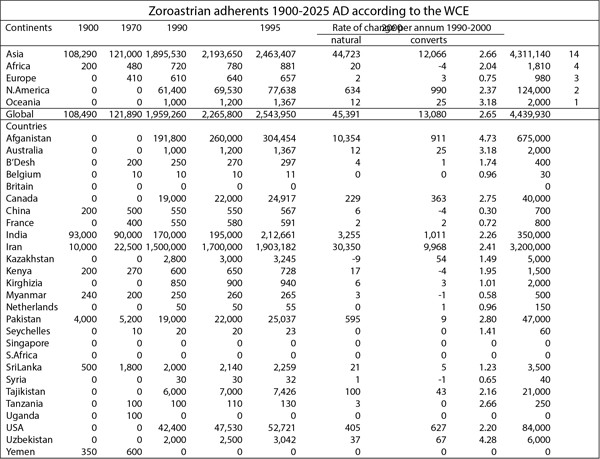
Tajikistan, according to the WCE had no Zoroastrians in 1970 but totalled 6,000 in 1990, 7,000 in 1995 and 7,426 in 2000. The community’s rate of growth there is assessed at 2.16 percent on the basis of 100 biological growth plus 43 conversions per year in the 1990-2000 period and a prospective number of 21,000 in 2025. There is no other reference to Zoroastrians in the chapter.
Similarly, Uzbekistan’s Zoroastrians numbered 2,000 in 1990, 2,500 in 1995 and 3,042 in 2000. With a natural increase of 37 plus 67 conversions per year in 1990-2000 they are said to have registered a growth rate of 4.28 percent which has been projected to an expected community size of 6,000 in 2025. There is no other reference to the community in this chapter.
Kazakhstan’s Zoroastrians are said to have numbered 2,800 in 1990, 3,000 in 1995 and 3,245 in 2000. With a negative biological rate of minus nine and 54 conversions per year, the community is projected to grow by 1.49 percent per year to reach 5,000 in 2025. No further reference to the religion/community in the chapter.
Kirghizia had 850 Zoroastrians in 1990, 900 in 1995 and 940 in 200. Their growth rate of 1.01 percent based on a natural increase of six plus three conversions per annum (1990-2000) placed their anticipated number in 2025 at 2,000. No other reference.
Another interesting statistic is the entry for Kenya where the community is shown to have grown from 200 in 1900 to 270 in 1970, 600 in 1990, 650 in 1995 and 728 in 2000. A case to note is that its biological increase of 17 per annum (1990-2000) is partly negated by out-conversion at the rate of four per year. Its annual growth rate of 1.95 nonetheless leads to a projection of 1,500 Zarathushtis in 2025.
The editors also provide some light on Zoroastrians in Myanmar (Burma). The 240 Zarathushtis of 1900 declined to 200 in 1970 before rising to 250 in 1990, 260 in 1995 and 265 in 2000. Though its natural yearly increase of three is reduced by an out conversion, the growth rate of 0.58 percent is expected to help the community reach 500 by 2025.
◆ ◆ ◆
From the archive