
Sports
Himalayan high road
It was an epic 16,000 km drive spread over 80 days. The adventures were several — from negotiating the slush-and-clay track that passes as the Srinagar-Kargil highway, barely wide enough for one vehicle sliding in the slush, a vast Himalayan abyss on one side; to "driving like bats out of hell to get to our night halt before curfew” in Nepal due to the insurgency and Maoist movement there; to an 11-hour crossing of the Brahma-putra in Arunachal Pradesh, heavily-loaded Scorpios precariously perched on canoes!
It was physically a very tough trip, says Farah Vakil. Being the primary driver in one of the Scorpios, Vakil told Parsiana that she did 98 percent of the driving throughout the expedition. Though other women were present as relief drivers, she was the only woman who drove from start to finish.
Describing in detail the journey in her article "Mile-eating in the mountains,” in the December 2004 issue of Autocar India, Vakil writes that the eclectic group of 16 people in two Mahindra Scorpios, a Bolero and an Invader were attempting a venture that had never been undertaken before. We were all "unsure that it was actually possible to traverse the Indian Himalayas by road from their western tip to their eastern tip,” starting from the Karakoram range on India’s border with Pakistan all the way across the country to Kibhitu in Arunachal Pradesh close to the Chinese border.
Vakil describes the night spent at the ink-blue, 28-km long Tso Moriri lake at 16,000 ft: "Living there in tents, which were set up in a wind corridor, was a unique experience. Not even three blankets and five layers of clothing were enough to keep the chill out. It certainly felt like it was close to -15°C, and this was only the middle of September!” (The expedition was conducted in the last months of 2003.)
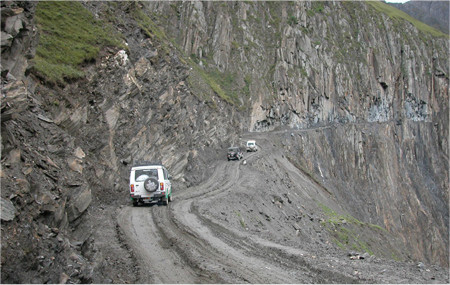
On edge on the Srinagar-Kargil highway
For Vakil, a chronic asthmatic, getting over Khardung La (pass at 18,380 ft) on the world’s highest motorable road to Siachen Glacier was a formidable challenge. "As the first civilians (and probably the first woman) allowed to go to the Glacier in 22 years, we were given a warm and generous welcome by the Indian Army,” she writes. An officer who had just returned to base camp from his forward post informed them that more men at the Glacier were lost to the weather than to the war. With high altitude sickness an omnipresent worry, one of the team members had to be rushed to an army hospital in Pang for emergency aid.
Special treats along the way included a glimpse of a large herd of ‘Kiangs,’ a close cousin of the Tibetan wild ass. A day trip to Cherrapunjee, reputed as the wettest place on earth, brought great disappointment: "Where we had expected to see lush green forest cover and copious quantities of water, there was none. Instead all that greeted us was desolate barren landscape with no telltale signs of heavy rainfall.”
After about 12,000 km, both men and machines were showing serious signs of fatigue: "Tempers were fraying and it was becoming evident that the group had to work a little bit harder at holding it all together. Even the cars needed gentler handling...”
As the expedition in the Himalayas came to a close, and the hardy travelers took the road to Calcutta, they knew in their hearts, writes Vakil, "that we, in our own way, had made history.”
◆ ◆ ◆
From the archive