
Cover Story
Only for the fit and faithful
Marginal architectural modifications would make fire temples more accessible to the aged, infirm and differently abled
Drawn by its proximity or sanctity or sentimentality, Zoroastrians show loyalty to certain atash behrams and agiaries. But the same fire temples where one may have offered sukhad, kathi, ashodad, divo umpteen times assume different dimensions when due to a physical handicap or advancing age mobility is restricted. Are our fire temples geared to receive within its portals differently abled devotees? Do those with handicaps feel comfortable at our places of worship? Parsiana addressed these issues to gauge the prevailing sentiments and the facilities available.

A climb up a flight of steps at the entrance of a temple may ready a devotee for the spiritual solace he/she seeks. But what happens when there are no railings to support the infirm? Whether there are one dozen or barely a couple, any steps are daunting for the physically disabled who need assistance to maneuver over such challenging inanities.
At the Iranshah in Udvada one wheelchair is specially set aside to serve the cause of the handicapped, mentions Dastur Khurshed Dastoor. With the improvement of roads and other transport facilities bringing in many devotees, especially during weekends, this wheelchair comes in handy at least twice each month. When a handicapped person comes to the Atash Behram, the Parsi workers at the Iranshah invariably transfer the invalid onto the Atash Behram wheelchair which is then lifted up the steps. Depending on the person’s independence, he/she may thereafter walk or be wheeled through the hall towards the atash padshah. "It is just for the sake of cleanliness and purity that we do not permit a wheelchair which may have been used on the road to be brought into the carpeted Atash Beh-ram,” explains Dastoor. "Our help is always assured unless it is the afternoon hours when our workers may not be on the premises,” he adds, citing the case of Dinaz and Mehernosh Anklesaria who bring in their handicapped children each month with prior intimation.
Many such invalids often being obese due to lack of exercise and finding it difficult to fit into a regular wheelchair, the Atash Behram is now planning to introduce an armchair with extended poles at the seat level to facilitate the lifting of the disabled. This can be carried by two or four persons depending on the size of the patient. For the convenience of the disabled "we are also planning a ramp at the time of the next Atash Behram renovation (hopefully within the next couple of years) which will be designed by the architect,” reveals Dastoor. "If any devotee has any difficulty they can always write to us and we can find a solution,” assures Dastur (Dr) Peshotan Mirza.
There is no religious reason to debar the erecting of a ramp, confirms Dastur (Dr) Kaikhusroo JamaspAsa citing his experience at Bombay’s Anjuman Atash Behram. Equipped with a special chair for the disabled which they share with the H. B. Wadia Atas Bahram in the same locality, JamaspAsa mentions that the chair is in demand "on a very, very rare occasion.” If a handicapped person were to visit the Anjuman Atash Behram, the men on the premises "will certainly guide him. But so far not a single person has expressed any difficulty,” adds JamaspAsa. The steps at the entrance are not of any religious significance but aesthetically they contribute "to the architecture of the monument,” he states.
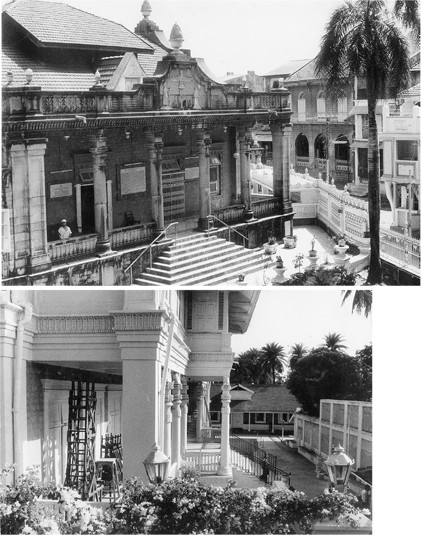
Aesthetically pleasing but difficult to access: Bhagarsath Anjumanna Atash Behram at Navsari and the Iranshah at Udvada
Steps make the "structure look imposing,” attests Dastur (Dr) Firoze Kotwal. Although there are no religious injunctions requiring a shrine to be constructed on an elevation, he believes the plinth for the foundation was deliberately raised to ensure safety in times of calamities like floods. During his years of association with Bombay’s H. B. Wadia Atas Bahram he recalled the religious-minded Ratan Nanabhoy being brought on a wheelchair three-four times a year, and being carried on the wooden chair towards the kebla. From the compound, through the portico, into the hall of the Wadia Atas Bahram is just one step high. However if one were to enter via the kusti enclosure, a devotee would be required to climb up two steps. That a handicapped person is dependent on four volunteers to lift him each time should not be a deterrent, believes Kotwal, reasoning, "Oomar thai tau help tau léveej paré. Budhaapo sané kehvaay (with advancing age you have to take help. How else does one recognize old age)!” With or without a handicap, a person can visit a temple. "Where there is a will there is a way,” he sums up.
"When a physically disabled person comes to a fire temple, invariably there will be members of the family accompanying him or her,” Ervad Parvez Bajan, panthaky of the Mewavala Agiary recalls the famous caterer, the late Freny Godiwalla visiting their agiary after diabetes had necessitated the amputation of her leg. "On an average, in one year, there are not more than two such visits from disabled Zoroastrians. Why then go into a ramp and all that? Even now when we see people need help, our mobeds or chasniwallas will invariably rush to the aid of a behdin,” reports Bajan, adding, "The mobed will go out of the way to take the chamach to the (handicapped) behdin [where he can place his sandalwood and accept rakhia (sacred ash)].”
When a resident of Behram Baug in Jogeshwari, a regular devotee at the agiary there, expressed his difficulty to remove his shoes before entering the carpeted sanctum, Rustom Balsara as the architect of the agiary conveyed how they made adjustments in the layout such that he could offer his sukhad through the grilled slats of the sanctum sanctorum without having to remove his footwear. "Every fire temple has such windows through which sukhad can be offered and rakhia taken,” mentions Balsara who is a trustee of the Narielwala Agiary in Bombay and also the Mistry Adarian in Surat. While a combination of a ramp, four feet in width, alongside the steps could be an ideal solution, he points out that it may not be feasible for all temples like the Mistry Adarian which has a small plinth and a narrow passage at its entrance. Where technically feasible, a ramp should be built for its financial cost would not be high. Most fire temples have a high plinth of three-four feet (approximately six steps above the road level) as a precautionary measure against floods and also to lend the structure "a majestic effect,” sums up Balsara.
With so many of our fire temples lying in the low-lying areas of Tardeo and Grant Road which continue to be prone to water-logging in the monsoons to this day, the provision of steps was mandatory although no religious significance was attached to them, mentions Dr Homi Dhalla pointing out how certain religious shrines like the Wadia Atas Bahram, the Dadysett Atash Behram and the Vachaghandhy Agiary are practically at ground level. Rather than have steps inconveniencing senior devotees, "I certainly believe that if certain alterations have to be made to the (temple) structure they should be done under right type of advice from architects,” declares Dhalla. Referring to the transport system and public conveniences abroad which are specially geared to facilitate the handicapped, Dhalla advocated that the community institutions in India too could be sensitive to the needs of the elderly realizing that we are an aging population.
When the trustees spend lakhs on the renovation of a fire temple "they should spend a few thousand more and give thought to those dependent on wheelchairs or walkers or sticks. Why spend only on marble, granite and carpets?” queries senior citizen Mini Boatwala. Every small flight of steps calls for a railing to support the elderly who, dependent on their sticks, dread the thought of losing their mobility. Uneven tiles or spillage of oil paint have led to the fall of many, and devotees should be cautioned against such possible dangers, she avers. The washroom facilities also need to be made more user friendly. She cites the instance of the Banaji Atash Behram where a devotee is required to step up to reach the ladies enclosure for the mandatory kusti ritual before entering the temple. For an infirm person, the half spring doors which swing open on either side are sufficient to throw the elderly off balance, she fears. After overcoming this nightmare, one has again to step down, cross the compound and climb the steps to the Atash Behram. A small ramp here could greatly facilitate the elderly, she believes. After a long circuitous walk does one reach the hall and finally the kebla by which time the devotee may have invoked God’s help many more times than originally intended!
Architect Dadi Darbary too has been strongly propounding the need for ramps which have a gradual incline (not steep gradient), with a non-slip surface which is slightly serrated for certain fire temples. He personally frequents the Wadia Atas Bahram daily, valuing its "calm and serene ambience and having great faith in the adarian fire there.” When the atash padshah fire was shifted to the neighboring baj room during renovations, Darbary recalls how he had to take out a torch from his pocket lest he trip over pavis on the approach route leading to the padshah. The water from the handas (vessels) used before doing the kusti should also be easily accessible to people of different heights, he recommends. While he is not suggesting that ramps be laid to reach the toilets outside the Wadia Atas Bahram, the high steps there definitely call for a handrail. "I am only 69,” he tells us wondering how those older than him must be coping with these obstacles. For those with visual difficulties, one-and-a-half to two-inch strips on the tread at the nosing could indicate the start and the end of the steps, he recommends.
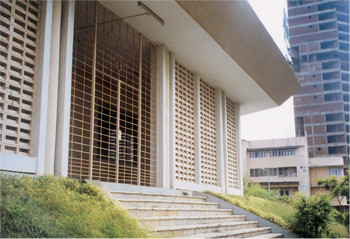
The recently built Shapoorji Fakirji Jokhi Agiary at Godrej Baug
Darbary who had designed the Soonawalla Agiary in Mahim when he was 30 years younger realizes that the elevated abode of the fire may now be out of reach for many disabled persons.
For the handful of handicapped worshipers who came to their portals the priests may not be inclined to introduce any major changes. But they should consider whether, by making the temples more user friendly, they can draw more disabled devotees. Considering that 31 percent of the Zoroastrian population in India is aged over 60, there is clearly a need for at least a few of the religious shrines to adapt to the requirements of those who come seeking blessings without wishing to be a burden.
Home conveniences
While it is easy to pinpoint steps public institutions should take for the physically impaired, there are certain precautions one can take at home too. Dignity Dialogue, the magazine for productive ageing offers some tips in its April 2005 issue, which we reproduce below:
Provide color contrast to the steps and non-slip strips and railings along the wall
Ideally have a home on one level
All furniture in the house should be fixed to the floor which can serve as props for those dependent on walking sticks or walkers
Chairs should have armrests to lever the person into a standing position
Sofa sets should not be so soft that one sinks in
To encourage participation in daily living, introduce a well-lit worktable or a kitchen sink at a comfortable height
For the wheelchair bound, have wide and clear passages, ample turning space for the wheelchair; low beds and chairs; and ramps instead of steps
Marble or smooth Italian tiles are not elderly friendly and should be replaced with non-slip tiles and non-skid mats
Sharp edges should be smoothened out or avoided in the entire house
Doorframes, knobs and switch points should be visually prominent
Telephone and controls for lights, fans and the TV should be accessible from the bed
Call bell or alarm should be within reach from the bed and even in the bathroom
Install western style toilets and bathrooms with doors opening out; grab bars and rails should be within reach
Allow for easy exit in emergencies
Windows, balconies, sit-outs and verandas ensure avenues for socialization and should be kept open
◆ ◆ ◆
From the archive