
Politics and Policy
The broken bridge
The conditions laid down by the Bombay Parsi Punchayet for joining the world body are unlikely to be acceptable to Zoroastrians abroad
The formation of the Zoroastrian world body received a further set back with the Bombay Parsi Punchayet’s board of trustees insisting that all office bearers for all times be Parsi/Irani Zoroastrians. While the trustees have agreed to join the International Zoroastrian Organization (IZO) with the above proviso, it is highly unlikely that the Federation of Zoroastrian Associations of North America (FEZANA) would accept such a discriminatory clause.
To counter the propaganda of the critics that only two Bombay Parsi Punchayet (BPP) trustees support the world body, the BPP statement signed by the chairman on behalf of the board states, "It may be clarified that all seven trustees of the BPP are of the unanimous view that a world body of Zoroastrians is a need of the times. Hence they are working towards the creation of such an organization, all of whose office bearers would at all times be Parsi/Irani Zoroastrians only. Besides, India with the largest number of Zoroastrians in the world would have adequate weightage which would enable it to play a leading role in the affairs and management of the body when established.”
To address the fears drummed up by the opposition that the world body would tell the Zarathushtis of India how to conduct their ceremonies and rituals, the release further adds, "It is also to be clarified that the proposed world body is not intended to be a religious body, and will not interfere in the religious practices followed by Zoroastrians residing in various parts of the world. Each region will be autonomous in pursuing (its) religious customs, traditions, rites, rituals without any interference from other regions. The world body is envisaged to be a social, economic and political organization.”
The press release of March 30, 2005 provoked contradictory responses. The Jam-e-Jamshed hailed it as a decision of "vision and foresight” in its issue of April 3, 2005. The same day The Bombay Samachar panned it as a "charade.”
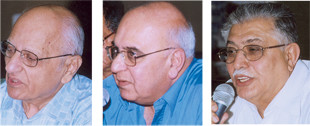
From left: Shroff, Tamboly and Gandhi: "need of the hour”
Anticipating that the other constituents of the proposed world body will politely tell the BPP that "the condition is unacceptable,” The Samachar argues that the "BPP has effectively decided not to join the world body.” Nor will this decision prevent the fundamentalists from going ahead with the ‘Parsis only’ body, argues the publication, because "they will not be appeased by the ‘office bearers’ compromise. They do not want any juddin to be a member of the world body. So the split is inevitable.”
Blaming BPP chairman Minoo Shroff’s non-confrontational style of work for the decision, the paper predicts that the BPP will neither be a member of the world body nor of the Parsi/Irani world body. "Unanimity has been achieved on ludicrous terms.”
The fire and brimstone predictions of the world body critics (see "A tale of two worlds,” page 30) had led the three Indian negotiators on the constitution of the proposed body — Shroff, BPP trustee Dinshaw Tamboly and Federation of Parsi Zoroastrian Anjumans of India (FPZAI) honorary secretary Keki Gandhi — to issue a press release titled "Facts about the world body” on March 10, 2005 (published in the Jamé on March 13, 2005): "It is being falsely represented that the proposed WBZ (World Body of Zoroastrians) will encourage conversions into our faith, resulting in a mass exodus of converts to India, seeking entry into our fire temples, laying claims to be consigned into our towers of silence, becoming beneficiaries of our charitable trusts, insisting on being provided housing and so on. We wish to reiterate that there is no truth, whatsoever, in these assumptions. This would be amply clear from the fact that the BPP has not received any application so far for any assistance, though the so called neo-Zoroastrians have been around in other countries for decades now.
"We have made it abundantly clear from day one that the proposed WBZ is not intended to be a religious body and will not interfere in the religious practices followed by Zoroastrians residing in various parts of the world and the WBZ is envisaged to be a social, economic and political organization of Zoroastrians.
"The underlying vision of the proposed WBZ is to act as a bridge for Zoroastrians residing in many countries of the world, to provide a political safe-ty net in times of need, strengthen the community through consultation, cooperation and networking in various areas. Each region would be autonomous, respecting the views professed and systems followed by other regions and would not seek to interfere in the affairs of other regions.
"The WBZ will not encourage Zoroastrians from any part of the world to subvert any of our institutions or lay claims to any benefit that is solely intended for Parsi/Irani Zoroastrians. Each and every charitable trust is autonomous and functions strictly within the objects laid down in its constitution. Hence where is the case for any concern on this count? We submit that this is only a deliberate attempt to mislead the community.
"The antagonists of the WBZ harp on the issue that neo-Zoroastrians will swamp our places of worship, housing colonies etc, if not now, within the next 20 years. They do not take cognizance of the fact that even after 20 years, Parsis only will continue to be the trustees, and the trust deeds will also remain for the benefit of Parsis. Conversion to Zoroastrianism is not a new phenomenon in the West. Till now, we in India have never perceived this to be a threat. By giving this issue so much importance, we are doing nothing but planting ideas in the minds of the converts who have, thus far, never shown any inclination to approach us...
"Charges have been made about a lack of transparency. Let us refer here to the statement issued by the BPP trustees in the Jam-e-Jamshed of October 17, 2004. That was followed by a personal letter dated October 20, 2004, sent by the chairman on behalf of the trustees, to the seven high priests. Two of the high priests acknowledged the letter conveying their great faith in the chairman and trustees to the effect that they would not take any step which may prejudice the Parsi Zoroastrian community in India. As no comments were received from the other high priests, it was presumed that they had no objection. Hence it came as a bolt from the blue when at the Ahmedabad meeting of the FPZAI on December 19, 2004 a letter was produced signed by two high priests conveying their objection to the formation of the WBZ. This letter was handed over personally by a participant but not received by the BPP/FPZAI officially, till today...
"Individuals spearheading the opposition themselves have attended many Zoroastrian World Congresses in the past, where they have not only given lectures but have also participated in discussions and sat on panels comprising members from North America and other Western countries, for whom they now appear to have developed an aversion for reasons best known to them. It is indeed strange that though the concept of the WBZ has been discussed at previous World Zoroastrian Congresses for the last few decades and also at FPZAI meetings in recent years, there has never been any objection voiced. How have the serious objections cropped up suddenly, now?...
"It would be an exercise in futility and impossible to move forward if members involved are expected to share with all the punchayets, anjumans and associations each and every point that they would be deliberating upon. An assurance has already been given that once final drafts acceptable to all regions have been evolved, the same would be circulated to all members of FPZAI to elicit their views, and only thereafter a final formal decision will be taken.
"We firmly believe that the community in India will only isolate itself if it retracts from the ongoing efforts to form the WBZ. Can there be a really representative WBZ without India? We pose this question to those who are attempting their hardest to checkmate the FPZAI from playing a leading role in the formation and operation of the WBZ. As the apex body of the community, should we take the lead or be passive bystanders?”
In the meanwhile the parallel world body of Parsi/Irani Zoroastrians promoted by Areez Khambatta, president of the Ahmedabad Parsi Panchayat, and orthodox community activist Khojeste Mistree is said to be launched shortly. A debate has arisen however, as the more conservative elements want only children of both Parsi parents to be included as members and not of those of a Parsi father only. Small world, isn’t it?
◆ ◆ ◆
From the archive