
Religion
The churches cope
Adjusting to population shifts the Roman Catholic churches merge, realign or close down
It is not only the fire-temples in South Bombay that are facing dwindling attendance. An article in The New York Times dated May 23, 2004 sent to Parsiana by reader Kersi Treasurywala, is headlined "Dwindling Congregations In Churches Once Filled.” Written by Jason George, the article notes that Catholic parishes in Jersey City "are told to consolidate, again... Altogether, the archdiocese would like to realign or merge 48 churches in the 235-parish diocese, and more changes and closures could follow. The plan is a reflection of the dwindling forces of the Catholic Church in the region that includes Hudson, Bergen, Essex and Union Counties. But it is also a story that has played out in city after city, neighborhood after neighborhood, around the country as the church has tried to adjust to changing times.”
"A lot of people simply moved away,” said James Fisher, co-director of the Center for American Catholic Studies at Fordham University. "An awful lot of people.”
The Rev Rino Lavaroni, the pastor at the Holy Rosary Church said he was "well aware that Italians no longer inhabited the apartments surrounding Holy Rosary in the numbers that they did before. But, he said, he still believes the church can turn the corner toward renewal. Attendance at Sunday Mass is about 300 now, an increase, he said. And the church is adapting: besides English, Italian and Latin, one Mass is offered in Chinese...
"Next door, at St Anthony’s, the pastor, the Rev Joseph Urban, has other plans on his mind. The church is trying to organize a celebration for its 120th anniversary next month. He, too, sees signs of hope. He said he has already seen attendance on Sunday grow to 300 people from about 40 in the last three years, though it is still nowhere near the 10,000 congregants of the past. Standing in the nave of his church last week he conceded that he should probably be doing more. ‘We know we need to develop our activities and improve...’
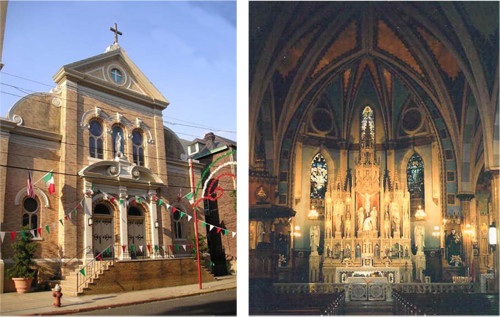
Left: Holy Rosary Church Right: St Anthony’s
Photo: rcan.org
"The third church in the Resurrection parish, St Michael’s, has maintained attendance figures stronger than Holy Rosary’s and St Anthony’s, largely because it has integrated these newer immigrants, said the Very Rev Gregory Studerus. Originally a church for Irish and German dockworkers, St Michael’s is now home to the Vietnamese Apostolate and offers Mass in English, Spanish, Vietnamese and Tagalog, a language mostly spoken in the Philippines. Last Tuesday night, members of the Apostolate gathered and sang prayers in Vietnamese to St Jude, patron saint of hopeless causes, which echoed off the gilded cathedral ceiling. Later, the Rev Joseph Minh said Mass in English for 14 congregants, half of whom were Vietnamese.
"Iris Perez, who has attended St Michael’s for more than 15 years, said that when Vietnamese parishioners began appearing at the church in large numbers about three years ago, there was talk then, too, of how it would affect the church. But not anymore, she said. ‘Honestly, they are the ones keeping the church alive.’”
Even in Bombay the shift of Catholics from South Bombay to the suburbs has affected church attendance.
An article in the Mid Day of August 3, 2004 by reporter Manoj Nair noted, "Where once there wasn’t enough space for people to even stand during daily Mass, the Holy Name Cathedral in Colaba today sports empty pews even on Sundays...
"The predicament of dwindling parishioners is shared by most Catholic churches in South Mumbai. Gloria Church in Byculla, one of the oldest parishes (established in 1595) once had over 10,000 parishioners. It now has just 4,500. Our Lady of Health in Marine Lines, established in 1794, has just 300 worshipers.
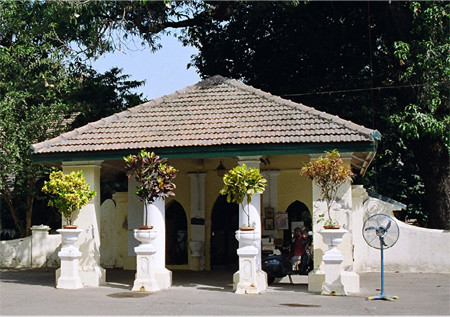
Dadysett Atash Behram: bogged in controversy
"‘Most of the exodus from South Mumbai churches has happened in the last 15 years. A large part of the Christian community in Byculla and Mazagaon have sold their homes at lucrative prices and moved to the suburbs,’” said Dolphy D’Souza of the Bombay Catholic Sabha, an organization of lay Catholics.
"While the population of South Mumbai parishes dwindled, the size of parishes in the suburbs burgeoned. The Orlem parish in Malad has nearly 21,000 members and on days like Christmas or Easter, masses have to be held outdoors because there is no space inside the church to accommodate the worshipers. In the seventies, the congregation here numbered just around a couple of thousands.”
"Despite the dwindling congregations in the city, the church says it will not reduce the number of parishes in South Mumbai.
"‘Most parishes have schools attached to them. So we cannot shut down the parishes. All we can do is reduce the number of priests in South Mumbai,’” said a priest.
Amongst Parsis any move to shift, merge or close fire-temples in response to changing demographic trends is always charged with emotion. Fire-temples may be vandalized, encroached upon but no steps will be taken to prevent the impending disasters.
The move by the trustees of the Dadysett Atash Behram to build housing for Parsis on the fire-temple’s property through the largesse of the Shapoorji Pallonji family, was an effort to reverse the exodus of Zoroastrians from the crowded vicinity.
But before an acceptable proposal could be arrived at the antagonism between the orthodox groups and the trustees prevented an amicable solution. Perhaps the pragmatic and dispassionate approach of the Catholic church could serve us an example to follow.
◆ ◆ ◆
From the archive