
Events & Personalities
Surat stalwart
"If ever there was a man to whom Surat and its suburbs owe a great debt of gratitude and who was unanimously enveloped by the enthusiastic love of the people, that man was Ardesar Kotwal Bahadur,” wrote historian J. R. B. Jeejeebhoy.
After joining the police department as an inspector Ardesar came to be known as a Kotwal. He rose very rapidly in the police force and took up the task of eliminating all thugs, robbers, dacoits and Pindharis once and for all. To this end, he started a spy-force to infiltrate the gangs of the law-breakers and frequently, he would himself spy on these gangs wearing various disguises.
Soon, Surat became a safe place, so much so that people slept at night with open doors and if Ardesar found a house with its door locked, he would insist on opening it.
Ardesar did not confine himself to merely being a Kotwal but helped people in, and around Surat in times of great natural disasters and calamities. In the great fires of 1837 and 1842, he helped hundreds of homeless people by giving them food-grains and clothes. During the great deluges (paani ni rail), he stood in knee-deep waters continuously for almost six days and six nights, helping people who had lost all hope at the risk of his own life. Several Gujarati poets (like Kavi Khabardar and Narbadey) have composed poems on this aspect of Ardesar.
Ardesar lived in the Sayedpura area of Surat in a huge house. Today, this area has been named Kotwal-wadi after him. Here, he used to give help and justice to the poor and the needy. Clearly, he was the champion of the underdog. Also, he was very secular in his religious views and a great devotee of Swai Sahejanandji. Fond of visiting peers, fakirs, sais, sadhus and swamijis, he had "khichdi” cooked in his own courtyard to feed these men of God.
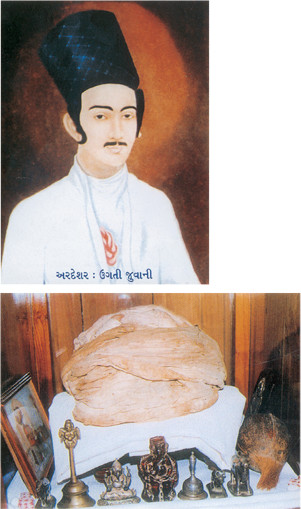
Kotwal (above) and the revered pugree
Bhagwan Swaminarayan had influenced him tremendously. Ardesar regarded him as his guru. One day, the guruji told Ardesar that it was time to bid a final farewell and this was the last time they were meeting in this birth. Ardesar became very emotional whereupon, Swamiji took off his pugree (head gear) and put it on Ardesar’s head saying: "I’m always with you and three days before you die, I shall appear before you and come to take you.”
Ardesar did prayers and "pooja-paath” of this pugree daily which is preserved in Surat by the Wadia family. Ardesar’s son Jehangirsha had married into the Wadia family and since he died at the age of 23 without leaving behind any children, the pugree has been with the Wadia family. (Jehangirsha was married to Edulji Hirji Wadia’s daughter Dosibai. Once a year, on Bhai-Beej day, thousands of people gather there for a darshan of this pugree at Kotwal-wadi.
In 1838, he established Surat’s first library at Valandaval (Dutch Road) called Surat Native Library and Reading Room. Though secular in thought, he was a true Zoroastrian and took part in all aspects of upliftment of the Surat Parsis.
He had a happy personal life, being married to Avabai, the daughter of Hormusji Bhimji Modina. He had 17 children of whom only one (Jehangirsha) was present when he died due to some fickle finger of fate. An extremely productive life ended on February 15, 1856, three days prior to which Ardesar declared that his guruji had come to fetch him.
Ruby P. Lilaowala
◆ ◆ ◆
From the archive