
Comment
Dhamaal at Doongerwadi
Encroachment and illegal construction by non-Parsis on Doongerwadi land in the late 19th century was resisted by community members, leading to their criminal trial
Not many Parsis are aware of a case which was tried at the criminal sessions of the Bombay High Court (BHC) in 1873 which created great sensation in Bombay and intense agitation amongst the Parsis. It pertained to encroachment and illegal construction on Doongerwadi land at Kemps’ Corner in Bombay (see "Trespassing on Doongerwadi,” Parsiana, July 2004 extracted from Sapur F. Desai’s book History of the Bombay Parsi Punchayet 1860-1960.) Fifty persons were committed to the sessions for trial, of which 48 were Parsis and two were Hindus. The case came up before Justice Green and a special jury consisting mainly of Englishmen and one Parsi, Dosabhai Dhunjibhoy. Senior Counsel Ferguson and Inverity appeared for the Crown (Government). Thomas Anstey appeared for the Bombay Parsi Punchayet (BPP). Sir Pherozeshah Mehta, Starling, Mathew, Jackson, Branson and Leith appeared for various parties. Hearing in the case commenced on March 27, 1873.
The facts of the case were that two persons, Cooverji Pragjee and Jacob Jamal, along with their men, illegally entered the Doongerwadi land where they built tenements and other structures. Entry was effected at 1 o’clock in the presence of the police. Between this time and April 4, 1873, the trustees of the Parsi Punchayet tried with police commissioner Souter to get redress, but failed. Pragjee and Jamal had engaged one John Duffy as their builder. He went to the site to mark out the boundaries and prepared the area for construction. Then building materials were brought in and a chawl hastily built there. A tent was also erected for Duffy, in which some items of furniture were placed. Thereafter, Pragjee applied for permission to carry out blasting on the land.
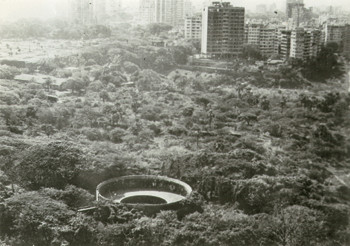
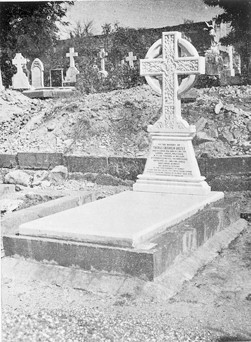
Thomas Anstey’s grave at the Sewri cemetery (right) and the Bombay Towers of Silence (alongside)
On April 4, 1873, Maneckji Dorabji, an aggrieved tenant of the BPP, organized an encroachment removal party. These Parsis broke down the chawl, pulled down the tent and burnt all the materials kept there by Pragjee and Jamal.
It was the day of Shahenshahi Meherangan, a holy festival when many Parsi and Irani Zoroastrians go to Doongerwadi to pray. Besides, that afternoon there was also a funeral. Some of the men who had taken part in removing the encroachments had entered the inner compound within the precincts of Doongerwadi when the police arrived on the scene. They indiscriminately arrested anyone they could lay their hands on, including many Parsis who had gathered there for prayers wearing white garments. The policemen effected the arrest under instructions from their superior, commissioner of police Souter, who entered Doongerwadi on horseback, accompanied by deputy superintendent of police Brown. Some of the arrested Parsis were handcuffed as though they were common felons and taken to the police station at Mazgaon, exposing them to jest and ridicule. But the Parsis did not lose courage and fought valiantly to safeguard the Doongerwadi land. The case was heard from July 7 to 16, 1873 before Justice Green. Leading lawyers were engaged by the 48 Parsis, including Anstey, Sir Pherozeshah Mehta and English barristers.
The arrested Parsis were charged under Section 141 of the Indian Penal Code — they had assembled together for the common object of committing mischief, to destroy a chawl and tents and thereby stood accused of unlawful assembly. Anstey came fully prepared with impressive arguments and crossexamined a number of witnesses including Souter. The witnesses made a great mistake while identifying some of the Parsis involved in the incident. Anstey also relied on the proclamation of February 29, 1792 prohibiting any obstruction in temples, tombs and/or religious places. Souter was not aware of any proclamation. Anstey strongly condemned Souter’s mala fide action and his tyranny against the Parsis, stating that Souter’s actions were not only a criminal neglect of his duties but that his personal feelings showcased bias.
After hearing Anstey for several days, the jury unanimously decided that the accused were not guilty. Soon thereafter Justice Green pronounced judgment, acquitting all the accused.
In those days, it seems, the BHC followed the British practice of locking up the jury in a room until they reached unanimity in their verdict. There was a story that the Parsi juror, Dhunjibhoy, a big-built, burly man, refused to budge from his place unless all the accused were acquitted. He ultimately wore out his co-jurors into agreeing to a unanimous verdict of not guilty for all the accused.
The Times of India reported: "The prisoners were then set free en masse. They were instantly surrounded by their friends, and congratulated on what not a few persons called their ‘escape.’ They were nearly mobbed going downstairs, and even in the street they were followed by a crowd who evidently regarded them as heroes. It was very amusing to see Khushroo Hormuz, the malee shuffling happily along in his big boots, while a Parsi on each side of him had an arm round his neck.”
The trustees of the BPP received a large number of letters of congratulations from Parsis all over India as well as Aden and Hong Kong. They received a requisition signed by a number of Parsis asking for an anjuman meeting to protest against encroachment by non-Parsis on Doongerwadi property and to send a memorandum to the Government. Thereafter the trustees received a donation of approximately Rs 36,000 to meet legal expenses and filed a civil suit in the BHC where they obtained a decree against Pragjee.
Anstey’s long, successful, stormy and colorful career at the Bombay Bar concluded with this memorable case. It was long remembered in Bombay as one of the most striking and spectacular of his forensic triumphs, due mainly to his fearless and tenacious advocacy of the cause of his clients. He died shortly after August 12, 1873, leaving a name which was commemorated in a grateful song which was sung by Parsis at weddings and other auspicious occasions for years after his death. Twenty-seven years after his death, Framji C. Mehta, proprietor of Kaiser-e-Hind, erected a column in his memory near Anstey’s tomb in Mazgaon.
Partner of Mulla and Mulla and Craigie Blunt and Caroe, Homiar Vakil is a practicing advocate and solicitor of the Bombay High Court for the last 25 years. He has handled litigation related to Parsis and religious matters.
◆ ◆ ◆
From the archive