
Books
Avestan alphabets
"I do hope that this work will encourage the younger generation of our community to learn more about their religion and culture through the study of the Avesta,” writes Dr Homi Dhalla in the foreword to Bejon Desai’s A Compendium For Learning Avesta. Dhalla elaborates that several ancient languages have been faced with the threat of extinction due to disuse. Despite Zoroastrians the world over reciting prayers in the Avestan language (transcribed in Gujarati or English), their meaning is not understood. Desai’s book offers the student an easy method to learn the alphabet either in English or Gujarati.
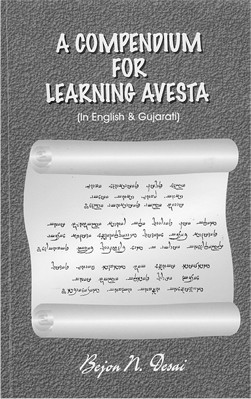
In his 190-page book Desai has "taken great pains to explain the minutest detail and illustrate the writing of each Avesta letter,” mentions Dastur (Dr) Kaikhusroo JamaspAsa. The formation of each of the 47 Avestan alphabets has been explained with the help of a small square block divided into the top, middle and base sections. Each Avestan letter and word is written from right to left. Desai notes that both the Devanagari and Avestan scripts have similar vertical and horizontal strokes, curves and circular patterns. These scripts were formerly inscribed on leather or leaves and then on papyrus. Distinguishing between the meanings of the words ‘Veda’ and ‘Avesta,’ he clarifies that the song "from the Divine” that was heard by the great Rishis "and kept in their memory,” was called ‘Veda,’ whereas the song "brought by the Paigambars (message carrier) i.e. prophets was called ‘Avesta.’”
At the launch of the book at the K. R. Cama Oriental Institute, Bombay on February 22, 2003, Desai spoke of the necessity of relearning the Avestan and Gujarati languages, mentions a press release. In his last book Learning Gujarati through English, he intended to "awaken the Jains, Vaishnavas, Parsis and Bohris whose mother tongue was Gujarati; but for various reasons, had forgotten to read and write it.” He admits that though A Compendium For Learning Avesta "would not prove very successful monetarily” he must continue the efforts of his teachers who wished that their students teach Avesta and Pahlavi as they once did. He thanked his student and renowned architect Hafeez Contractor who bore a large part of the book’s printing cost and Dinshaw Tamboly, chairman of the World Zoroastrian Organisation Trust Funds, for distributing the book gratis. Chief guest, Arvind Inamdar, ex-director general of police (Maharashtra state) quoted from the Vedic and Avestan scriptures impressing on the Parsis to chant their scriptures daily, notes the release. A double graduate in Avesta-Pahlavi, Gujarati and English, Desai has 22 books and over 50 research papers to his credit. He acquired his MA in 1947 and his Bachelor of Education degree a year after his appointment as principal of the Boys’ Town Public School, Nasik in 1956, states the release.
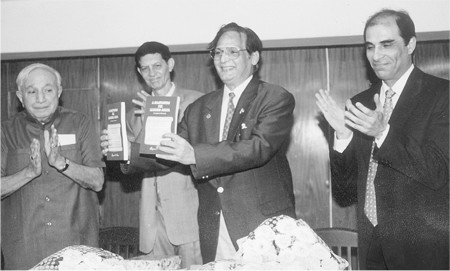
From left: Desai, Dhalla, Inamdar and Contractor at the release of A Compendium for Learning Avesta
Though Desai’s diagramatic formation of each Avestan letter is clear and accurate, the explanation offered may prove a little difficult for a beginner. Priced at Rs 200, A Compendium is available at the P. N. Mehta Education Trust Office, Cook’s Building, 324, Dadabhai Naoroji Road, Fort, Bombay 400001.
Dhalla quotes Samuel Johnson in his foreword, "With every language that dies, an image of mankind is wiped out.” In the hope to encourage the community to study Avesta the Sir J. J. Zarthosti Madressa and the Bombay Parsi Punchayet offer classes free of cost. With six students acquiring their BA in 2002, the course has been upgraded to an MA degree. The Avesta classes are held once a week at the J. J. School premises, 2nd floor, Engineer Building, Princess Street. The new batch commenced on June 20, 2003.
Simin J. Patel
◆ ◆ ◆
From the archive